Updates

  1. Person pages list letters, writing, profiles and links as sortable tables with filters, and show each person's companies as links; Fund letters show each letter's description in its own column.
  2. Experts show a checked job title and a short description of each person; 30 more people have photographs.
  3. Every company, fund, university and publication the experts work for has a page listing the people there.
  4. Fund letters show each letter's thesis and filter by it; 225 person pages list the essays, columns and newsletter issues the person wrote.
  5. Person pages list every essay and newsletter issue a person wrote, and their own books as a table in List view.
  6. Recommends shows the five largest kinds of book and the rest under More; browse pictures load sooner.
  7. Podcasts and talks link the original episode, filter by Audio and video or Press, and list each publisher once.
  8. Pages are wider, Recommends has List and Grid, and a filter clicked again turns off.
  9. Book cards sit in a ruled grid with Open Library and Goodreads links and each book's one-line note.
  10. Funds is now Investors; each investor's styles are buttons that filter the table.
  11. Podcasts and talks on a person's page filter by year and publisher and show as a list or a grid of pictures.
  12. Quotes show only people's own words: 472 summaries written by list sites are gone.
  13. Country pages open from Browse again, and every link on the shelf lands on a page.
  14. Subject and person pages show their sections as tabs, and each book appears once on a person's page.
  15. Book cards show the quote, who said it and the source; grids show five cards to a row.
  16. On a phone, a menu holds the sections, search, Updates, Feedback and dark mode.
  17. Feedback takes a screenshot of the page with no browser prompt, opens a screenshot full size when you click it, and clears itself once sent.
  18. Book cards are centred, search names the topic each book sits in, and any text cut short shows whole on hover.
  19. Search groups its results by kind: people, companies, geographies, subjects, topics, books, funds, fund letters and papers.
  20. The Books table lists who recommended each book by name, and the browser tab names the section you are in.
  21. Feedback can take a screenshot of the page, or one you paste or choose, and opens in the corner beside Updates.
  22. Each rail button reopens its section where you left it, and Browse, Table and People show on every book and subject page.
  23. Filters grey out choices that hold nothing instead of hiding them, and Books › People filters by authors or recommenders.
  24. Feedback takes a subject line and up to three screenshots.
  25. Biographies are grouped by the person they are about: 41 new pages, from Abraham Lincoln to Lee Kuan Yew.
  26. Sport splits into 23 sports, and Religion into one topic per faith.
  27. Book lists show as cards: the cover, one recommendation quote and every recommender by name.
  28. Seventeen subjects that had two or three pages under different names now have one page each.
  29. Every page lists its Experts as authors and recommenders, with a link to them on the Experts tab.
  30. Economics, Financial history, Financial panics and Accounting are subjects of their own, with one page per financial crisis.
  31. Book, person and subject pages open inside the app, so the tabs stay in view.
  32. 996 more book covers, and photographs or logos for 227 more people and companies.
  33. Books › Browse shows every subject as cards, and the rail holds Fund letters, Papers, Experts, Books and Funds.
  34. Every topic over 150 books splits into narrower topics, each with a page of its own.

Send feedback

What is it?
Screenshots, up to 3 (optional)
or paste one with Ctrl+V

We use your email only to reply to you.

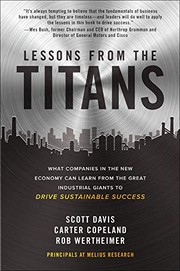
Lessons from the Titans

Lessons from the Titans

Scott Davis, Carter Copeland, Rob Wertheimer
2020
T3 352 pages · about 5h 52m to read Open Librarygoodreads

Sell-side analysts comparing Boeing, GE, Honeywell and Danaher.

Summary

Davis, Copeland and Wertheimer are industrial equity analysts at Melius Research who covered the sector for decades, and they examine the long-run records of major American industrial companies to identify what distinguished the durable performers from the ones that declined. Their cases include General Electric, Boeing, Honeywell, Danaher, Roper, Stanley Black and Decker, Caterpillar, United Technologies and others. The book is organised around what each company did and what happened as a consequence.

Their central argument concerns culture and capital discipline. They argue that companies which sustained performance combined a decentralised operating structure with rigorous capital allocation, continuous process improvement systems that were genuinely used rather than announced, and management that came from operating rather than financial backgrounds. The declining companies pursued financial engineering, acquisitions that added scale without capability, and accounting practices that smoothed results while the underlying operations deteriorated.

Their treatment of General Electric is the most detailed and argues that the financial services business masked deterioration in the industrial operations for years. Their treatment of Danaher covers the business system and the acquisition approach that applied it.

The reference has verified the book's framework and its principal cases rather than every claim in each chapter. The authors are sell-side analysts writing about companies they cover, which is a relationship readers should weigh. The book is organised for practitioners rather than as a narrative, and its value is the comparison across companies in the same sector over the same period.

Key takeaways 8

  1. Companies that sustained industrial performance combined decentralised operations with rigorous central capital allocation.
  2. Process improvement systems produced results only where they were genuinely used rather than announced and then abandoned.
  3. Management drawn from operating backgrounds made better capital allocation decisions in industrial businesses than management drawn from finance.
  4. Financial services operations attached to industrial companies masked deterioration in the underlying businesses for years.
  5. Acquisitions that added scale without adding capability destroyed value, while those that extended an existing operating system created it.
  6. Accounting practices that smoothed reported results across quarters concealed operational deterioration until it became unrecoverable.
  7. A defined business system applied consistently to acquired companies is what allowed serial acquirers to create value rather than destroy it.
  8. The authors are sell-side analysts writing about companies they cover, which readers should weigh.

Who should read it

Investors in industrial companies who want a comparative analysis of what separated the durable performers from the declines over several decades.

Who recommended it 1

Similar books 6

Chosen by shared topics, the entries that hold them, and the people who recommended both.

William N. Thorndike Jr. · 2012

Eight CEOs who beat the market by allocating capital, not by running operations.

“…books I've recommended, highlighted to death, or forced on friends.” — Andrew Wilkinson

Source: Andrew Wilkinson's Bookshelf, neverenough.com

Recommended by: Andrew Wilkinson, Dan Loeb, Francois Rochon and 12 others
John Newhouse · 1982

Classic on the bet-the-company economics of airliner programs.

Bryce G. Hoffman · 2012

The 2006-2010 turnaround told with close management access.

Recommended by: Mohnish Pabrai

Where it sits in the reference 5

Companies
Companies
Business themes
Investment styles
Business themes

Topics

InvestingCompany HistoriesBusiness and Management