Updates

  1. Person pages list letters, writing, profiles and links as sortable tables with filters, and show each person's companies as links; Fund letters show each letter's description in its own column.
  2. Experts show a checked job title and a short description of each person; 30 more people have photographs.
  3. Every company, fund, university and publication the experts work for has a page listing the people there.
  4. Fund letters show each letter's thesis and filter by it; 225 person pages list the essays, columns and newsletter issues the person wrote.
  5. Person pages list every essay and newsletter issue a person wrote, and their own books as a table in List view.
  6. Recommends shows the five largest kinds of book and the rest under More; browse pictures load sooner.
  7. Podcasts and talks link the original episode, filter by Audio and video or Press, and list each publisher once.
  8. Pages are wider, Recommends has List and Grid, and a filter clicked again turns off.
  9. Book cards sit in a ruled grid with Open Library and Goodreads links and each book's one-line note.
  10. Funds is now Investors; each investor's styles are buttons that filter the table.
  11. Podcasts and talks on a person's page filter by year and publisher and show as a list or a grid of pictures.
  12. Quotes show only people's own words: 472 summaries written by list sites are gone.
  13. Country pages open from Browse again, and every link on the shelf lands on a page.
  14. Subject and person pages show their sections as tabs, and each book appears once on a person's page.
  15. Book cards show the quote, who said it and the source; grids show five cards to a row.
  16. On a phone, a menu holds the sections, search, Updates, Feedback and dark mode.
  17. Feedback takes a screenshot of the page with no browser prompt, opens a screenshot full size when you click it, and clears itself once sent.
  18. Book cards are centred, search names the topic each book sits in, and any text cut short shows whole on hover.
  19. Search groups its results by kind: people, companies, geographies, subjects, topics, books, funds, fund letters and papers.
  20. The Books table lists who recommended each book by name, and the browser tab names the section you are in.
  21. Feedback can take a screenshot of the page, or one you paste or choose, and opens in the corner beside Updates.
  22. Each rail button reopens its section where you left it, and Browse, Table and People show on every book and subject page.
  23. Filters grey out choices that hold nothing instead of hiding them, and Books › People filters by authors or recommenders.
  24. Feedback takes a subject line and up to three screenshots.
  25. Biographies are grouped by the person they are about: 41 new pages, from Abraham Lincoln to Lee Kuan Yew.
  26. Sport splits into 23 sports, and Religion into one topic per faith.
  27. Book lists show as cards: the cover, one recommendation quote and every recommender by name.
  28. Seventeen subjects that had two or three pages under different names now have one page each.
  29. Every page lists its Experts as authors and recommenders, with a link to them on the Experts tab.
  30. Economics, Financial history, Financial panics and Accounting are subjects of their own, with one page per financial crisis.
  31. Book, person and subject pages open inside the app, so the tabs stay in view.
  32. 996 more book covers, and photographs or logos for 227 more people and companies.
  33. Books › Browse shows every subject as cards, and the rail holds Fund letters, Papers, Experts, Books and Funds.
  34. Every topic over 150 books splits into narrower topics, each with a page of its own.

Send feedback

What is it?
Screenshots, up to 3 (optional)
or paste one with Ctrl+V

We use your email only to reply to you.

Lifespan

Lifespan

David Sinclair
2019
404 pages · about 6h 44m to read Open Librarygoodreads

Summary

Sinclair, a Harvard genetics professor, argues that ageing should be classified and treated as a disease rather than accepted as inevitable, and presents his information theory of ageing. The theory holds that ageing results from loss of epigenetic information, meaning the instructions telling cells which genes to express, rather than from accumulated DNA mutations. Cells retain the genetic information and lose the ability to read the right parts of it.

The mechanism he proposes centres on sirtuins, a family of proteins that regulate gene expression and DNA repair, and which are diverted from their regulatory role when repairing damage, producing epigenetic drift over time. He connects this to caloric restriction, to the compounds he studies including resveratrol and NAD precursors, and to work on partial cellular reprogramming using Yamanaka factors, which in mouse experiments restored function in damaged optic nerves.

His personal recommendations include intermittent fasting, exposure to cold and heat, exercise, reduced protein intake, and the supplements he takes.

The conflicts of interest are substantial and Sinclair discloses them: he has founded and holds positions in companies commercialising the compounds he discusses. The resveratrol research has been widely disputed, including a legal dispute over Sirtris after GlaxoSmithKline's acquisition, and other laboratories have failed to replicate key sirtuin findings. Several researchers criticised the book for presenting contested hypotheses with the confidence of established results. The Yamanaka factor reprogramming work is genuinely significant and the most substantial part of the science. Readers should treat the personal protocol chapters as untested and the theory as one hypothesis among several.

Key takeaways 8

  1. Sinclair argues that ageing results from loss of epigenetic information rather than from accumulated genetic mutation, so the instructions rather than the data are degraded.
  2. If the information is intact but misread, ageing may in principle be reversible rather than only slowable.
  3. Sirtuins regulate gene expression and are diverted to DNA repair, which Sinclair proposes as the mechanism producing epigenetic drift.
  4. Partial reprogramming using Yamanaka factors restored function in damaged mouse optic nerves, which is the most substantial experimental result in the book.
  5. Classifying ageing as a disease would change how research and treatment for age-related conditions are funded and approved.
  6. Interventions including caloric restriction, fasting and temperature stress activate the same survival pathways, which is the basis for the lifestyle recommendations.
  7. Sinclair holds commercial positions in companies developing the compounds discussed, which he discloses and which readers should weigh.
  8. Key sirtuin and resveratrol findings have failed to replicate in other laboratories, and the theory is contested rather than established.

Who should read it

Readers following longevity research who want the epigenetic hypothesis stated by its main advocate, with the commercial interests and replication problems in view.

Who recommended it 6

Jason Friedreported
Raoul Palreported
Vinod Khoslareported

Similar books 6

Chosen by shared topics, the entries that hold them, and the people who recommended both.

Shanna H. Swan and Stacey Colino

Recommended by: Nat Eliason

Gary Taubes · 2016

Background on how the obesity market got as large as it is.

Recommended by: Vinod Khosla

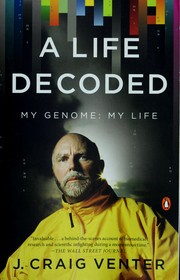
J. Craig Venter · 2007

Insider account of the private race to sequence the human genome

Recommended by: Sam Altman

Where it sits in the reference 0

No entry holds this book yet. It reached the reference because someone recommended it.

Topics

Medicine and BiologyHealth and FitnessBiology and genetics