Updates

  1. Person pages list letters, writing, profiles and links as sortable tables with filters, and show each person's companies as links; Fund letters show each letter's description in its own column.
  2. Experts show a checked job title and a short description of each person; 30 more people have photographs.
  3. Every company, fund, university and publication the experts work for has a page listing the people there.
  4. Fund letters show each letter's thesis and filter by it; 225 person pages list the essays, columns and newsletter issues the person wrote.
  5. Person pages list every essay and newsletter issue a person wrote, and their own books as a table in List view.
  6. Recommends shows the five largest kinds of book and the rest under More; browse pictures load sooner.
  7. Podcasts and talks link the original episode, filter by Audio and video or Press, and list each publisher once.
  8. Pages are wider, Recommends has List and Grid, and a filter clicked again turns off.
  9. Book cards sit in a ruled grid with Open Library and Goodreads links and each book's one-line note.
  10. Funds is now Investors; each investor's styles are buttons that filter the table.
  11. Podcasts and talks on a person's page filter by year and publisher and show as a list or a grid of pictures.
  12. Quotes show only people's own words: 472 summaries written by list sites are gone.
  13. Country pages open from Browse again, and every link on the shelf lands on a page.
  14. Subject and person pages show their sections as tabs, and each book appears once on a person's page.
  15. Book cards show the quote, who said it and the source; grids show five cards to a row.
  16. On a phone, a menu holds the sections, search, Updates, Feedback and dark mode.
  17. Feedback takes a screenshot of the page with no browser prompt, opens a screenshot full size when you click it, and clears itself once sent.
  18. Book cards are centred, search names the topic each book sits in, and any text cut short shows whole on hover.
  19. Search groups its results by kind: people, companies, geographies, subjects, topics, books, funds, fund letters and papers.
  20. The Books table lists who recommended each book by name, and the browser tab names the section you are in.
  21. Feedback can take a screenshot of the page, or one you paste or choose, and opens in the corner beside Updates.
  22. Each rail button reopens its section where you left it, and Browse, Table and People show on every book and subject page.
  23. Filters grey out choices that hold nothing instead of hiding them, and Books › People filters by authors or recommenders.
  24. Feedback takes a subject line and up to three screenshots.
  25. Biographies are grouped by the person they are about: 41 new pages, from Abraham Lincoln to Lee Kuan Yew.
  26. Sport splits into 23 sports, and Religion into one topic per faith.
  27. Book lists show as cards: the cover, one recommendation quote and every recommender by name.
  28. Seventeen subjects that had two or three pages under different names now have one page each.
  29. Every page lists its Experts as authors and recommenders, with a link to them on the Experts tab.
  30. Economics, Financial history, Financial panics and Accounting are subjects of their own, with one page per financial crisis.
  31. Book, person and subject pages open inside the app, so the tabs stay in view.
  32. 996 more book covers, and photographs or logos for 227 more people and companies.
  33. Books › Browse shows every subject as cards, and the rail holds Fund letters, Papers, Experts, Books and Funds.
  34. Every topic over 150 books splits into narrower topics, each with a page of its own.

Send feedback

What is it?
Screenshots, up to 3 (optional)
or paste one with Ctrl+V

We use your email only to reply to you.

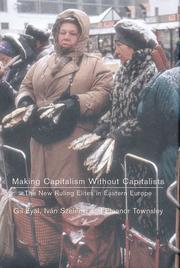
Making Capitalism Without Capitalists

Making Capitalism Without Capitalists

Gil Eyal, Iván Szelényi, Eleanor Townsley
1998
T2 280 pages · about 4h 40m to read Open Librarygoodreads

Who ended up owning Central European assets when there were no owners.

Summary

Gil Eyal, Ivan Szelenyi and Eleanor Townsley are sociologists, and they ask who actually took charge of the economies of Central Europe after 1989. Their answer is that the Czech Republic, Hungary and Poland built capitalist economies without a domestic capitalist class, because none existed and none was created quickly enough to matter.

Instead, they argue, power went to a coalition of technocrats, former communist managers, and dissident intellectuals, whose asset was cultural capital rather than property. This group ran the privatisation programmes, staffed the new institutions and set the terms on which foreign capital entered. Ownership of the largest firms passed substantially to foreign corporations, while control of the domestic economy rested with people whose position derived from credentials and networks. The authors call the resulting arrangement capitalism from without and contrast it with Russia, where insiders converted political position into personal property and produced what the authors describe as a form of clientelist or political capitalism.

The book applies Bourdieu's categories of capital to the transition and is written for sociologists, with the theoretical apparatus visible throughout. Its empirical basis is survey data on elite composition across the region. The comparative claim about Central Europe against Russia has held up well. The prediction that a propertied domestic bourgeoisie would remain weak is less clearly correct, given the emergence of large domestically owned groups in Hungary and Poland since, often through political connection in ways the authors would recognise.

Key takeaways 7

  1. Central Europe built capitalist institutions before it had a capitalist class, so credentials rather than property determined who held power.
  2. Ownership of large Central European firms passed to foreign corporations while domestic control rested with technocrats and managers.
  3. The authors distinguish Central Europe's capitalism from without from Russia's conversion of political position into personal property.
  4. Cultural capital, meaning education, expertise and network position, functioned as the transferable asset when property rights were being redefined.
  5. Former communist managers and anti-communist dissidents formed a working coalition because both held cultural rather than economic capital.
  6. The absence of a domestic propertied class made foreign direct investment politically acceptable in Central Europe in a way it was not in Russia.
  7. Elite composition after a regime change is determined by which resources survive the change, and expertise survives better than office.

Who should read it

Analysts of institutional transition and emerging market ownership structures who want a sociological account of who captured the postcommunist economies.

Similar books 6

Chosen by shared topics, the entries that hold them, and the people who recommended both.

Bálint Magyar · 2019

A framework for post-communist regimes, built on the Hungarian case.

János Kornai · 2006

An economist's path from young communist in Hungary to analyst of socialism.
Ivan T. Berend · 1996

Economic history that explains the industrial base the Czechs privatised.

János Kornai · 1979

A theory of socialist economies, where chronic shortage is the normal state.
János Kornai · 2008

Eight essays on the post-1989 move from socialism to capitalism.

Anders Aslund, Anders Åslund · 2007

Comparative transition account; Czech vouchers judged against other sequencing choices.

Where it sits in the reference 2

Geographies
Geographies

Topics

Sociology and CulturePolitics and GovernmentEurope, Britain and RussiaGlobalisation and national societies