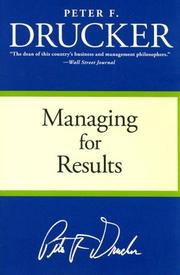
Managing for Results
How a business focuses on opportunities, not problems, to produce economic results.
Summary
Peter Drucker published this in 1964 and later described it as the first book on what would come to be called business strategy. Its subject is the economic task of the business, meaning the decisions that determine what the firm sells, to whom, and with what resources.
The analytical apparatus is a set of questions and classifications. Drucker asks managers to identify their firm's actual results areas, which he insists exist only outside the business, and to classify products into categories including today's breadwinners, tomorrow's breadwinners, yesterday's breadwinners, repair jobs, unnecessary specialities and investments in managerial ego. He argues that resources concentrate naturally on problems and that management must force them onto opportunities instead. He introduces the observation, later associated with the Pareto principle in business, that a small number of products, customers and orders typically produce most of the revenue while costs are spread evenly across all of them.
He follows with the concentration decision: a business should identify its area of leadership, allocate its best people there, and abandon the rest. The abandonment argument is the book's most demanding and least followed recommendation. The specific product classifications now read as dated management vocabulary, and the analysis assumes a manufacturing firm of the period. The core arguments about concentration, about staffing opportunities rather than problems, and about the necessity of abandonment have been restated by every strategy writer since.
Key takeaways 7
- Results exist only outside the business, and everything inside it is a cost.
- Revenue concentrates in a small number of products, customers and orders while costs spread evenly across all of them.
- Resources drift toward problems, and management must deliberately allocate them to opportunities instead.
- The ablest people should be assigned to the largest opportunities rather than to the largest problems.
- Every business must decide what to abandon, and refusing to decide means abandoning by neglect.
- A business should concentrate on the area where it can achieve leadership, because leadership in something specific is the only defensible position.
- Economic results come from exploiting opportunities rather than from solving problems, and solving all a firm's problems only restores it to normal.
Who should read it
Executives making resource allocation and product portfolio decisions who want the original statement of concentration and abandonment as strategic disciplines.
About Peter F. Drucker
Management writer and consultant; professor at Bennington, NYU and Claremont Graduate University
He invented management as a field of study, and The Practice of Management and The Effective Executive remain the primary sources every later writer builds on.
Who recommended it 1 · 1 direct
Similar books 6
Chosen by shared topics, the entries that hold them, and the people who recommended both.
An 800-page treatise on management, meant as the field's standard work.
Recommended by: Jim Collins, Tobi Lütke
Essays on the information age, organisations and management practice.
Recommended by: Jim Collins
Effectiveness is learned practice: manage time, pick priorities, decide well.
“The second is The Effective Executive by Peter Drucker, and the central core of that book is really about it's very easy to mistake effort for effectiveness.” — Drew Houston
Source: The Tim Ferriss Show Transcripts: Drew Houston (#334)
Recommended by: Drew Houston, Ev Williams, Jim Collins and 6 others
Management as a discipline: business purpose, objectives and managing managers.
Recommended by: Jim Collins

Essays from five decades on community, society and how they function.
A memoir told through portraits of the people the author knew, from Vienna on.
Recommended by: Mohnish Pabrai, Stewart Brand
Where it sits in the reference 3
Topics 1
As an Amazon Associate I earn from qualifying purchases.