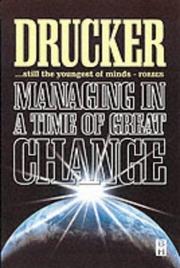
Managing in a Time of Great Change
Essays on the information age, organisations and management practice.
Summary
Peter Drucker collected these essays from the mid-1990s, covering management practice, the changing shape of the organisation, the information executives need, and the economic and social changes he expected to dominate the following decades.
The strongest pieces concern information. Drucker argues that executives receive accounting data designed for cost control and receive almost nothing about what happens outside the organisation, where all results and all threats originate. He calls for measures of the business's position relative to customers, non-customers and competitors, and argues that a firm's most dangerous blind spot is the market it does not serve. He also writes on the theory of the business, meaning the set of assumptions about environment, mission and core competencies on which every organisation operates, and argues that these assumptions become obsolete without anyone noticing because they were never stated explicitly.
Other essays cover the growth of outsourcing and the unbundling of the corporation, the management of non-profit institutions, the productivity of service work, and the political consequences of economic integration. The collection repeats material from the surrounding books. The theory of the business essay is the one most worth reading and was published separately in Harvard Business Review.
Key takeaways 7
- Every organisation operates on a theory of the business, meaning assumptions about its environment, mission and competencies, and these assumptions are rarely stated.
- A theory of the business becomes obsolete through the organisation's own success, because success changes the environment the theory assumed.
- Executives receive detailed internal accounting data and almost no information about non-customers, where the threats originate.
- The most important information about a business exists outside it and is not collected by any accounting system.
- Service work productivity requires defining the task first, and most service organisations have never done so.
- Outsourcing separates ownership from the activities a business performs, which changes what management must be able to see.
- Drucker argues that an organisation should test its founding assumptions against evidence at fixed intervals rather than waiting for a crisis to reveal them.
Who should read it
Executives who want Drucker on the theory of the business and on what information management systems systematically fail to supply.
About Peter F. Drucker
Management writer and consultant; professor at Bennington, NYU and Claremont Graduate University
He invented management as a field of study, and The Practice of Management and The Effective Executive remain the primary sources every later writer builds on.
Who recommended it 1 · 1 direct
Similar books 6
Chosen by shared topics, the entries that hold them, and the people who recommended both.
An 800-page treatise on management, meant as the field's standard work.
Recommended by: Jim Collins, Tobi Lütke
How a business focuses on opportunities, not problems, to produce economic results.
Recommended by: Jim Collins
Effectiveness is learned practice: manage time, pick priorities, decide well.
“The second is The Effective Executive by Peter Drucker, and the central core of that book is really about it's very easy to mistake effort for effectiveness.” — Drew Houston
Source: The Tim Ferriss Show Transcripts: Drew Houston (#334)
Recommended by: Drew Houston, Ev Williams, Jim Collins and 6 others
Management as a discipline: business purpose, objectives and managing managers.
Recommended by: Jim Collins
Essays from five decades on community, society and how they function.
A memoir told through portraits of the people the author knew, from Vienna on.
Recommended by: Mohnish Pabrai, Stewart Brand
Where it sits in the reference 3
Topics 1
As an Amazon Associate I earn from qualifying purchases.