Updates

  1. Person pages list letters, writing, profiles and links as sortable tables with filters, and show each person's companies as links; Fund letters show each letter's description in its own column.
  2. Experts show a checked job title and a short description of each person; 30 more people have photographs.
  3. Every company, fund, university and publication the experts work for has a page listing the people there.
  4. Fund letters show each letter's thesis and filter by it; 225 person pages list the essays, columns and newsletter issues the person wrote.
  5. Person pages list every essay and newsletter issue a person wrote, and their own books as a table in List view.
  6. Recommends shows the five largest kinds of book and the rest under More; browse pictures load sooner.
  7. Podcasts and talks link the original episode, filter by Audio and video or Press, and list each publisher once.
  8. Pages are wider, Recommends has List and Grid, and a filter clicked again turns off.
  9. Book cards sit in a ruled grid with Open Library and Goodreads links and each book's one-line note.
  10. Funds is now Investors; each investor's styles are buttons that filter the table.
  11. Podcasts and talks on a person's page filter by year and publisher and show as a list or a grid of pictures.
  12. Quotes show only people's own words: 472 summaries written by list sites are gone.
  13. Country pages open from Browse again, and every link on the shelf lands on a page.
  14. Subject and person pages show their sections as tabs, and each book appears once on a person's page.
  15. Book cards show the quote, who said it and the source; grids show five cards to a row.
  16. On a phone, a menu holds the sections, search, Updates, Feedback and dark mode.
  17. Feedback takes a screenshot of the page with no browser prompt, opens a screenshot full size when you click it, and clears itself once sent.
  18. Book cards are centred, search names the topic each book sits in, and any text cut short shows whole on hover.
  19. Search groups its results by kind: people, companies, geographies, subjects, topics, books, funds, fund letters and papers.
  20. The Books table lists who recommended each book by name, and the browser tab names the section you are in.
  21. Feedback can take a screenshot of the page, or one you paste or choose, and opens in the corner beside Updates.
  22. Each rail button reopens its section where you left it, and Browse, Table and People show on every book and subject page.
  23. Filters grey out choices that hold nothing instead of hiding them, and Books › People filters by authors or recommenders.
  24. Feedback takes a subject line and up to three screenshots.
  25. Biographies are grouped by the person they are about: 41 new pages, from Abraham Lincoln to Lee Kuan Yew.
  26. Sport splits into 23 sports, and Religion into one topic per faith.
  27. Book lists show as cards: the cover, one recommendation quote and every recommender by name.
  28. Seventeen subjects that had two or three pages under different names now have one page each.
  29. Every page lists its Experts as authors and recommenders, with a link to them on the Experts tab.
  30. Economics, Financial history, Financial panics and Accounting are subjects of their own, with one page per financial crisis.
  31. Book, person and subject pages open inside the app, so the tabs stay in view.
  32. 996 more book covers, and photographs or logos for 227 more people and companies.
  33. Books › Browse shows every subject as cards, and the rail holds Fund letters, Papers, Experts, Books and Funds.
  34. Every topic over 150 books splits into narrower topics, each with a page of its own.

Send feedback

What is it?
Screenshots, up to 3 (optional)
or paste one with Ctrl+V

We use your email only to reply to you.

Markets over Mao

Markets over Mao

Nicholas R. Lardy
2014
T2 186 pages · about 3h 6m to read Open Librarygoodreads

The case that private firms drove the growth miracle.

Summary

Nicholas Lardy of the Peterson Institute argues against the view that China's growth is driven by its state sector and that the state has been advancing at the expense of private firms. His method is to assemble Chinese official data on output, employment, investment, credit and profitability, disaggregated by ownership, and to show what it says.

The findings run against the state capitalism thesis as it stood in 2014. Private firms had come to produce the large majority of manufacturing output and to generate almost all net employment growth. State enterprises' share of industrial output, investment and employment had fallen steadily. Private firms earned substantially higher returns on assets than state firms across almost every sector. Bank lending to private firms had grown faster than lending to state firms, contradicting the standard claim that credit is reserved for the state sector. Lardy also argues that the 2008 stimulus, often cited as the moment the state advanced, produced a temporary rather than a lasting reversal.

The book is a data argument and stands or falls on the reliability of Chinese statistics and on the ownership classifications, both of which Lardy discusses carefully. Its conclusion has been substantially overtaken: Lardy himself published The State Strikes Back in 2019, arguing that the trend reversed under Xi Jinping. The two books should be read together, and the pair is a useful demonstration of an economist changing position in response to data.

Key takeaways 7

  1. Private firms produced the large majority of Chinese manufacturing output and essentially all net new employment by 2013.
  2. State enterprises earned substantially lower returns on assets than private firms in almost every sector.
  3. Bank credit to private firms grew faster than credit to state firms, which contradicts the claim that lending is politically reserved.
  4. The 2008 stimulus produced a temporary rather than a permanent expansion of the state sector's share.
  5. Lardy argues that China's growth since the 1990s is explained by the expansion of the private sector rather than by state direction.
  6. Ownership classification in Chinese statistics is ambiguous, and Lardy's conclusions depend on how mixed-ownership firms are counted.
  7. Lardy's own later work reverses this conclusion for the period after 2013, which makes the book a snapshot rather than a settled finding.

Who should read it

Investors in China who want the data-based case that private enterprise drove growth, read alongside the author's later reversal.

Similar books 6

Chosen by shared topics, the entries that hold them, and the people who recommended both.

Arthur R. Kroeber · 2016

A question-and-answer guide to how China's economy works.

Henry M. Paulson · 2015

Twenty-five years negotiating with Chinese officials, from Goldman to the Treasury.

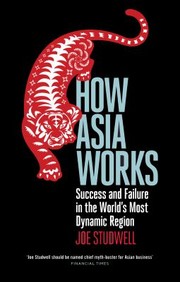
Joe Studwell · 2013

Why some Asian nations grew rich: land reform, export-led industry, directed credit.

“it's a good read for anyone who wants to understand what actually determines whether a developing economy will succeed.” — Bill Gates

Source: Gates Notes review of How Asia Works

Recommended by: Bill Gates, Mohnish Pabrai, Patrick Collison
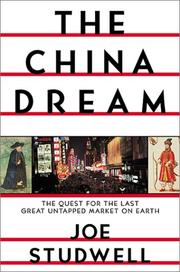
Joe Studwell · 2002

Why foreign investors' hopes of profit in 1990s China were mostly disappointed.

Nicholas R. Lardy · 2019

How China's state sector returned after 2012 and slowed growth.
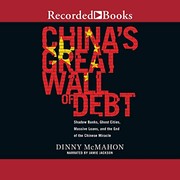
Dinny McMahon · 2018

Local-government financing vehicles, shadow banking and the property build-out.

Where it sits in the reference 2

Geographies
Economics

Topics

EconomicsPolitics and GovernmentAsia and the Pacific