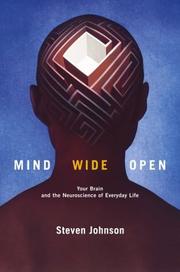
Mind Wide Open: Your Brain and the Neuroscience of Everyday Life
How the brain's chemicals and structures shape everyday experience.
Summary
Steven Johnson, a science writer, describes how the brain's chemicals, structures and subroutines connect to everyday experience, and makes himself the test subject. He takes a battery of attention tests, learns to control video games by changing his brain waves, and scans his own brain in a $2 million fMRI machine, in search of a modern answer to the question of who he is.
Johnson suggests that for a century people assumed the best route to self-knowledge was lying on a couch talking about childhood, and that learning the brain's mechanics can widen self-awareness as much as therapy, meditation or drugs. He takes up how people read one another, the neurochemistry of love and sex, the brain chemicals closely related to recreational drugs, why music moves people to tears, where breakthrough ideas come from, and why people sometimes smile when they do not want to. He mixes reportage, personal story and recent research.
Key takeaways 4
- Johnson uses neuroscience as a tool of self-knowledge alongside therapy and meditation.
- He tests his own brain with attention tests, neurofeedback and an fMRI scan.
- The brain runs on chemicals closely related to recreational drugs.
- Everyday acts such as reading a face or a smile have traceable neural mechanics.
Who should read it
General readers who want an accessible tour of how brain science explains daily life.
Who recommended it 2 · 1 direct
Similar books 6
Chosen by shared topics, the entries that hold them, and the people who recommended both.
How consciousness and the senses evolved, and the history of the mind.
Recommended by: Mohnish Pabrai, Nassim Nicholas Taleb

Why IQ scores have risen from one generation to the next, the Flynn effect.
Recommended by: Mohnish Pabrai
What brain science says about learning, sleep, stress, memory and multitasking.
“New scientific insights into why our brains work this way, and how to use what we now know to learn or work better.” — Derek Sivers
Source: Derek Sivers book notes (primary, rated list) · Rating: 8/10
Recommended by: Derek Sivers, Mohnish Pabrai, Nat Eliason and 2 others
A neurologist's case that emotion and feeling are part of reason.
“Antonio R. Damasio, Descartes’ Error: Emotion, Reason and the Human Brain (New York: Avon Books, 1994), 3-10” — Michael Mauboussin
Source: Mine Your Mind: Neuroscience and Investing, page 6
Recommended by: Michael Mauboussin, Mohnish Pabrai
Why television and video games have grown more complex and demanding.
Recommended by: Ev Williams

What genius is and how it appears in art, science and other fields.
Recommended by: Mohnish Pabrai