Updates

  1. Person pages list letters, writing, profiles and links as sortable tables with filters, and show each person's companies as links; Fund letters show each letter's description in its own column.
  2. Experts show a checked job title and a short description of each person; 30 more people have photographs.
  3. Every company, fund, university and publication the experts work for has a page listing the people there.
  4. Fund letters show each letter's thesis and filter by it; 225 person pages list the essays, columns and newsletter issues the person wrote.
  5. Person pages list every essay and newsletter issue a person wrote, and their own books as a table in List view.
  6. Recommends shows the five largest kinds of book and the rest under More; browse pictures load sooner.
  7. Podcasts and talks link the original episode, filter by Audio and video or Press, and list each publisher once.
  8. Pages are wider, Recommends has List and Grid, and a filter clicked again turns off.
  9. Book cards sit in a ruled grid with Open Library and Goodreads links and each book's one-line note.
  10. Funds is now Investors; each investor's styles are buttons that filter the table.
  11. Podcasts and talks on a person's page filter by year and publisher and show as a list or a grid of pictures.
  12. Quotes show only people's own words: 472 summaries written by list sites are gone.
  13. Country pages open from Browse again, and every link on the shelf lands on a page.
  14. Subject and person pages show their sections as tabs, and each book appears once on a person's page.
  15. Book cards show the quote, who said it and the source; grids show five cards to a row.
  16. On a phone, a menu holds the sections, search, Updates, Feedback and dark mode.
  17. Feedback takes a screenshot of the page with no browser prompt, opens a screenshot full size when you click it, and clears itself once sent.
  18. Book cards are centred, search names the topic each book sits in, and any text cut short shows whole on hover.
  19. Search groups its results by kind: people, companies, geographies, subjects, topics, books, funds, fund letters and papers.
  20. The Books table lists who recommended each book by name, and the browser tab names the section you are in.
  21. Feedback can take a screenshot of the page, or one you paste or choose, and opens in the corner beside Updates.
  22. Each rail button reopens its section where you left it, and Browse, Table and People show on every book and subject page.
  23. Filters grey out choices that hold nothing instead of hiding them, and Books › People filters by authors or recommenders.
  24. Feedback takes a subject line and up to three screenshots.
  25. Biographies are grouped by the person they are about: 41 new pages, from Abraham Lincoln to Lee Kuan Yew.
  26. Sport splits into 23 sports, and Religion into one topic per faith.
  27. Book lists show as cards: the cover, one recommendation quote and every recommender by name.
  28. Seventeen subjects that had two or three pages under different names now have one page each.
  29. Every page lists its Experts as authors and recommenders, with a link to them on the Experts tab.
  30. Economics, Financial history, Financial panics and Accounting are subjects of their own, with one page per financial crisis.
  31. Book, person and subject pages open inside the app, so the tabs stay in view.
  32. 996 more book covers, and photographs or logos for 227 more people and companies.
  33. Books › Browse shows every subject as cards, and the rail holds Fund letters, Papers, Experts, Books and Funds.
  34. Every topic over 150 books splits into narrower topics, each with a page of its own.

Send feedback

What is it?
Screenshots, up to 3 (optional)
or paste one with Ctrl+V

We use your email only to reply to you.

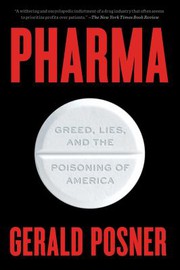
Pharma: Greed, Lies, and the Poisoning of Am

Pharma: Greed, Lies, and the Poisoning of America

Gerald Posner
2020
T2 816 pages · about 13h 36m to read Open Librarygoodreads

Industry history covering J&J's opioid marketing and its regulatory politics.

Summary

Gerald Posner wrote a history of the American pharmaceutical industry from the nineteenth century patent medicine trade to the opioid epidemic, with the Sackler family and Purdue Pharma at the centre of the later chapters.

The historical material covers the origins of the industry, the passage of the Pure Food and Drug Act and the later Kefauver-Harris amendments requiring proof of efficacy, the amphetamine and barbiturate booms, the development of the modern regulatory regime, and the growth of direct-to-consumer advertising after the rules were relaxed in 1997. Posner treats Arthur Sackler as the figure who invented modern pharmaceutical marketing, through medical advertising agencies, controlled medical journals, and the recruitment of physicians as promotional agents, using Valium as the case.

The opioid chapters cover Purdue's development of OxyContin, the claim that its formulation made addiction unlikely, the sales practices, the 2007 guilty plea by the company and three executives, and the litigation and bankruptcy that followed. Posner also covers the Food and Drug Administration's dependence on industry user fees since 1992 and the movement of personnel between the agency and the companies it regulates. The book is long, journalistic, and organised as accumulated indictment rather than as analysis; it does not seriously address the industry's actual therapeutic achievements. The reporting on the Sacklers and on FDA funding is well documented.

Key takeaways 7

  1. Arthur Sackler built the template for modern pharmaceutical marketing through medical advertising, controlled journals and physician recruitment.
  2. Purdue marketed OxyContin on a claim of low addiction risk that its own evidence did not support.
  3. The Food and Drug Administration has been funded substantially by industry user fees since 1992, which shaped its review priorities.
  4. Relaxation of direct-to-consumer advertising rules in 1997 converted patients into a demand channel that physicians could not easily refuse.
  5. Personnel movement between the regulator and the industry it oversees is routine and structural rather than exceptional.
  6. Company guilty pleas and financial penalties have consistently cost less than the revenue the conduct generated.
  7. Posner argues that the industry's conduct in the opioid epidemic followed patterns established decades earlier with amphetamines and tranquillisers.

Who should read it

Investors in pharmaceuticals and readers of regulatory capture who want a long history of industry marketing practice and its regulatory context.

Similar books 6

Chosen by shared topics, the entries that hold them, and the people who recommended both.

Scott Higham, Sari Horwitz · 2022

The drug distributors behind the opioid epidemic and the lawsuits against them.

Chris McGreal · 2018

How drug makers, regulators and distributors let the US opioid epidemic grow.

Patrick Radden Keefe · 2021

Three generations of the Sackler family and how Purdue Pharma sold OxyContin.

E. Richard Brown · 1979

How Rockefeller philanthropy reshaped American medicine.

Eric Eyre · 2020

How a West Virginia town of 382 people got 12 million opioid pills in three years.

Where it sits in the reference 2

Companies
Companies

Topics

Medicine and BiologyGeneral HistoryPolitics and GovernmentEconomic and Business HistoryRegulation, central banks and public policyDoctors, drugs and health care