
Updates

  1. Person pages list letters, writing, profiles and links as sortable tables with filters, and show each person's companies as links; Fund letters show each letter's description in its own column.
  2. Experts show a checked job title and a short description of each person; 30 more people have photographs.
  3. Every company, fund, university and publication the experts work for has a page listing the people there.
  4. Fund letters show each letter's thesis and filter by it; 225 person pages list the essays, columns and newsletter issues the person wrote.
  5. Person pages list every essay and newsletter issue a person wrote, and their own books as a table in List view.
  6. Recommends shows the five largest kinds of book and the rest under More; browse pictures load sooner.
  7. Podcasts and talks link the original episode, filter by Audio and video or Press, and list each publisher once.
  8. Pages are wider, Recommends has List and Grid, and a filter clicked again turns off.
  9. Book cards sit in a ruled grid with Open Library and Goodreads links and each book's one-line note.
  10. Funds is now Investors; each investor's styles are buttons that filter the table.
  11. Podcasts and talks on a person's page filter by year and publisher and show as a list or a grid of pictures.
  12. Quotes show only people's own words: 472 summaries written by list sites are gone.
  13. Country pages open from Browse again, and every link on the shelf lands on a page.
  14. Subject and person pages show their sections as tabs, and each book appears once on a person's page.
  15. Book cards show the quote, who said it and the source; grids show five cards to a row.
  16. On a phone, a menu holds the sections, search, Updates, Feedback and dark mode.
  17. Feedback takes a screenshot of the page with no browser prompt, opens a screenshot full size when you click it, and clears itself once sent.
  18. Book cards are centred, search names the topic each book sits in, and any text cut short shows whole on hover.
  19. Search groups its results by kind: people, companies, geographies, subjects, topics, books, funds, fund letters and papers.
  20. The Books table lists who recommended each book by name, and the browser tab names the section you are in.
  21. Feedback can take a screenshot of the page, or one you paste or choose, and opens in the corner beside Updates.
  22. Each rail button reopens its section where you left it, and Browse, Table and People show on every book and subject page.
  23. Filters grey out choices that hold nothing instead of hiding them, and Books › People filters by authors or recommenders.
  24. Feedback takes a subject line and up to three screenshots.
  25. Biographies are grouped by the person they are about: 41 new pages, from Abraham Lincoln to Lee Kuan Yew.
  26. Sport splits into 23 sports, and Religion into one topic per faith.
  27. Book lists show as cards: the cover, one recommendation quote and every recommender by name.
  28. Seventeen subjects that had two or three pages under different names now have one page each.
  29. Every page lists its Experts as authors and recommenders, with a link to them on the Experts tab.
  30. Economics, Financial history, Financial panics and Accounting are subjects of their own, with one page per financial crisis.
  31. Book, person and subject pages open inside the app, so the tabs stay in view.
  32. 996 more book covers, and photographs or logos for 227 more people and companies.
  33. Books › Browse shows every subject as cards, and the rail holds Fund letters, Papers, Experts, Books and Funds.
  34. Every topic over 150 books splits into narrower topics, each with a page of its own.

Send feedback

What is it?
Screenshots, up to 3 (optional)
or paste one with Ctrl+V

We use your email only to reply to you.

Plunder

Plunder

Brendan Ballou
2023
T3 368 pages · about 6h 8m to read Open Librarygoodreads

The prosecutorial case against the industry KKR created; read as counterweight.

Summary

Ballou, a federal prosecutor who served as special counsel for private equity at the Department of Justice antitrust division, wrote a critique of the private equity industry aimed at the legal and regulatory structures that permit its practices.

The argument is that private equity firms extract value from acquired companies while being insulated from the consequences. The mechanisms he identifies are specific. Dividend recapitalisations load the acquired company with debt to pay the sponsor. Sale-leaseback transactions sell the company's real estate and commit it to rent payments it did not previously bear. Management and monitoring fees charged to the portfolio company transfer cash to the sponsor regardless of performance. The limited liability structure means the fund and its partners are not liable for the portfolio company's obligations when it fails, including pension liabilities and tort claims.

He examines sectors where the effects are most visible: nursing homes, where he presents research associating private equity ownership with higher mortality; emergency medicine staffing and the surprise billing practices that followed; retail chains including Toys R Us and Sears; prison services; mobile home parks; and local newspapers.

His policy recommendations include holding sponsors liable for portfolio company obligations, changing the tax treatment of carried interest and of interest deductibility, restricting dividend recapitalisations, and enforcing existing antitrust and fiduciary law more aggressively.

The book argues one side and does not engage with the evidence that private equity ownership improves productivity in some settings, or with the returns delivered to the pension funds that are the industry's largest investors. Ballou selects cases where the outcome was bad, and the industry includes both. The legal analysis of liability structures is the strongest part and is where his professional background shows.

Key takeaways 7

  1. Limited liability insulates private equity sponsors from the obligations of the companies they control, including pensions and tort claims.
  2. Dividend recapitalisations transfer cash to the sponsor by borrowing against the acquired company, which raises its fixed costs permanently.
  3. Sale-leaseback transactions convert owned real estate into a rent obligation that the company did not previously carry.
  4. Management and monitoring fees charged to portfolio companies pay the sponsor regardless of whether the investment succeeds.
  5. Research associates private equity ownership of nursing homes with measurably worse patient outcomes.
  6. The tax deductibility of interest subsidises leveraged acquisition structures relative to equity-funded ownership.
  7. Existing legal doctrine could impose liability on controlling owners, and the failure to do so is an enforcement choice rather than a statutory gap.

Who should read it

Investors, limited partners and operators who want the legal and regulatory critique of private equity structures, read alongside evidence on the industry's returns and productivity effects.

Similar books 6

Chosen by shared topics, the entries that hold them, and the people who recommended both.
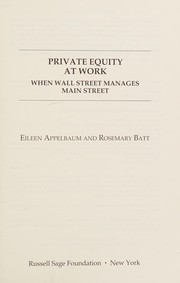
Eileen Appelbaum, Rosemary Batt · 2014

What private equity does to companies, workers and investor returns, critically.
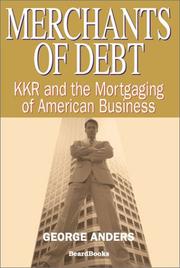
George Anders · 1992

KKR from 1976 through the RJR Nabisco buyout, and what debt did to its companies.
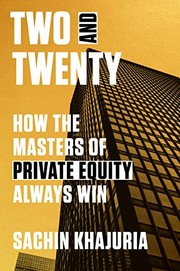
Sachin Khajuria · 2022

Practitioner insider on how a modern buyout firm actually earns.
Bryan Burrough, John Helyar · 1989

The 1988 bidding war for RJR Nabisco, the largest leveraged buyout to that date.

Antoin E. Murphy · 2004

Cross-holdings, the state and who actually controls French companies.
Stuart C. Gilson · 2001

Harvard case studies in bankruptcy and workout situations.

Where it sits in the reference 2

Companies
Business models

Topics

Finance and MarketsPolitics and GovernmentRegulation, central banks and public policy