Updates

  1. Person pages list letters, writing, profiles and links as sortable tables with filters, and show each person's companies as links; Fund letters show each letter's description in its own column.
  2. Experts show a checked job title and a short description of each person; 30 more people have photographs.
  3. Every company, fund, university and publication the experts work for has a page listing the people there.
  4. Fund letters show each letter's thesis and filter by it; 225 person pages list the essays, columns and newsletter issues the person wrote.
  5. Person pages list every essay and newsletter issue a person wrote, and their own books as a table in List view.
  6. Recommends shows the five largest kinds of book and the rest under More; browse pictures load sooner.
  7. Podcasts and talks link the original episode, filter by Audio and video or Press, and list each publisher once.
  8. Pages are wider, Recommends has List and Grid, and a filter clicked again turns off.
  9. Book cards sit in a ruled grid with Open Library and Goodreads links and each book's one-line note.
  10. Funds is now Investors; each investor's styles are buttons that filter the table.
  11. Podcasts and talks on a person's page filter by year and publisher and show as a list or a grid of pictures.
  12. Quotes show only people's own words: 472 summaries written by list sites are gone.
  13. Country pages open from Browse again, and every link on the shelf lands on a page.
  14. Subject and person pages show their sections as tabs, and each book appears once on a person's page.
  15. Book cards show the quote, who said it and the source; grids show five cards to a row.
  16. On a phone, a menu holds the sections, search, Updates, Feedback and dark mode.
  17. Feedback takes a screenshot of the page with no browser prompt, opens a screenshot full size when you click it, and clears itself once sent.
  18. Book cards are centred, search names the topic each book sits in, and any text cut short shows whole on hover.
  19. Search groups its results by kind: people, companies, geographies, subjects, topics, books, funds, fund letters and papers.
  20. The Books table lists who recommended each book by name, and the browser tab names the section you are in.
  21. Feedback can take a screenshot of the page, or one you paste or choose, and opens in the corner beside Updates.
  22. Each rail button reopens its section where you left it, and Browse, Table and People show on every book and subject page.
  23. Filters grey out choices that hold nothing instead of hiding them, and Books › People filters by authors or recommenders.
  24. Feedback takes a subject line and up to three screenshots.
  25. Biographies are grouped by the person they are about: 41 new pages, from Abraham Lincoln to Lee Kuan Yew.
  26. Sport splits into 23 sports, and Religion into one topic per faith.
  27. Book lists show as cards: the cover, one recommendation quote and every recommender by name.
  28. Seventeen subjects that had two or three pages under different names now have one page each.
  29. Every page lists its Experts as authors and recommenders, with a link to them on the Experts tab.
  30. Economics, Financial history, Financial panics and Accounting are subjects of their own, with one page per financial crisis.
  31. Book, person and subject pages open inside the app, so the tabs stay in view.
  32. 996 more book covers, and photographs or logos for 227 more people and companies.
  33. Books › Browse shows every subject as cards, and the rail holds Fund letters, Papers, Experts, Books and Funds.
  34. Every topic over 150 books splits into narrower topics, each with a page of its own.

Send feedback

What is it?
Screenshots, up to 3 (optional)
or paste one with Ctrl+V

We use your email only to reply to you.

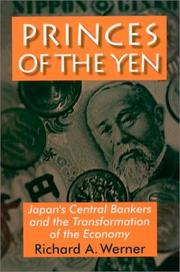
Princes of the Yen

Princes of the Yen

Richard A. Werner
2003
T3 341 pages · about 5h 41m to read Open Librarygoodreads

A contested but influential reading of the Bank of Japan's credit guidance.

Summary

Richard Werner argues that the Bank of Japan, rather than fiscal policy or market forces, created the Japanese asset bubble of the late 1980s and then deliberately destroyed it in order to force structural change on the Japanese economy. This is a strong claim about intent, and the book is built to support it.

His mechanism is window guidance, the informal quota system through which the Bank of Japan told commercial banks how much to lend and to which sectors. Werner argues that the central bank directed enormous credit growth toward real estate and speculative lending during the 1980s, that this rather than interest rates drove the asset price rise, and that when the bank withdrew the guidance the bubble collapsed. He then argues that officials chose not to reflate during the 1990s because they wanted the crisis to break the postwar economic model, weaken the Ministry of Finance and force liberalisation.

Werner also develops his general theory that credit creation for asset purchases affects asset prices while credit creation for productive purposes affects the real economy, which is the basis of his later work on disaggregated credit. He is a heterodox economist and this thesis is not accepted by mainstream Japanese monetary historians, who attribute the bubble to a combination of financial liberalisation, the Plaza Accord's consequences and monetary policy errors without the deliberate intent Werner alleges. The evidence for intent is largely inferential and rests on interviews and on published statements. Read it as a serious heterodox argument that has not been accepted, and treat the intent claims separately from the credit analysis.

Key takeaways 7

  1. Werner argues that Bank of Japan window guidance, not interest rates, determined the volume and direction of Japanese bank lending in the 1980s.
  2. Credit created for asset purchases raises asset prices, while credit created for productive investment raises output, and aggregating the two conceals both.
  3. The withdrawal of lending guidance rather than the increase in interest rates ended the Japanese bubble.
  4. Werner alleges that Japanese monetary officials prolonged the 1990s stagnation deliberately in order to force structural change.
  5. Central bank independence transfers power to an institution that faces no electoral accountability for the outcomes it produces.
  6. Bank credit creation, rather than saving, is the source of new purchasing power in an economy.
  7. The intent claims rest on inference and are rejected by mainstream accounts of the Japanese bubble.

Who should read it

Investors interested in credit-driven asset cycles and in the disaggregated credit framework, treating the claims about deliberate policy intent as contested.

Who recommended it 1 · 1 direct

Similar books 6

Chosen by shared topics, the entries that hold them, and the people who recommended both.

Ben S. Bernanke · 2022

Insider account of the Fed from Burns through the QE era.

Allan H. Meltzer · 2003

The Fed from 1913 to 1951, told from its own minutes and internal memos.
Ezra F. Vogel · 1979

What Japan's institutions had solved that America had not, and what to learn.

Chalmers A. Johnson · 1982

How Japan's trade ministry steered industry from 1925 to 1975.
William Greider · 1987

The Volcker Fed from the inside; still the fullest political account.

Recommended by: Mohnish Pabrai
Neil Irwin · 2013

The 2007 to 2012 crises through three central bankers: Bernanke, King and Trichet.

Where it sits in the reference 2

Geographies
Financial history

Topics

EconomicsPolitics and GovernmentFinancial HistoryAsia and the Pacific