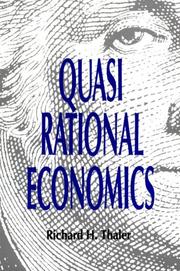
Quasi Rational Economics
Why economic models fail when they assume people act fully rationally.
About Richard H. Thaler
Charles R. Walgreen Distinguished Service Professor of Behavioral Science and Economics, University of Chicago Booth School of Business; co-founder, Fuller & Thaler Asset Management; Nobel laureate in economics 2017
The Anomalies series and Nudge are the primary sources for behavioral economics as an applied discipline in finance and public policy.
Similar books 6
Chosen by shared topics, the entries that hold them, and the people who recommended both.
The foundational papers of behavioural finance, collected.
A second collection of behavioural finance papers, more theoretical than the first.
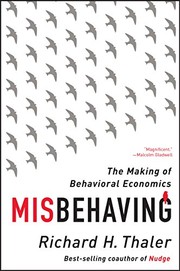
How behavioural economics was built against economists who assumed rational agents.
“He opens his new book, Misbehaving, with Vilfredo Pareto’s assertion that “the foundation of political economy and, in general, of every social science, is evidently psychology.” — Howard Marks
Source: On the Couch, page 1
Recommended by: Howard Marks, Michael Mauboussin and 2 others
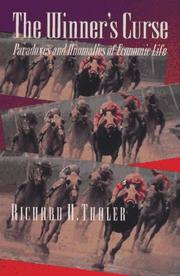
The Anomalies columns: systematic departures from standard economic theory.
“Richard H. Thaler, The Winner’s Curse: Paradoxes and Anomalies of Economic Life (Princeton, NJ: Princeton University Press, 1992, 157-158” — Michael Mauboussin
Source: Capital Ideas Revisited - Part 2: Thoughts on Beating a Mostly-Efficient Stock Market, page 9
Recommended by: Michael Mauboussin
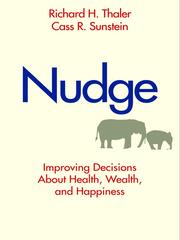
How choice architecture can steer people to better choices without removing options.
“Introducing the idea of Libertarian Paternalism: influencing people's behavior for their own benefit, without forbidding any options or significantly changing their economic incentives.” — Derek Sivers
Source: Derek Sivers book notes (primary, rated list) · Rating: 5/10
Recommended by: Derek Sivers, Tristan Harris
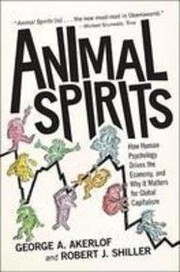
How psychology, which Keynes called animal spirits, drives the economy.
Recommended by: Jim Collins, Mohnish Pabrai