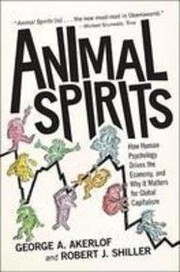
Animal Spirits
How psychology, which Keynes called animal spirits, drives the economy.
Summary
Akerlof and Shiller argue that macroeconomics has excluded the psychological factors Keynes called animal spirits, and that a great deal of what economies actually do cannot be explained without them.
They identify five components. Confidence, which is not merely a rational forecast but a state that leads people to act without full information and which has multiplier effects through the economy. Fairness, which determines wage setting and explains why wages do not fall in recessions as market clearing would require. Corruption and bad faith, which appear in predictable cycles and which mainstream models treat as outside economics. Money illusion, meaning that people respond to nominal rather than real values, which the profession assumed away and which the evidence supports. And stories, meaning the narratives people hold about the economy, which spread and which change behaviour.
They then apply these to eight questions: why economies fall into depression, why central banks have the power they do, why some people cannot find work, why there is a trade-off between inflation and unemployment in the long run, why saving for the future is arbitrary, why financial prices and investment are so volatile, why real estate markets go through cycles, and why minority poverty persists.
The book was published in 2009 and its argument was well timed. Its weakness is that identifying omitted factors is easier than incorporating them, and the book proposes no formal framework that replaces what it criticises. The chapters vary in quality and the treatment of minority poverty has been criticised as thin.
Key takeaways 7
- Confidence is not a rational forecast but a state that leads people to act without full information, and it has multiplier effects through an economy.
- Considerations of fairness determine wage setting, which is why wages do not fall in recessions as market clearing would require.
- Money illusion is real and measurable, meaning people respond to nominal rather than real values, which invalidates a standard modelling assumption.
- Corruption and bad faith occur in predictable cycles tied to the economic cycle, and excluding them from economics removes a recurring cause of crises.
- Stories people tell about the economy spread through populations and change behaviour, which makes narrative a causal variable rather than a description.
- Asset price and investment volatility exceed anything justified by changes in fundamentals, which requires a psychological explanation.
- Real estate cycles are driven by beliefs about future prices that become self-confirming during the expansion phase.
Who should read it
Investors and policy readers who want the behavioural critique of macroeconomics stated by two of its most credible proponents.
About Robert J. Shiller
Sterling Professor of Economics Emeritus, Yale University; co-creator of the Case-Shiller home price indices; Nobel laureate in economics 2013
Excess-volatility work and Irrational Exuberance are the primary sources for the empirical case that asset prices move far more than fundamentals justify.
Who recommended it 2 · 1 direct
Similar books 6
Chosen by shared topics, the entries that hold them, and the people who recommended both.
How popular stories spread like epidemics and drive economic events.
“Robert J. Shiller, Narrative Economics: How Stories Go Viral and Drive Major Economic Events (Princeton, NJ: Princeton University Press, 2019)” — Michael Mauboussin
Source: Who Is On the Other Side? A Framework for Understanding Market (In)Efficiency
Recommended by: Michael Mauboussin, Jackie Vullinghs
How free markets produce manipulation and deception as well as goods.
People have no fixed sense of value, so context and anchors set the prices they pay.
“For a good popular treatment of this topic, see William Poundstone, Priceless: The Myth of Fair Value (and How to Take Advantage of It) (New York: Hill and Wang” — Michael Mauboussin
Source: Blaming the Rat: Incentives, Motivation, and How They Interact, page 14
Recommended by: Michael Mauboussin, Mohnish Pabrai and 1 other
How positional spending on status goods drives American consumption.
The Anomalies columns: systematic departures from standard economic theory.
“Richard H. Thaler, The Winner’s Curse: Paradoxes and Anomalies of Economic Life (Princeton, NJ: Princeton University Press, 1992, 157-158” — Michael Mauboussin
Source: Capital Ideas Revisited - Part 2: Thoughts on Beating a Mostly-Efficient Stock Market, page 9
Recommended by: Michael Mauboussin

Why evolved instincts push people toward bad choices on money, food and sex.
Recommended by: Mohnish Pabrai, Nassim Nicholas Taleb