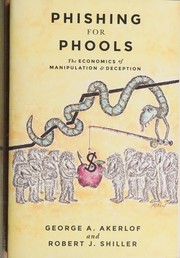
Phishing for Phools
How free markets produce manipulation and deception as well as goods.
Summary
George Akerlof and Robert Shiller, both Nobel laureates, argue that competitive markets do not only produce goods people want; they also produce manipulation and deception, and they do so with the same reliability. Their term for the result is a phishing equilibrium.
The argument follows from ordinary competitive logic. If a profit opportunity exists in exploiting a systematic weakness in human judgement, competition will ensure that someone takes it, and firms that decline will be outcompeted by those that do not. Manipulation is therefore not a market failure caused by bad actors but an equilibrium outcome of markets populated by people with ordinary psychological weaknesses. The authors give the cases: cinnamon rolls placed where the smell reaches passers-by, credit card design that exploits present bias, slot machines engineered for reinforcement schedules, pharmaceutical marketing, food and tobacco, political advertising, and financial products including the reputation mining they identify in the securitisation of subprime mortgages.
The most useful analytical move is the concept of reputation mining: a firm builds a reputation for quality and then sells that reputation by degrading the product, which is profitable so long as the degradation is discovered slowly. They apply this to ratings agencies and to investment banks in the mortgage boom. Critics have argued that the framework is unfalsifiable, since any transaction can be characterised as exploitation of some weakness, and that the authors underweight the market and regulatory mechanisms that limit deception. The reputation mining argument is the part most directly usable by an investor.
Key takeaways 7
- Competitive markets produce manipulation as reliably as they produce goods, because any available profit from exploiting a weakness will be taken.
- A firm that declines to exploit a customer weakness is outcompeted by one that does, so individual ethics cannot solve the problem.
- Reputation mining means building a reputation for quality and then selling it by degrading the product before customers notice.
- Ratings agencies and investment banks mined reputations built over decades during the mortgage securitisation boom.
- Free markets give people what they think they want, which is not the same as what they would want on reflection.
- The authors argue that regulation and standards bodies exist precisely to limit the phishing equilibrium and are not deviations from market logic.
- Advertising and marketing work by constructing the story a customer tells themselves, which is why factual disclosure is a weak remedy.
Who should read it
Investors and operators who want an economic account of why deceptive practices persist in competitive markets, and a usable concept of reputation as a depletable asset.
About Robert J. Shiller
Sterling Professor of Economics Emeritus, Yale University; co-creator of the Case-Shiller home price indices; Nobel laureate in economics 2013
Excess-volatility work and Irrational Exuberance are the primary sources for the empirical case that asset prices move far more than fundamentals justify.
Similar books 6
Chosen by shared topics, the entries that hold them, and the people who recommended both.
How psychology, which Keynes called animal spirits, drives the economy.
Recommended by: Jim Collins, Mohnish Pabrai
How popular stories spread like epidemics and drive economic events.
“Robert J. Shiller, Narrative Economics: How Stories Go Viral and Drive Major Economic Events (Princeton, NJ: Princeton University Press, 2019)” — Michael Mauboussin
Source: Who Is On the Other Side? A Framework for Understanding Market (In)Efficiency
Recommended by: Michael Mauboussin, Jackie Vullinghs
How positional spending on status goods drives American consumption.
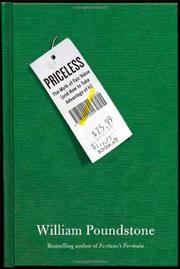
People have no fixed sense of value, so context and anchors set the prices they pay.
“For a good popular treatment of this topic, see William Poundstone, Priceless: The Myth of Fair Value (and How to Take Advantage of It) (New York: Hill and Wang” — Michael Mauboussin
Source: Blaming the Rat: Incentives, Motivation, and How They Interact, page 14
Recommended by: Michael Mauboussin, Mohnish Pabrai and 1 other

The Anomalies columns: systematic departures from standard economic theory.
“Richard H. Thaler, The Winner’s Curse: Paradoxes and Anomalies of Economic Life (Princeton, NJ: Princeton University Press, 1992, 157-158” — Michael Mauboussin
Source: Capital Ideas Revisited - Part 2: Thoughts on Beating a Mostly-Efficient Stock Market, page 9
Recommended by: Michael Mauboussin

Why evolved instincts push people toward bad choices on money, food and sex.
Recommended by: Mohnish Pabrai, Nassim Nicholas Taleb