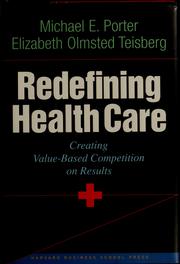
Redefining Health Care
Why American health care competes on the wrong things, and value-based competition.
Creating Value-Based Competition on Results
Summary
Michael Porter and Elizabeth Teisberg apply competitive strategy to American health care and argue that the system's failure comes from competing on the wrong things. Competition exists, they say, but it operates on cost shifting between payers, providers and patients rather than on results for patients.
Their diagnosis identifies zero-sum competition: hospitals and insurers negotiate over who bears cost, providers compete for referrals and for profitable service lines, and nobody competes on whether patients get better. They argue the correct unit of competition is the medical condition over the full cycle of care, from prevention through treatment to management, rather than the discrete intervention or the hospital visit. Value is defined as health outcomes achieved per dollar spent over that cycle.
The prescriptions follow. Providers should organise into integrated practice units around conditions rather than around specialties and departments. Outcomes must be measured and published at the condition level, since competition on results is impossible without them. Reimbursement should cover care cycles rather than individual procedures. Providers should concentrate on conditions where they can achieve excellence and stop offering everything, since volume in a condition produces better outcomes. Health plans should compete on helping members get value rather than on restricting access. The book has been enormously influential in the value-based care movement and in outcome measurement initiatives. Its critics note that the American system's financing structure blocks most of the prescriptions, that outcome measurement is harder and more gameable than the authors allow, and that the argument treats a financing problem as a strategy problem.
Key takeaways 7
- Health care competition operates on shifting costs between parties rather than on producing results for patients.
- The correct unit of value in health care is the medical condition over a full care cycle, not the individual procedure or visit.
- Value means health outcomes achieved per dollar spent, and neither term can be assessed without measuring the other.
- Providers should organise into integrated units around conditions rather than around clinical specialties and departments.
- Outcome measurement published at the condition level is a precondition for any competition on results.
- Volume in a specific condition improves outcomes, so providers offering every service produce worse results than concentrated ones.
- Reimbursement for episodes of care rather than for procedures aligns provider incentives with the full cycle.
Who should read it
Health care executives, policymakers and investors who want a strategy framework for restructuring provision around measured outcomes.
About Michael E. Porter
Bishop William Lawrence University Professor Emeritus, Harvard Business School; founder, Institute for Strategy and Competitiveness
Competitive Strategy and the five-forces framework are the primary source for industry analysis, and Competitive Advantage supplied the value-chain vocabulary the field still uses.
Similar books 6
Chosen by shared topics, the entries that hold them, and the people who recommended both.
Teaching cases for applying the framework of Competitive Strategy.
Research on how firms compete internationally, from a Harvard colloquium.

The value chain: how to find where a firm's cost or differentiation advantage lies.
“For example, I read Competitive Strategy and Competitive Advantage by Michael Porter.” — Michael Mauboussin
Source: Thirty Years: Reflections on the Ten Attributes of Great Investors, page 3
Recommended by: Michael Mauboussin, Li Lu
The five forces model for analysing an industry and a firm's place in it.
“For example, I read Competitive Strategy and Competitive Advantage by Michael Porter.” — Michael Mauboussin
Source: Thirty Years: Reflections on the Ten Attributes of Great Investors, page 3
Recommended by: Jim Collins, Michael Mauboussin and 3 others

Harvard Business Review articles on competitive strategy across two decades.
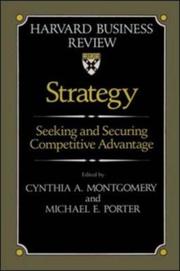
Harvard Business Review readings on strategy and competitive advantage.
“Michael E. Porter, “The Internet and Strategy”, Harvard Business Review, February 2001. Jeff Bezos at the 1999 Internet Summit, quoted in Julie Rawe, “Doom Stalks the Dotcoms,” Time, April 17, 2000. 3 See Extinction: Bad Genes or Bad Luck by David M. Raup, W.W. Norton, 1991, pp” — Michael Mauboussin
Source: Fill and Kill: Succeeding with Survivors is Nothing New, page 11
Recommended by: Jim Collins, Michael Mauboussin