Updates

  1. Person pages list letters, writing, profiles and links as sortable tables with filters, and show each person's companies as links; Fund letters show each letter's description in its own column.
  2. Experts show a checked job title and a short description of each person; 30 more people have photographs.
  3. Every company, fund, university and publication the experts work for has a page listing the people there.
  4. Fund letters show each letter's thesis and filter by it; 225 person pages list the essays, columns and newsletter issues the person wrote.
  5. Person pages list every essay and newsletter issue a person wrote, and their own books as a table in List view.
  6. Recommends shows the five largest kinds of book and the rest under More; browse pictures load sooner.
  7. Podcasts and talks link the original episode, filter by Audio and video or Press, and list each publisher once.
  8. Pages are wider, Recommends has List and Grid, and a filter clicked again turns off.
  9. Book cards sit in a ruled grid with Open Library and Goodreads links and each book's one-line note.
  10. Funds is now Investors; each investor's styles are buttons that filter the table.
  11. Podcasts and talks on a person's page filter by year and publisher and show as a list or a grid of pictures.
  12. Quotes show only people's own words: 472 summaries written by list sites are gone.
  13. Country pages open from Browse again, and every link on the shelf lands on a page.
  14. Subject and person pages show their sections as tabs, and each book appears once on a person's page.
  15. Book cards show the quote, who said it and the source; grids show five cards to a row.
  16. On a phone, a menu holds the sections, search, Updates, Feedback and dark mode.
  17. Feedback takes a screenshot of the page with no browser prompt, opens a screenshot full size when you click it, and clears itself once sent.
  18. Book cards are centred, search names the topic each book sits in, and any text cut short shows whole on hover.
  19. Search groups its results by kind: people, companies, geographies, subjects, topics, books, funds, fund letters and papers.
  20. The Books table lists who recommended each book by name, and the browser tab names the section you are in.
  21. Feedback can take a screenshot of the page, or one you paste or choose, and opens in the corner beside Updates.
  22. Each rail button reopens its section where you left it, and Browse, Table and People show on every book and subject page.
  23. Filters grey out choices that hold nothing instead of hiding them, and Books › People filters by authors or recommenders.
  24. Feedback takes a subject line and up to three screenshots.
  25. Biographies are grouped by the person they are about: 41 new pages, from Abraham Lincoln to Lee Kuan Yew.
  26. Sport splits into 23 sports, and Religion into one topic per faith.
  27. Book lists show as cards: the cover, one recommendation quote and every recommender by name.
  28. Seventeen subjects that had two or three pages under different names now have one page each.
  29. Every page lists its Experts as authors and recommenders, with a link to them on the Experts tab.
  30. Economics, Financial history, Financial panics and Accounting are subjects of their own, with one page per financial crisis.
  31. Book, person and subject pages open inside the app, so the tabs stay in view.
  32. 996 more book covers, and photographs or logos for 227 more people and companies.
  33. Books › Browse shows every subject as cards, and the rail holds Fund letters, Papers, Experts, Books and Funds.
  34. Every topic over 150 books splits into narrower topics, each with a page of its own.

Send feedback

What is it?
Screenshots, up to 3 (optional)
or paste one with Ctrl+V

We use your email only to reply to you.

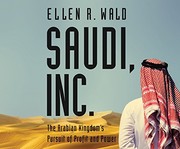
Saudi, Inc.

Saudi, Inc.

Ellen R. Wald
2018
T2 302 pages · about 5h 2m to read Open Librarygoodreads

Aramco as a corporate history, from concession to national champion.

Summary

Wald, an energy historian and consultant, wrote a history of Saudi Arabia through its oil business, from the 1930s concession to the American consortium that became Aramco, through nationalisation, to the period around Mohammed bin Salman's Vision 2030 and the plans to sell shares in Saudi Aramco.

Her organising argument is that the Al Saud have run the country as a family business, making commercial decisions with commercial logic rather than acting as an ideological or purely political actor. She traces the gradual acquisition of Aramco from the American companies, completed in 1980, and argues it was executed with patience and legal care rather than through the confrontational nationalisations elsewhere in the region. She documents the training of Saudi engineers and managers who took over the operation, which is why the company remained technically capable after the transfer.

The oil market chapters cover the price decisions: the 1973 embargo, the swing producer role of the 1980s and the decision to abandon it in 1985 by moving to netback pricing, which collapsed prices and disciplined other producers, and the 2014 decision not to cut production against American shale.

The later chapters cover diversification, the Public Investment Fund and the initial public offering plans as they stood before the listing.

Wald is sympathetic to her subject and writes about the ruling family's commercial competence rather than about the political system, the human rights record or the treatment of dissent, which readers should note. The book predates the 2019 Aramco listing, the Khashoggi killing's consequences, the 2020 price war and the subsequent shifts, and its treatment of Mohammed bin Salman is necessarily provisional.

Key takeaways 7

  1. The Al Saud acquired Aramco from the American companies gradually through negotiation rather than by expropriation.
  2. Training Saudi engineers and managers over decades meant the company remained technically capable after the ownership transfer.
  3. Saudi Arabia abandoned the swing producer role in 1985 by moving to netback pricing, which collapsed prices and disciplined competitors.
  4. The 2014 decision not to cut production was a deliberate attempt to test the resilience of American shale producers.
  5. Oil production decisions are made with commercial reasoning about long-run market share rather than as political gestures.
  6. Aramco's operational capability is unusual among national oil companies, most of which declined after nationalisation.
  7. Diversification plans depend on the same oil revenue they are intended to replace, which constrains how fast they can proceed.

Who should read it

Investors and operators in energy and in Gulf markets who want the commercial history of Saudi oil policy from a perspective sympathetic to its decision-making.

Similar books 6

Chosen by shared topics, the entries that hold them, and the people who recommended both.
Bradley Hope, Justin Scheck · 2020

Mohammed bin Salman's rise to power in Saudi Arabia and the decisions that followed.
Jill Crystal · 1990

How oil revenue let rulers buy out the merchant families; the origin of the modern business elite.
Daniel Yergin · 2020

Energy and geopolitics in 2020: US shale, Russia, China and the Middle East.
Alan Richards, John Waterbury · 1990

Egypt is the anchor case throughout; the standard textbook on regional state-business relations.

Robert McNally · 2017

Argues price stability always required a swing producer or cartel.
Christopher M. Davidson · 2008

The emirate's development model and its structural dependencies.

Where it sits in the reference 3

Geographies
Geographies
Industries

Topics

Company HistoriesPolitics and GovernmentEnvironment and EnergyMiddle East and North AfricaOil, gas and coal