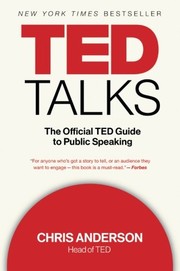
TED Talks: The Official TED Guide to Public Speaking
How to give a talk that transfers one idea, from TED's work with its speakers.
Summary
Anderson, who runs TED, wrote a practical guide to giving a talk, drawing on the organisation's experience preparing several thousand speakers.
The central instruction concerns the objective: a talk should transfer one idea into the audience's minds, and everything else is subordinate to that. He argues that the most common failure is attempting to cover a subject rather than deliver an idea, which produces a talk the audience cannot summarise afterwards. The idea should be statable in a sentence, and the talk's structure should be the path by which the audience is brought to it.
The practical content covers: connection, meaning the opening moments in which the audience decides whether to attend, and the specific techniques that build it; narration, and why a story works better than an assertion for delivering a claim; explanation, including starting from what the audience already knows and building rather than starting from the concept; persuasion, where he argues that dismantling the audience's existing belief must precede offering a replacement; and revelation, meaning delivering something the audience has not seen.
He also covers the practical matters of visuals, memorisation versus notes, rehearsal, stage presence, nerves and voice, with the specific recommendation that a talk should be rehearsed enough that the words are not being composed on stage.
The book is oriented to the TED format, which is short, single-idea and heavily prepared, and much of it applies less directly to other speaking situations. The one-idea discipline is the transferable core.
Key takeaways 7
- A talk should transfer one idea into the audience's minds, and everything else must be subordinated to that single objective.
- The most common failure is attempting to cover a subject rather than deliver an idea, which produces a talk nobody can summarise afterwards.
- The idea must be statable in a single sentence before the talk is structured, since the structure is the path to it.
- Explanation should start from what the audience already knows and build outward rather than starting from the concept being explained.
- Dismantling an existing belief must precede offering a replacement, because a new idea cannot occupy space that is already filled.
- A story delivers a claim more effectively than an assertion because the audience reaches the conclusion themselves.
- A talk should be rehearsed enough that the words are not being composed on stage, which is where the anxiety and the wandering come from.
Who should read it
Anyone preparing a short high-stakes talk who needs the single-idea discipline and the specific structural techniques.
About Chris Anderson
Head of TED, the nonprofit that publishes TED talks; founded Future Publishing and the games site IGN.
TED Talks: The Official TED Guide to Public Speaking sets out how the talks TED publishes are built.
Who recommended it 1 · 1 direct
Similar books 6
Chosen by shared topics, the entries that hold them, and the people who recommended both.
Techniques for handling people, being liked and winning others to your view.
“If you want to learn what people want, read Dale Carnegie's How to Win Friends and Influence People.” — Paul Graham
Source: Why Smart People Have Bad Ideas
Recommended by: Mohnish Pabrai, Patrick Collison and 14 others
How the internet can spread generosity and make giving a force for good.
Recommended by: Bill Gates
Principles of persuasion for crafting the right message and delivering it.
Recommended by: Sheryl Sandberg
A short method for direct conversations and for making difficult requests.
Recommended by: Shane Parrish
How to handle the unexpected at work with improv skills for impromptu speaking.
Recommended by: Chelsea Krost
Why some words persuade and others fail, from a political pollster.
Recommended by: Nat Eliason, Tristan Harris, Matt Mullenweg and 1 other