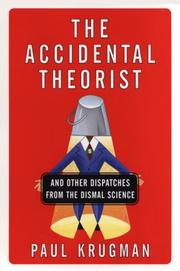
The Accidental Theorist: And Other Dispatches from the Dismal Science
Short essays on unemployment, globalization, growth and financial speculation.
Summary
Paul Krugman gathers recent articles and addresses, some unpublished before, into a short narrative on the main economic issues of the late 1990s: unemployment, globalisation, economic growth and financial speculation. Published in 1998, the essays take on bad economic ideas from across the political spectrum in plain English.
Some pieces start from current issues, such as corporate downsizing or the crisis set off by monetary policy in Thailand. Others demolish ideas that sound plausible but are false, such as blaming America's economic troubles on the internationalisation of commerce when the real cause is a failure of resolve in domestic policy. One essay imagines declaring New York an independent country to explain an economic point. All are joined by Krugman's clear view of the basic economics behind each issue and the wit with which he applies it.
Key takeaways 4
- Krugman blames domestic policy, not globalisation, for many American economic problems.
- Plausible-sounding economic ideas are often wrong.
- The Asian crisis and corporate downsizing illustrate basic economic principles.
- Thought experiments make economic reasoning easy to follow.
Who should read it
Readers who want short, witty essays that apply basic economics to policy debates.
Who recommended it 1 · 1 direct
Similar books 6
Chosen by shared topics, the entries that hold them, and the people who recommended both.
How GDP is measured, and why its figures can jump overnight.
Recommended by: Mohnish Pabrai, Patrick Collison
How prices, incentives and trade-offs work, from housing and labour to trade.
Recommended by: Marc Andreessen
Economics for daily life: motivating people, choosing food, giving to charity.
“Recommendations for the transactions of life. When to give to charity, what restaurants to choose, what insurance to buy, etc. He makes a rational case for these, often surprising, from an economics point of view.” — Derek Sivers
Source: Derek Sivers book notes (primary, rated list) · Rating: 8/10
Recommended by: Derek Sivers, Graham Duncan
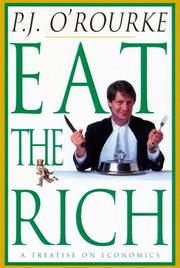
A humorist's world tour asking why some places prosper and others fail.
Recommended by: Eric Weinstein
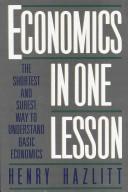
Judge a policy by its long-run effects on all groups, applied to two dozen cases.
“I've given dozens of copies of this classic to students... The book should be required reading on every campus.” — Christopher Bloomstran
Source: Semper Augustus 2020 Letter to Clients, 'To Read or Not to Read', p. 57
Recommended by: Christopher Bloomstran, Changpeng Zhao and 3 others
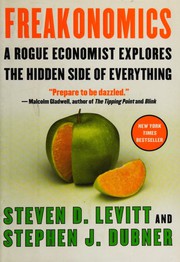
Incentives and data applied to cheating teachers, sumo wrestlers and other puzzles.
“Also, see the story of cheating in the Chicago Public School system in Steven D. Levitt and Stephen J. Dubner, Freakonomics: A Rogue Economist Explores the Hidden Side of Everything (New York: Harper Perennial, 2009), 23-35” — Michael Mauboussin
Source: Blaming the Rat: Incentives, Motivation, and How They Interact, page 14
Recommended by: Michael Mauboussin, Mohnish Pabrai and 7 others