
Updates

  1. Person pages list letters, writing, profiles and links as sortable tables with filters, and show each person's companies as links; Fund letters show each letter's description in its own column.
  2. Experts show a checked job title and a short description of each person; 30 more people have photographs.
  3. Every company, fund, university and publication the experts work for has a page listing the people there.
  4. Fund letters show each letter's thesis and filter by it; 225 person pages list the essays, columns and newsletter issues the person wrote.
  5. Person pages list every essay and newsletter issue a person wrote, and their own books as a table in List view.
  6. Recommends shows the five largest kinds of book and the rest under More; browse pictures load sooner.
  7. Podcasts and talks link the original episode, filter by Audio and video or Press, and list each publisher once.
  8. Pages are wider, Recommends has List and Grid, and a filter clicked again turns off.
  9. Book cards sit in a ruled grid with Open Library and Goodreads links and each book's one-line note.
  10. Funds is now Investors; each investor's styles are buttons that filter the table.
  11. Podcasts and talks on a person's page filter by year and publisher and show as a list or a grid of pictures.
  12. Quotes show only people's own words: 472 summaries written by list sites are gone.
  13. Country pages open from Browse again, and every link on the shelf lands on a page.
  14. Subject and person pages show their sections as tabs, and each book appears once on a person's page.
  15. Book cards show the quote, who said it and the source; grids show five cards to a row.
  16. On a phone, a menu holds the sections, search, Updates, Feedback and dark mode.
  17. Feedback takes a screenshot of the page with no browser prompt, opens a screenshot full size when you click it, and clears itself once sent.
  18. Book cards are centred, search names the topic each book sits in, and any text cut short shows whole on hover.
  19. Search groups its results by kind: people, companies, geographies, subjects, topics, books, funds, fund letters and papers.
  20. The Books table lists who recommended each book by name, and the browser tab names the section you are in.
  21. Feedback can take a screenshot of the page, or one you paste or choose, and opens in the corner beside Updates.
  22. Each rail button reopens its section where you left it, and Browse, Table and People show on every book and subject page.
  23. Filters grey out choices that hold nothing instead of hiding them, and Books › People filters by authors or recommenders.
  24. Feedback takes a subject line and up to three screenshots.
  25. Biographies are grouped by the person they are about: 41 new pages, from Abraham Lincoln to Lee Kuan Yew.
  26. Sport splits into 23 sports, and Religion into one topic per faith.
  27. Book lists show as cards: the cover, one recommendation quote and every recommender by name.
  28. Seventeen subjects that had two or three pages under different names now have one page each.
  29. Every page lists its Experts as authors and recommenders, with a link to them on the Experts tab.
  30. Economics, Financial history, Financial panics and Accounting are subjects of their own, with one page per financial crisis.
  31. Book, person and subject pages open inside the app, so the tabs stay in view.
  32. 996 more book covers, and photographs or logos for 227 more people and companies.
  33. Books › Browse shows every subject as cards, and the rail holds Fund letters, Papers, Experts, Books and Funds.
  34. Every topic over 150 books splits into narrower topics, each with a page of its own.

Send feedback

What is it?
Screenshots, up to 3 (optional)
or paste one with Ctrl+V

We use your email only to reply to you.

The Big Four

The Big Four

Ian D. Gow, Stuart Kells
2018
T3 266 pages · about 4h 26m to read Open Librarygoodreads

The accounting oligopoly's economics and conflicts.

Summary

Gow and Kells trace the history of the accounting profession from its nineteenth-century origins through the consolidation that produced Deloitte, PwC, EY and KPMG, and examine what the firms have become.

The historical material covers the founding partners, the development of the audit as a statutory requirement, the firms' expansion into consulting and tax, the merger wave that reduced the Big Eight to the Big Five, and the Andersen collapse that produced the current four. They also cover the peculiar legal structure: each Big Four firm is a network of national partnerships bound by contract rather than a single entity, which limits liability across borders and makes the firms difficult to hold accountable or to regulate as a whole.

The critical argument concerns what the firms actually do. Audit has become a low-margin compliance product that the firms cross-sell from, tax practice has moved toward structuring that governments then attempt to close, and consulting has grown to dominate revenue despite the conflicts that produced the Andersen collapse and the reforms that followed it. They document repeated audit failures and note that the firms' market position is protected by regulation requiring audits and by the fact that only four firms can serve large multinational clients.

The book is well researched and written for a general audience. It is stronger on history and structure than on proposals, and its suggestions for reform are sketched. The concentration problem it identifies has since become a live regulatory question in Britain and elsewhere.

Key takeaways 7

  1. Each Big Four firm is a network of national partnerships bound by contract rather than a single legal entity, which limits cross-border liability and complicates regulation.
  2. Audit has become a low-margin compliance product that the firms use as an entry point for higher-margin consulting and tax work.
  3. Only four firms can audit a large multinational, which means a regulator cannot credibly threaten any of them with the sanction that ended Andersen.
  4. The conflicts between audit and consulting that destroyed Andersen were addressed by reforms that the firms have since substantially worked around.
  5. Tax practice at these firms involves designing structures that governments then legislate against, which is an adversarial relationship with the state that sits oddly with their public role.
  6. Repeated audit failures have produced fines rather than structural change, because no regulator can afford to reduce the number of firms below four.
  7. The profession's market position is protected by regulation requiring audits, which means competition operates on price rather than on audit quality.

Who should read it

Directors, investors and anyone relying on audited financial statements who wants to understand the structure and incentives of the firms producing them.

Similar books 6

Chosen by shared topics, the entries that hold them, and the people who recommended both.
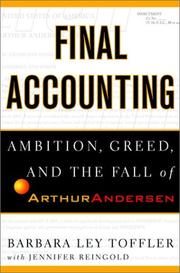
Barbara Ley Toffler · 2003

An Andersen partner on how consulting revenue corroded audit.
Rebecca Smith, John R. Emshwiller · 2003

The two Wall Street Journal reporters who broke the story.

David H. Maister · 1993

How firms that sell expertise set their ratio of juniors to partners, and price.
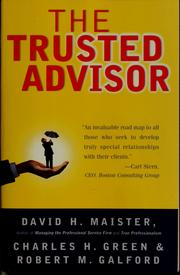
David H. Maister, Charles H. Green, Robert M. Galford · 2000

The trust equation: credibility, reliability and intimacy over self-orientation.

Recommended by: Nat Eliason

Rob Rose · 2018

Steinhoff: the largest accounting fraud in South African corporate history.

Where it sits in the reference 4

Companies
Business models
Industries
Accounting

Topics

AccountingCompany HistoriesGeneral HistoryEconomic and Business History