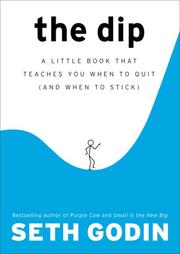
The Dip
When to push through a hard stretch and when to quit a dead end.
Summary
Godin argues that quitting is usually the correct decision and that the failure is quitting the wrong things at the wrong time. His central distinction is between a dip and a cul-de-sac. A dip is a period of difficulty that separates people who will reach mastery from those who will not, and the difficulty is what makes the reward on the other side worth having. A cul-de-sac is a situation that does not get better regardless of effort.
His argument is that the reward for getting through a dip is disproportionate, because being the best in a defined market captures most of the value while being merely good captures very little, and the dip is what keeps most competitors out.
His prescription is to quit cul-de-sacs immediately and to quit them early, freeing resources for a dip worth entering, and to decide in advance what conditions would cause you to quit a dip, before you are inside it and reasoning under pressure. He argues that most people do the opposite: they quit dips because the difficulty is uncomfortable, and they persist in cul-de-sacs because quitting feels like failure and because the situation is not painful enough to force a decision.
The book is very short, roughly eighty pages, and states its argument without evidence. The distinction between a dip and a cul-de-sac is difficult to apply in practice, since the two look identical from inside, and Godin offers no test. The instruction to decide quitting conditions in advance is the practical content and it does not require the rest of the framework.
Key takeaways 8
- Quitting is usually correct, and the failure is quitting the wrong things at the wrong time rather than quitting at all.
- A dip is difficulty that separates those who will reach mastery from those who will not, and the difficulty is what makes the reward available.
- A cul-de-sac does not improve regardless of effort, and persisting in one consumes the resources a worthwhile dip would require.
- Being the best in a defined market captures most of the available value while being merely good captures very little.
- The scarcity produced by the dip is what makes the position on the other side of it valuable.
- Quitting conditions should be decided before entering a dip, since the decision cannot be made well from inside it.
- Most people quit dips because the difficulty is uncomfortable and persist in cul-de-sacs because quitting feels like failure.
- A dip and a cul-de-sac look identical from inside, and the book provides no test for distinguishing them.
Who should read it
Founders and operators deciding whether to persist with something difficult, wanting a short direct argument for deliberate quitting.
About Seth Godin
American marketing writer, founder of Yoyodyne and Squidoo, who has published a daily marketing blog for two decades.
Permission Marketing argued for earning attention through opt-in years before that became the default of email and content marketing, and Purple Cow made remarkability the product's job rather than the advertising budget's. The Dip supplies a decision rule for when to quit a market and when the difficulty itself is the barrier worth pushing through.
Who recommended it 5 · 3 direct
“Tiny quick read with a punchy point: Anything worth doing has a painfully-hard middle period, which is where most people quit. But knowing this in advance, ask yourself seriously if you really have the dedication to stick it through that hard time. If not, then don’t begin! Quit in advance! But if so, then expect that dark dip, and don’t quit when you’re in it. Read the whole book if this applies to you. There’s not a wasted page.”
Similar books 6
Chosen by shared topics, the entries that hold them, and the people who recommended both.
Valuable work now needs people who do what can't be written into a job description.
“For someone who has a job at a company, I would call this essential reading with my highest recommendation. Since I haven't had a job since 1992, I couldn't apply many of his great points to my life. Still I loved his reminder of the value of the brilliant workers instead of systemized workers. The opposite of E-Myth (another book reviewed here).” — Derek Sivers
Source: Derek Sivers book notes (primary, rated list) · Rating: 5/10
Recommended by: Derek Sivers, Tom Bilyeu, Ann Handley and 3 others
How to get what you need from your boss, step by step.
Recommended by: Tim Ferriss
Networking advice for introverts from a former Google and Twitter executive.
Recommended by: Ryan Hoover

Run your career the way an entrepreneur runs a startup.
Recommended by: Mohnish Pabrai, Jack Dorsey and 4 others

Lessons from Fortune's 40 Under 40 on how top founders and leaders built careers.
Recommended by: Mohnish Pabrai