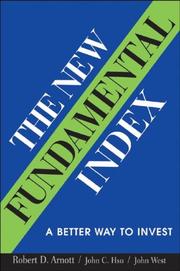
The Fundamental Index: A Better Way to Invest
Summary
Arnott, Hsu and West argue that capitalisation-weighted indices contain a structural flaw and propose weighting by fundamental measures instead.
The argument is precise. In a capitalisation-weighted index, a security's weight is proportional to its price, so any security whose price exceeds its fair value is necessarily overweighted and any security priced below fair value is underweighted. This holds regardless of whether anyone can identify which is which, and the authors show it produces a drag on returns that they estimate at one to two percent annually.
Their alternative weights holdings by fundamental measures including sales, cash flow, book value and dividends, which are not functions of price. This severs the link between price error and weight. Because these measures change slowly while prices move, the approach mechanically sells securities whose prices have risen relative to fundamentals and buys those that have fallen, which is a contrarian rebalancing.
They present backtested evidence across markets and periods showing outperformance against capitalisation-weighted indices.
The critiques are substantial. Fundamental weighting produces a systematic tilt toward value and toward smaller companies, and much of the outperformance may be that factor exposure rather than the elimination of price error, which means it is a factor strategy sold as an index. Turnover and costs are higher than pure capitalisation weighting. And the backtests were conducted over a period favourable to value. The core logical argument about price error and weight is correct regardless of the empirical dispute.
Key takeaways 7
- In a capitalisation-weighted index, weight is proportional to price, so any overpriced security is necessarily overweighted and any underpriced one underweighted.
- This structural flaw holds regardless of whether anyone can identify which securities are mispriced, which makes it an arithmetic rather than an empirical claim.
- Weighting by fundamental measures that are not functions of price severs the link between valuation error and portfolio weight.
- Because fundamentals change slowly while prices move, fundamental weighting mechanically sells what has risen and buys what has fallen.
- The authors estimate the drag from capitalisation weighting at one to two percent annually, which the empirical evidence disputes.
- Fundamental weighting produces a systematic value and size tilt, so much of the outperformance may be factor exposure rather than the mechanism claimed.
- Turnover and transaction costs are higher than pure capitalisation weighting, which reduces the net advantage.
Who should read it
Allocators evaluating alternative index construction who need the logical argument separated from the disputed empirical claims.
About Robert D. Arnott
Founder and Chairman, Research Affiliates (rebranded Syzygy Asset Management, 2026); former CEO of First Quadrant; former editor of the Financial Analysts Journal
Fundamental Indexation launched the smart-beta industry and The Fundamental Index turned it into a book that outlived its news cycle, on top of a long asset-management record.
Research Affiliates, First Quadrant, Financial Analysts Journal
Who recommended it 1 · 1 direct
Similar books 6
Chosen by shared topics, the entries that hold them, and the people who recommended both.
Vanguard's founder on costs, turnover and fund structure.
“Wonderful Book. I highly recommend all of John Bogle's writings to any investor.” — Mohnish Pabrai
Source: Mohnish's Bookshelf — Books on Investing & Capital Allocation, entry 50
Recommended by: Mohnish Pabrai, Jason Zweig and 3 others
Recommended by: Mohnish Pabrai
How speculation displaced long-term investment in markets, shown in turnover data.
“I also recommend The Clash of the Cultures by Jack Bogle” — Warren Buffett
Source: 2012 Berkshire Hathaway Shareholder Letter, p. 21
Recommended by: Mohnish Pabrai, Warren Buffett and 1 other
Recommended by: Mohnish Pabrai
Why active investing became a loser's game, decided by errors, not by skill.
“In his marvelous book, Winning the Loser's Game, Charlie Ellis says” — Bill Miller
Source: Bill Miller 2Q 2020 Market Letter
Recommended by: Bill Miller, Mohnish Pabrai, Howard Marks
Where it sits in the reference 2
Topics