Updates

  1. Fund letters lists 118 more letters, each with its own page: 44 weekly commentaries by Jeremy Siegel from 2026, 31 issues of Van Tharp's newsletter from 2018, 23 Pabrai Investment Funds letters from 2021 to Q3 2026, 13 Efficient Frontier essays by William Bernstein, Oakmark's three 3Q 2026 commentaries, two Lindsell Train reports, a John Hussman comment and Third Point's Q3 2026 letter.
  2. 2,027 more books carry a one-line description in the Books table and on their pages; 7,067 of 7,715 have one, every tier 1, 2 and 3 book among them.
  3. Fund letters lists 187 more letters from 19 firms, among them Permanent Equity, Social Capital, Lux Capital, Square Peg, Bestinver, Cobas, Sequoia Fund, Marketfield and EquityCompass; each shows on its investor's page and has a page of its own.
  4. 2,928 more books carry a one-line description in the Books table and on their pages, so every tier 1, 2 and 3 book has one; 5,040 in all.
  5. Every publication on Newsletters has its own page: its writing, its writers, its staff and who recommends it. Investor pages have a Management tab; a company's Experts tab now leaves out its own people, who list under Management. Tabs on a phone move sideways only.
  6. Every fund letter and research paper has its own page: the thesis, the PDF, the companies and books it names, and for 176 letters and 24 papers so far a summary, key insights and quotes with their page.
  7. 99 books that no page listed now sit under their topics in Books, among them Caste, American Prometheus and Pale Blue Dot.
  8. Newsletters lists every newspaper, magazine, investment newsletter, journal and blog the reference holds, 442 in all, with the people who write there. The search box keeps your last 20 searches. You can create an account.
  9. 283 books that fund managers recommend in their letters are on the shelf, each with the letter's own words and page; investor pages have a Recommends tab.
  10. Person, company, investor and show pages link their own accounts on X, Threads, Instagram, LinkedIn, YouTube and Substack: 275 people, 552 companies and organisations, 88 investors and 478 shows.
  11. 716 more book recommendations name their source: the person's own reading list, letter, blog post, speech or interview, or an article that reports it. 232 of them quote the person's own words about the book, on the book card and on the book's page.
  12. Every US-listed company has a page with its SEC filings. Company pages list their experts and their management, past and present. Fund managers sit under Investors. Each show has a page of its episodes, and an episode page names its guests and hosts. Biographies lists groups, then people. Breadcrumbs show where a page sits.
  13. Media lists every podcast episode, video, interview and talk, over 10,000, by person, company, publisher and event; each filter searches its own choices. Books opens on its table, then Browse, then Authors and Recommenders. A filter's count no longer covers its arrow.
  14. A book that no company, country or subject page lists shows its topics under Where it sits in the reference. On a phone, a page's tabs scroll sideways only. Descriptions read the same on every page. See them in the Experts tab lists every expert the page names.
  15. Every podcast episode, video and interview has its own page with a video or audio player and a link to the source. Investor pages show each company's sector and market cap; firms such as Berkshire Hathaway have one page that holds their letters and their company tabs. Letters tabs filter by company and search the theses. Companies filter by Public, Private and Defunct and link each company's website.
  16. Every tab, view and search has its own address, such as /books/table/asset or /letters/companies, so Back works and a link opens the same place. Page addresses no longer end in .html. Fund letters, Investors, Companies and Papers load about a fifth of the data they did.
  17. Fund letters has a Companies tab: every company the letters name, with its market cap, sector, country, and how many letters and investors name it. Investor pages link each investor's website. Lists in table cells end with “… and N more” at every width.
  18. 1,120 more book summaries; descriptions for 373 papers; pages for 137 more companies, each with the fund letters that discuss it; 215 official photographs; search has its own page.
  19. 411 more books have a summary; person pages list 930 more of the books they wrote; 147 people show their official photograph.
  20. Every investor has a page with its letters and the companies they discuss; company pages list the investors whose letters name them.
  21. A Companies section at the top of the rail lists every company the books, experts and fund letters name.
  22. Person pages list letters, writing, profiles and links as sortable tables with filters, and show each person's companies as links; Fund letters show each letter's description in its own column.
  23. Experts show a checked job title and a short description of each person; 30 more people have photographs.
  24. Every company, fund, university and publication the experts work for has a page listing the people there.
  25. Fund letters show each letter's thesis and filter by it; 225 person pages list the essays, columns and newsletter issues the person wrote.
  26. Person pages list every essay and newsletter issue a person wrote, and their own books as a table in List view.
  27. Recommends shows the five largest kinds of book and the rest under More; browse pictures load sooner.
  28. Podcasts and talks link the original episode, filter by Audio and video or Press, and list each publisher once.
  29. Pages are wider, Recommends has List and Grid, and a filter clicked again turns off.
  30. Book cards sit in a ruled grid with Open Library and Goodreads links and each book's one-line note.
  31. Funds is now Investors; each investor's styles are buttons that filter the table.
  32. Podcasts and talks on a person's page filter by year and publisher and show as a list or a grid of pictures.
  33. Quotes show only people's own words: 472 summaries written by list sites are gone.
  34. Country pages open from Browse again, and every link on the shelf lands on a page.
  35. Subject and person pages show their sections as tabs, and each book appears once on a person's page.
  36. Book cards show the quote, who said it and the source; grids show five cards to a row.
  37. On a phone, a menu holds the sections, search, Updates, Feedback and dark mode.
  38. Feedback takes a screenshot of the page with no browser prompt, opens a screenshot full size when you click it, and clears itself once sent.
  39. Book cards are centred, search names the topic each book sits in, and any text cut short shows whole on hover.
  40. Search groups its results by kind: people, companies, geographies, subjects, topics, books, funds, fund letters and papers.
  41. The Books table lists who recommended each book by name, and the browser tab names the section you are in.
  42. Feedback can take a screenshot of the page, or one you paste or choose, and opens in the corner beside Updates.
  43. Each rail button reopens its section where you left it, and Browse, Table and People show on every book and subject page.
  44. Filters grey out choices that hold nothing instead of hiding them, and Books › People filters by authors or recommenders.
  45. Feedback takes a subject line and up to three screenshots.
  46. Biographies are grouped by the person they are about: 41 new pages, from Abraham Lincoln to Lee Kuan Yew.
  47. Sport splits into 23 sports, and Religion into one topic per faith.
  48. Book lists show as cards: the cover, one recommendation quote and every recommender by name.
  49. Seventeen subjects that had two or three pages under different names now have one page each.
  50. Every page lists its Experts as authors and recommenders, with a link to them on the Experts tab.
  51. Economics, Financial history, Financial panics and Accounting are subjects of their own, with one page per financial crisis.
  52. Book, person and subject pages open inside the app, so the tabs stay in view.
  53. 996 more book covers, and photographs or logos for 227 more people and companies.
  54. Books › Browse shows every subject as cards, and the rail holds Fund letters, Papers, Experts, Books and Funds.
  55. Every topic over 150 books splits into narrower topics, each with a page of its own.

Send feedback

What is it?
Screenshots, up to 3 (optional)
or paste one with Ctrl+V

We use your email only to reply to you.

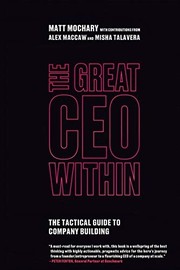
The Great CEO Within

The Great CEO Within

An operating manual for founders scaling from a few people to a few hundred.

Matt Mochary
2019
T4 202 pages · about 3h 22m to read Open Librarygoodreads

Summary

Mochary coaches technology chief executives and wrote a practical operating manual for founders scaling from a handful of people to a few hundred. It is short, organised as a reference rather than as a narrative, and available free online.

The content is procedural. He gives specific formats for board meetings, weekly executive meetings, one-on-ones, and what he calls the top goal practice, in which a person identifies one goal and spends the first hour of each day on it before anything else. He covers hiring processes including scorecards and reference checks, firing procedures with specific language, compensation frameworks, and the mechanics of running a company on objectives and key results.

Distinctive elements include his conflict resolution process, in which two people in dispute are brought together with a facilitator who requires each to state the other's position until the other agrees it is accurate; the practice of writing down all issues and having the team vote on which to discuss rather than working through an agenda; the areas of responsibility document assigning every function to a named person; and his argument that a chief executive should personally handle recruiting, fundraising and setting the vision, and delegate everything else.

The book has no evidence base and is entirely Mochary's coaching practice. It is specific to venture-funded technology companies and assumes that funding model. Some sections are lists without explanation. Its value is that it gives templates a founder can implement the same week, which most management books do not. The conflict resolution process and the areas of responsibility document are the parts most often adopted.

Key takeaways 8

  1. A chief executive should personally own recruiting, fundraising and setting direction, and delegate everything else including operations.
  2. Each person should identify a single top goal and spend the first working hour on it before responding to anything else.
  3. Every function in the company should be assigned to a single named person in a written document, so that nothing is owned by everyone.
  4. Meetings should begin with participants writing down their issues and voting on which to discuss, rather than following a prepared agenda.
  5. Conflict between two people is resolved by requiring each to state the other's position until the other confirms it is accurate.
  6. Firing decisions should be made and executed quickly once the evidence is clear, and the manager should prepare the specific language in advance.
  7. Feedback should be given within twenty-four hours of the event, because delayed feedback cannot change the behaviour that produced it.
  8. Written communication should replace meetings wherever a decision does not require live discussion, which recovers the largest block of executive time.

Who should read it

Founders scaling past thirty people who need implementable templates for meetings, hiring, conflict and responsibility assignment this week.

Who recommended it 7 · 1 direct

Ali Abdaalreported
Ryan Hooverreported

Similar books 6

Chosen by shared topics, the entries that hold them, and the people who recommended both.
Elad Gil · 2018

How to run a company as it grows from ten employees to several thousand.

Jim Collins, William C. Lazier · 2020

An expanded edition of a guide for entrepreneurs, with material from later research.

Jim Collins, William C. Lazier · 1992

How leaders turn a founder-driven startup into a company that lasts.

Recommended by: Reed Hastings
Maynard Webb · 2018

Nearly eighty letters of advice for founders on building a company.

Recommended by: Meg Whitman
Dave Ramsey · 2011

A step-by-step playbook for growing a small business, from Ramsey's own company.

“If you want to learn how to work on your business, not in it, read this.” — David Cancel

Source: The Books Every Startup CEO Should Read — David Cancel, Medium

Recommended by: David Cancel, Nick Huber
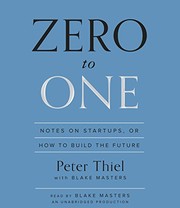
Peter Thiel, Blake Masters · 2014

Why startups should build something new and own a small market before growing.

“Inspired by modern tech classics like Zero to One and The Hard Thing About Hard Things, I wrote the book to be succinct, thorough, and accessible.” — Chris Dixon

Source: I wrote a book: Read Write Own — cdixon

Recommended by: Balaji S. Srinivasan, Chris Dixon and 36 others

Where it sits in the reference 2

Business themes
Business themes

Topics 3

LeadershipEntrepreneurship and StartupsScaling and Leading a Startup

As an Amazon Associate I earn from qualifying purchases.