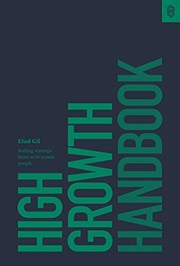
High Growth Handbook
How to run a company as it grows from ten employees to several thousand.
Operating manual for scaling a company from fifty to thousands
Summary
Gil assembles operating guidance for companies moving from roughly ten to several thousand employees, the stage he argues is least covered by existing startup writing. He worked at Google, co-founded Color Genomics, and has advised or invested in Airbnb, Coinbase, Stripe, Instacart and others, and the book draws on that specific stage of those companies.
The material covers the CEO's changing role, managing the board, hiring and organising executive teams, mergers and acquisitions, later-stage financing, and the mechanics of running a company that is doubling. The chapters on executive hiring are the most concrete, covering when to hire each functional leader, how to assess candidates who have operated at larger scale, and how to remove executives who have stopped scaling. Gil argues that most founders wait too long on both hiring and firing.
A large part of the book is interviews, including Reid Hoffman on blitzscaling, Marc Andreessen on the CEO role and board management, Claire Hughes Johnson on operations, Aaron Levie on marketing, Sam Altman on late-stage financing and Naval Ravikant on secondary sales. These give first-person detail rather than framework.
The book is a compilation, so it is uneven and repeats itself. It assumes venture-funded companies growing quickly in Silicon Valley and does not transfer well to other financing or growth models. The advice is specific to conditions between roughly 2010 and 2018, particularly on financing and on secondary markets. It is best used as a reference for a specific problem rather than read through.
Key takeaways 8
- Founders consistently hire executives too late and remove failing executives too late, and both errors compound at high growth rates.
- The CEO's job changes completely between ten and a thousand employees, and the skills that produced the early success actively obstruct the later stage.
- Hiring an executive who has operated at the next scale up is different from hiring one who has operated only at much larger scale, and the second frequently fails.
- A board should be managed actively with pre-circulated materials and no surprises, because board meetings run reactively consume the CEO's leverage.
- Organisational structure should be redesigned repeatedly during rapid growth, and treating any structure as permanent creates the next crisis.
- Acquisitions at this stage work mainly for acquiring teams and products, and the integration decision should be made before the deal rather than after.
- Allowing founders and early employees limited secondary sales reduces pressure to sell the company prematurely.
- Most late-stage financing decisions should be evaluated by the terms and the investor's behaviour in a downturn rather than by valuation.
Who should read it
Founders and executives at companies past product-market fit that are growing quickly, needing specific answers about hiring, structure and financing.
Who recommended it 12 · 2 direct
Similar books 6
Chosen by shared topics, the entries that hold them, and the people who recommended both.
Why startups should build something new and own a small market before growing.
“Inspired by modern tech classics like Zero to One and The Hard Thing About Hard Things, I wrote the book to be succinct, thorough, and accessible.” — Chris Dixon
Source: I wrote a book: Read Write Own — cdixon
Recommended by: Balaji S. Srinivasan, Chris Dixon and 38 others
When and how to put speed before efficiency to capture a market before rivals.
“A great book on blitzscaling: An insightful book on how to scale at a very fast pace and more importantly WHEN.” — Vinod Khosla
Source: 2019 Book Recommendations — Vinod Khosla, Medium
Recommended by: Vinod Khosla, Anthony Pompliano, Bill Gates and 7 others
Data on 10,000 founders: co-founders, hiring, investors, control and succession.
“The Founder’s Dilemmas by Noam Wasserman is another book that belongs on every entrepreneur’s bookshelf. It’s excellent.” — Brad Feld
Source: Book: The Founder's Dilemmas — Feld Thoughts
Recommended by: Brad Feld, Patrick Collison, Leo Polovets
How to lead a company through layoffs, near-death crises and the decision to sell.
“…books I've recommended, highlighted to death, or forced on friends.” — Andrew Wilkinson
Source: Andrew Wilkinson's Bookshelf, neverenough.com
Recommended by: Andrew Wilkinson, Balaji S. Srinivasan and 34 others
An operating framework for growing firms: priorities, data and meeting rhythm.
Recommended by: Julie Stevanja
Build, measure, learn: test what customers want with small experiments.
“There's a bunch of - I think if it's a little company, Eric Ries's book is great, The Lean Startup.” — Ben Horowitz
Recommended by: Ben Horowitz, Derek Sivers, Kathryn Minshew and 19 others
Where it sits in the reference 5
Topics 3
As an Amazon Associate I earn from qualifying purchases.