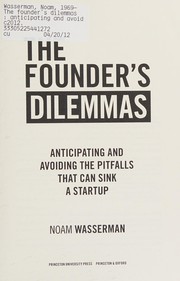
The Founder's Dilemmas
Data on 10,000 founders: co-founders, hiring, investors, control and succession.
The data on founder control, dilution and succession.
Summary
Wasserman, then at Harvard Business School, assembled data on roughly ten thousand founders and several thousand startups and used it to examine the decisions founders make about people: whether to found alone or with others, whom to choose, how to split equity, what roles to assign, when to hire, whom to take money from, and whether to remain chief executive.
The organising finding is what he calls the rich versus king trade-off. Founders who prioritise control, by staying chief executive, retaining board seats and avoiding outside investment, end up with a larger share of a smaller company. Founders who prioritise value, by bringing in professional management, accepting investor board control and diluting, end up with a smaller share of a larger company. His data shows that founders who gave up more control ended up with more valuable stakes on average, and that most founders make control decisions without recognising the trade-off.
The specific findings are useful. Equity splits agreed quickly and equally at founding correlate with later conflict, because they are made before information about contribution exists. Founding teams of prior friends and relatives are more fragile than teams of prior coworkers. Roughly half of founder chief executives are replaced within three years, and most replacements are triggered by success rather than failure, since raising capital and scaling both create pressure for professional management.
The data is from a specific period and is heavily United States technology weighted. The correlations do not establish causation, and Wasserman is generally careful about this.
Key takeaways 7
- Founders face a trade-off between control and value, and those who give up more control end up with more valuable stakes on average.
- Equity splits agreed quickly and equally at founding correlate with later conflict, because they are decided before any information about relative contribution exists.
- Founding teams formed from prior friends and family are less stable than teams formed from prior coworkers.
- Roughly half of founder chief executives are replaced within three years, and the replacement is usually triggered by success rather than failure.
- Raising outside capital transfers control incrementally and irreversibly through board composition and protective provisions rather than through share ownership alone.
- Hiring experienced executives early raises the company's capability and reduces the founder's authority, and founders consistently underestimate the second effect.
- Most founder decisions about people are made implicitly and early, and they constrain what the company can become long before anyone examines them.
Who should read it
Founders making decisions about co-founders, equity splits, hiring and investors who want data on how those choices correlate with outcomes.
Who recommended it 3 · 2 direct
“The Founder’s Dilemmas by Noam Wasserman is another book that belongs on every entrepreneur’s bookshelf. It’s excellent.”
Similar books 6
Chosen by shared topics, the entries that hold them, and the people who recommended both.
How to run a company as it grows from ten employees to several thousand.
Recommended by: Balaji S. Srinivasan, Matt Mullenweg and 10 others
When and how to put speed before efficiency to capture a market before rivals.
“A great book on blitzscaling: An insightful book on how to scale at a very fast pace and more importantly WHEN.” — Vinod Khosla
Source: 2019 Book Recommendations — Vinod Khosla, Medium
Recommended by: Vinod Khosla, Anthony Pompliano, Bill Gates and 7 others
An operating framework for growing firms: priorities, data and meeting rhythm.
Recommended by: Julie Stevanja
Why startups should build something new and own a small market before growing.
“Inspired by modern tech classics like Zero to One and The Hard Thing About Hard Things, I wrote the book to be succinct, thorough, and accessible.” — Chris Dixon
Source: I wrote a book: Read Write Own — cdixon
Recommended by: Balaji S. Srinivasan, Chris Dixon and 38 others
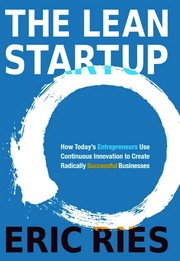
Build, measure, learn: test what customers want with small experiments.
“There's a bunch of - I think if it's a little company, Eric Ries's book is great, The Lean Startup.” — Ben Horowitz
Recommended by: Ben Horowitz, Derek Sivers, Kathryn Minshew and 19 others
Where it sits in the reference 4
Topics 3
As an Amazon Associate I earn from qualifying purchases.