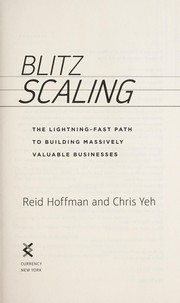
Blitzscaling
When and how to put speed before efficiency to capture a market before rivals.
Chris Yeh is co-author
Summary
Hoffman and Yeh argue for prioritising speed over efficiency under specific conditions, defining blitzscaling as rapid growth accepted deliberately in an environment of uncertainty, in order to capture a market before competitors do. They distinguish it from ordinary fast growth by the willingness to burn capital and to accept organisational damage in exchange for time.
The framework specifies when the approach applies. A market must be large, distribution must be available, gross margins must be high, network effects or other advantages must make first scale defensible, and the competitive situation must be winner-take-most. Where those conditions fail, the authors say blitzscaling destroys the company.
The operational content covers five stages, from family through tribe, village, city and nation, each roughly a tenfold increase in headcount, and describes what breaks at each transition. They give eight transitions, including from generalist to specialist, from contributor to manager, from dialogue to broadcast communication, and from inspiration to data. They also give counterintuitive rules including embracing chaos, launching a product that embarrasses you, letting fires burn, and ignoring customers at particular stages.
The book's timing has hurt it. It was published in 2018, near the top of a cycle in which capital was cheap and growth was rewarded. WeWork, Uber's early economics and a number of failed blitzscaling attempts show the approach's cost when the preconditions are absent or the capital markets close. The authors state the preconditions clearly, but readers and founders applied the method without checking them. The stage-transition material is the most durable part and applies to any fast-growing company.
Key takeaways 8
- Blitzscaling means deliberately accepting inefficiency and organisational damage to capture a market before competitors can.
- The approach applies only where the market is large, margins are high, distribution exists and first scale creates a defensible position.
- Speed matters when the winner takes most of the market, and matters very little otherwise.
- An organisation breaks at each roughly tenfold increase in size, and the management practices that worked at one stage actively fail at the next.
- Founders should hire people who fit the current stage rather than the eventual one, and should expect to replace them.
- Launching a product that embarrasses you produces information that no amount of internal refinement will.
- Some problems should be left unaddressed deliberately, because attention is the scarcest resource during rapid growth.
- Capital markets must remain open for the strategy to work, which makes blitzscaling a bet on financing conditions as much as on the market.
Who should read it
Founders and investors in winner-take-most markets who need the preconditions stated explicitly before deciding to prioritise speed over economics.
About Reid Hoffman
Co-founder and former executive chairman of LinkedIn; partner at Greylock Partners; co-founder of Inflection AI
Blitzscaling and The Start-up of You outlived their news cycles and gave the industry durable vocabulary, on top of a first-rate operating and investing record.
Who recommended it 10 · 1 direct
“A great book on blitzscaling: An insightful book on how to scale at a very fast pace and more importantly WHEN.”
Similar books 6
Chosen by shared topics, the entries that hold them, and the people who recommended both.

How to run a company as it grows from ten employees to several thousand.
Recommended by: Balaji S. Srinivasan, Matt Mullenweg and 10 others
Why startups should build something new and own a small market before growing.
“Inspired by modern tech classics like Zero to One and The Hard Thing About Hard Things, I wrote the book to be succinct, thorough, and accessible.” — Chris Dixon
Source: I wrote a book: Read Write Own — cdixon
Recommended by: Balaji S. Srinivasan, Chris Dixon and 38 others
An operating framework for growing firms: priorities, data and meeting rhythm.
Recommended by: Julie Stevanja
Data on 10,000 founders: co-founders, hiring, investors, control and succession.
“The Founder’s Dilemmas by Noam Wasserman is another book that belongs on every entrepreneur’s bookshelf. It’s excellent.” — Brad Feld
Source: Book: The Founder's Dilemmas — Feld Thoughts
Recommended by: Brad Feld, Patrick Collison, Leo Polovets
Build, measure, learn: test what customers want with small experiments.
“There's a bunch of - I think if it's a little company, Eric Ries's book is great, The Lean Startup.” — Ben Horowitz
Recommended by: Ben Horowitz, Derek Sivers, Kathryn Minshew and 19 others
How to choose a startup's metrics by its business model and its stage.
Recommended by: Marty Cagan, Michael Batko, Sean Ellis
Where it sits in the reference 6
Topics 3
As an Amazon Associate I earn from qualifying purchases.