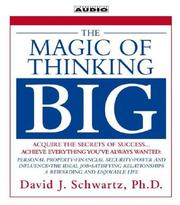
The Magic of Thinking Big
The size of your thinking sets the size of your results, and how to think bigger.
Summary
Schwartz, a marketing professor, published this in 1959 as a self-improvement manual arguing that the size of a person's thinking determines the size of their results, and that most limits people encounter are self-imposed rather than external.
The practical content covers a set of habits. Belief is treated as a mechanism rather than a sentiment, on the argument that a person who believes something is achievable generates the methods for achieving it while a person who does not stops looking. He attacks what he calls excusitis, meaning the habit of explaining current position through health, intelligence, age or luck, and gives a treatment for each. He argues for building confidence through action rather than waiting for it, using specific behaviours including sitting at the front, walking faster, speaking up first and making eye contact.
Other material covers thinking in terms of what can be added rather than what cannot be done, the argument that people are judged on the size of their thinking rather than on their qualifications, managing the environment including the people a person spends time with, and treating setbacks as information. The book has sold enormously and has influenced most subsequent self-improvement writing, including material that does not credit it.
It contains no research and the claims are asserted. Schwartz's examples are from 1950s American corporate life and the gender assumptions are of their period. Some of the advice, particularly on projecting confidence, will read as superficial. The observation that most constraints people cite are self-generated, and the treatment of belief as something that changes what a person notices and attempts, is the durable content.
Key takeaways 8
- The size of a person's thinking determines the size of their results more than their ability does.
- Belief functions as a mechanism rather than a sentiment, since a person who believes something is possible generates methods while one who does not stops looking.
- Most explanations people give for their current position, including health, intelligence, age and luck, are excuses that survive because they are unexamined.
- Confidence follows action rather than preceding it, which means the behaviours should be adopted before the feeling arrives.
- People are judged on the scale of their thinking rather than on their qualifications, which is why the same credentials produce different outcomes.
- The people a person spends time with determine the scale of what they consider possible, which makes environment a deliberate choice.
- Setbacks should be treated as information about method rather than as verdicts about capability.
- The book asserts its claims without evidence and its examples reflect 1950s American corporate life.
Who should read it
Readers who want the foundational text of modern self-improvement writing, treated as assertion rather than as evidence.
Who recommended it 6 · 5 direct
“A classic self-help book. Exactly what you'd expect. But very good.”
“The first is The Magic of Thinking Big by David Schwartz. This book was first recommended to me by Stephen Key, an ultra successful inventor who has made millions of dollars licensing products to companies like Disney, Nestle, Coca-Cola.”
Similar books 6
Chosen by shared topics, the entries that hold them, and the people who recommended both.
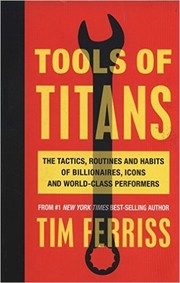
Routines, tools and advice from over 200 podcast guests on health, wealth and wisdom.
“A very useful collection of notes from hundreds of hours of Tim's podcast interviews. It's definitely a mix of thoughts and advice from a mix of people. A real collage. The first quarter of the book, full of milligram measurements of things you could be ingesting, almost made me quit, but the 2nd half of the book had some great ideas.” — Derek Sivers
Source: Derek Sivers book notes (primary, rated list) · Rating: 5/10
Recommended by: Balaji S. Srinivasan, Derek Sivers and 7 others
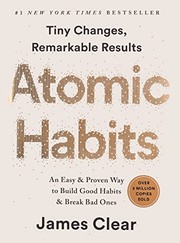
Build habits by making them obvious, attractive, easy and satisfying.
“Last October, my friend James Clear published the breakout hit book, Atomic Habits. As we both discovered in the months that followed, we have many readers in common.” — Cal Newport
Source: The Atomic Minimalist: My Conversation with James Clear
Recommended by: Ali Abdaal, Balaji S. Srinivasan and 22 others
Change behaviour by changing what you link with pain and pleasure.
“This 1992 book changed everything about my life. It's my Bible. Most of my beliefs come from it.” — Derek Sivers
Source: Book notes by Derek Sivers
Recommended by: Derek Sivers, Guy Spier, Nat Eliason and 2 others
Why to stop trying to be positive all the time and accept life's problems instead.
“The opposite of every other book. Don’t try. Give up. Be wrong. Lower your standards. Stop believing in yourself. Follow the pain. And oh yeah, kill yourself. Each point is profoundly true, useful, and more powerful than the usual positivity. Succinct but surprisingly deep, I read it in one night, then read it again a month later.” — Derek Sivers
Source: Derek Sivers book notes (primary, rated list) · Rating: 9/10
Recommended by: Derek Sivers, Nat Eliason

Seventeen common beliefs that hold people back, and the truths that replace them.
Recommended by: Mohnish Pabrai
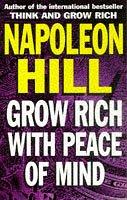
How to get what you want and enjoy peace of mind, from the author's later work.
“His first book, “Think and Grow Rich”, was a huge influence on me as a teenager. I recently heard he wrote a major update to it shortly before he died, that some say is much better. I guess my tastes have changed because though this book has good intentions, and might have made a big impact on me long ago, now I found it almost unreadably vague and had to stop. The order in which we read books really does make a big difference.” — Derek Sivers
Source: Derek Sivers book notes (primary, rated list) · Rating: 1/10
Recommended by: Derek Sivers, The Barefoot Investor