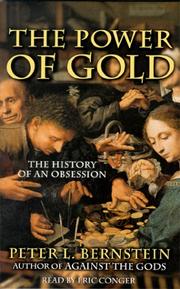
The Power of Gold: The History of an Obsession
Gold from ancient Egypt and Lydian coins to the end of Bretton Woods.
Summary
Bernstein wrote a history of gold from the ancient world through the collapse of Bretton Woods, treating it as a subject in economic and political history rather than as an investment case.
The narrative covers gold's role across many periods: Egyptian and Near Eastern accumulation, Lydian coinage, Roman debasement, medieval scarcity and the effect of the Black Death, the Spanish extraction from the Americas and the resulting price revolution in Europe, the recoinage debate in England involving Locke and Newton, the accidental establishment of the British gold standard, the nineteenth-century classical gold standard and the conditions that made it work, the American bimetallism controversy and Bryan's campaign, the interwar attempts to restore the standard including Churchill's decision on sterling parity, Bretton Woods, and the American suspension of convertibility in 1971.
The analytical thread is that gold's monetary role has repeatedly imposed costs that societies eventually refused to bear. A gold standard makes the price level depend on the accidents of mining discovery. It requires domestic deflation to correct external imbalances, which falls on wages and employment. It transfers monetary policy to whoever holds the metal. Bernstein documents each of these with specific episodes, particularly the interwar restoration, which he treats as the clearest demonstration of the costs.
He is also attentive to the psychological and political attachment that persists regardless of the economics.
The book is narrative history for general readers and does not engage the technical monetary economics literature. It is not an investment book and says nothing useful about holding gold in a portfolio. Specialists find some of the historical detail simplified. The account of the interwar period is broadly consistent with the scholarly consensus that gold standard constraints deepened the Depression.
Key takeaways 7
- A gold standard makes the price level depend on the accidents of mining discovery rather than on any policy decision.
- Correcting an external imbalance under a gold standard requires domestic deflation, which falls on wages and employment.
- Spanish extraction of American silver and gold produced a sustained price revolution in Europe rather than lasting Spanish wealth.
- The British gold standard was established through a technical decision about coinage ratios rather than by deliberate policy choice.
- Restoring sterling to its prewar gold parity in 1925 required deflation that damaged British industry and employment for a decade.
- The classical gold standard worked under conditions of political tolerance for deflation that ceased to exist after universal suffrage.
- Attachment to gold as money persisted through every demonstration of its costs, which indicates the attachment is not economic.
Who should read it
Readers who want the historical record of what monetary gold actually required of the societies that used it, rather than an investment case.
About Peter L. Bernstein
Founder, Peter L. Bernstein Inc.; founding editor of The Journal of Portfolio Management; economist and financial historian (1919-2009)
Against the Gods and Capital Ideas are the standard accounts of risk and of modern finance theory, read across the whole field.
Who recommended it 1 · 1 direct
“And right next to him I’d put Peter Bernstein (Against the Gods, The Power of Gold) and James Grant (Money of the Mind), both enormously gifted writers and friends of mine.”
Similar books 6
Chosen by shared topics, the entries that hold them, and the people who recommended both.

How the gold standard spread the Depression, and why leaving it early meant recovery.
“Eichengreen, Barry. Golden Fetters: The Gold Standard and the Great Depression, 1919–1939. New York: Oxford University Press, 1996” — Ray Dalio
Source: The Changing World Order — citations and bibliography, page 29
Recommended by: Ray Dalio

How American lending standards loosen in long cycles as the memory of losses fades.
“And right next to him I’d put Peter Bernstein (Against the Gods, The Power of Gold) and James Grant (Money of the Mind), both enormously gifted writers and friends of mine.” — John C. Bogle
Source: The Joy of Writing — Books, Ideas, Advocacy, and Idealism, page 3
Recommended by: John C. Bogle, Mohnish Pabrai, Seth Klarman and 1 other
Key academic papers on how the gold standard worked and why it broke down.
Gold's purchasing power in England and the United States across four centuries.
Interest rates from Babylonian lending through Rome and Europe to modern bonds.
“Courtesy of Homer and Sylla’s A History of Interest Rates, I’ve plotted the market price of the 5% prestiti in the 14th and 15th centuries: Even taking these stumbles into account, investors in medieval and Renaissance Europe earned healthy returns on their capital.” — William J. Bernstein
Source: Efficient Frontier, issue 901 (2001)
Recommended by: Mohnish Pabrai, William J. Bernstein
How the Federal Reserve was argued into existence, from the 1907 panic to 1913.
Recommended by: Seth Klarman