Updates

  1. Person pages list letters, writing, profiles and links as sortable tables with filters, and show each person's companies as links; Fund letters show each letter's description in its own column.
  2. Experts show a checked job title and a short description of each person; 30 more people have photographs.
  3. Every company, fund, university and publication the experts work for has a page listing the people there.
  4. Fund letters show each letter's thesis and filter by it; 225 person pages list the essays, columns and newsletter issues the person wrote.
  5. Person pages list every essay and newsletter issue a person wrote, and their own books as a table in List view.
  6. Recommends shows the five largest kinds of book and the rest under More; browse pictures load sooner.
  7. Podcasts and talks link the original episode, filter by Audio and video or Press, and list each publisher once.
  8. Pages are wider, Recommends has List and Grid, and a filter clicked again turns off.
  9. Book cards sit in a ruled grid with Open Library and Goodreads links and each book's one-line note.
  10. Funds is now Investors; each investor's styles are buttons that filter the table.
  11. Podcasts and talks on a person's page filter by year and publisher and show as a list or a grid of pictures.
  12. Quotes show only people's own words: 472 summaries written by list sites are gone.
  13. Country pages open from Browse again, and every link on the shelf lands on a page.
  14. Subject and person pages show their sections as tabs, and each book appears once on a person's page.
  15. Book cards show the quote, who said it and the source; grids show five cards to a row.
  16. On a phone, a menu holds the sections, search, Updates, Feedback and dark mode.
  17. Feedback takes a screenshot of the page with no browser prompt, opens a screenshot full size when you click it, and clears itself once sent.
  18. Book cards are centred, search names the topic each book sits in, and any text cut short shows whole on hover.
  19. Search groups its results by kind: people, companies, geographies, subjects, topics, books, funds, fund letters and papers.
  20. The Books table lists who recommended each book by name, and the browser tab names the section you are in.
  21. Feedback can take a screenshot of the page, or one you paste or choose, and opens in the corner beside Updates.
  22. Each rail button reopens its section where you left it, and Browse, Table and People show on every book and subject page.
  23. Filters grey out choices that hold nothing instead of hiding them, and Books › People filters by authors or recommenders.
  24. Feedback takes a subject line and up to three screenshots.
  25. Biographies are grouped by the person they are about: 41 new pages, from Abraham Lincoln to Lee Kuan Yew.
  26. Sport splits into 23 sports, and Religion into one topic per faith.
  27. Book lists show as cards: the cover, one recommendation quote and every recommender by name.
  28. Seventeen subjects that had two or three pages under different names now have one page each.
  29. Every page lists its Experts as authors and recommenders, with a link to them on the Experts tab.
  30. Economics, Financial history, Financial panics and Accounting are subjects of their own, with one page per financial crisis.
  31. Book, person and subject pages open inside the app, so the tabs stay in view.
  32. 996 more book covers, and photographs or logos for 227 more people and companies.
  33. Books › Browse shows every subject as cards, and the rail holds Fund letters, Papers, Experts, Books and Funds.
  34. Every topic over 150 books splits into narrower topics, each with a page of its own.

Send feedback

What is it?
Screenshots, up to 3 (optional)
or paste one with Ctrl+V

We use your email only to reply to you.

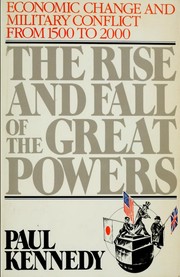
The Rise and Fall of the Great Powers

The Rise and Fall of the Great Powers

Paul Kennedy
1987
T4 706 pages · about 11h 46m to read Open Librarygoodreads

Military spending measured against the economy that has to carry it.

Summary

Kennedy examines the great powers from 1500 to the late twentieth century and argues that a power's international position is determined by its relative economic position, and that powers decline when their military and strategic commitments exceed what their economic base can support. He calls this imperial overstretch.

The historical work covers Habsburg Spain, the Netherlands, France, Britain, Germany, Russia, Japan and the United States, with detailed attention to the economics of war finance, industrial production, population and relative shares of world manufacturing output. He assembles comparative economic data across five centuries and shows the pattern repeating: a power's rise rests on economic growth, that growth funds military expansion and commitments, the commitments become permanent while the relative economic position erodes as other powers grow faster, and the resulting gap is closed either by retrenchment or by defeat.

The final chapter applied the argument to the United States in the 1980s and predicted relative decline, which is what made the book famous and what has been most criticised. The Soviet Union collapsed instead, and American relative economic position improved through the 1990s. Kennedy's defenders point out that he argued about relative shares over long periods rather than making a short-term prediction, and that the underlying data on American share of world output has in fact declined as he described. The book remains the standard reference on the relationship between economic base and strategic commitment, and its comparative data is its most durable contribution.

Key takeaways 7

  1. A great power's international position is determined by its relative rather than absolute economic strength, so a growing power can decline if others grow faster.
  2. Powers decline when strategic and military commitments exceed what the economic base can sustain, and commitments are far harder to reduce than to acquire.
  3. Military spending diverts capital and skilled labour from productive investment, which accelerates the erosion of the economic base that funds it.
  4. The pattern of overextension repeats across Habsburg Spain, Bourbon France, Britain and the Soviet Union with the same mechanism in each case.
  5. Wars between great powers are decided by productive capacity and financial staying power more than by initial military advantage.
  6. Relative shares of world manufacturing output are the best available leading indicator of shifts in international position.
  7. A declining power's most difficult problem is political rather than economic, because reducing commitments requires admitting a change in status.

Who should read it

Macro investors and strategists who want the standard analysis of how economic base and strategic commitment interact over long periods.

Who recommended it 2 · 1 direct

“The River Out of Eden by Richard Dawkins, The Rise and Fall of the Great Powers by Paul Kennedy”

Michael Wongreported

Similar books 6

Chosen by shared topics, the entries that hold them, and the people who recommended both.

Edward Fishman · 2025

How the US made sanctions and economic warfare its main tool of coercion.
Peter Zeihan · 2014

How geography, demography and shale energy set America up to dominate as others age.

Recommended by: Mohnish Pabrai
Peter Zeihan · 2022

Why the US-guarded trading order is ending, and what that means for supply chains.

Recommended by: Andrew Wilkinson
Parag Khanna · 2019

Asia as one order from Saudi Arabia to Japan, linking five billion people by trade.

Recommended by: Balaji S. Srinivasan
Where it sits in the reference 2

Secular themes
Economics

Topics

General HistoryPolitics and GovernmentEconomicsWorld and Big HistoryGeopolitics and international relations