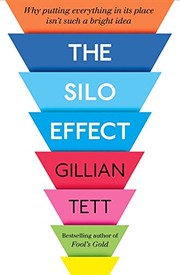
The Silo Effect
How the way organisations divide work blinds them, and how some break down silos.
How organisational silos hide risk; an anthropologist inside banks
Summary
Tett applies her anthropological training to the problem of organisational silos, arguing that the classification systems organisations use to divide work also determine what they are able to see, and that the resulting blindness causes failures that appear inexplicable afterward.
Her theoretical basis is Bourdieu's work on classification and habitus, and her argument is that the categories an organisation adopts become invisible to the people inside it, so that questions falling between categories are not asked by anyone. She uses this to explain UBS's failure to see that its own trading desks held the securities its risk reports treated as sold, and the Bank of England's pre-crisis structure in which financial stability and monetary policy were separate functions that did not share information.
The positive cases are the more interesting half. She examines Facebook's deliberate anti-silo practices including rotation programmes and hackathons, Cleveland Clinic's reorganisation of departments around patient conditions rather than medical specialties, the Chicago police department's use of crime data across jurisdictional boundaries, and a Sony history in which internal competition between divisions prevented the company from producing a networked music product.
The book is journalism informed by theory rather than research, the cases are selected to fit, and the anthropological framing is applied more loosely here than in Fool's Gold. The central observation is correct and useful, and the practical suggestions, principally staff rotation, flexible boundaries, shared data and periodic reclassification, are sensible without being demonstrated.
Key takeaways 7
- The classification system an organisation uses to divide work determines what it is able to see, and questions falling between categories are asked by nobody.
- Silos are invisible to the people inside them because the categories feel natural rather than chosen.
- UBS held securities its own risk reports treated as sold, because the trading and risk functions used different classifications of the same positions.
- Rotating staff between functions is the most effective practical countermeasure, because it moves knowledge that documents cannot carry.
- Reorganising around the customer's problem rather than around internal specialties changes what an organisation notices, as Cleveland Clinic's condition-based departments demonstrate.
- Internal competition between divisions can prevent a company from building products that require the divisions to cooperate.
- Classification systems should be revisited periodically, since a structure that fits one period's problems obscures the next period's.
Who should read it
Executives worried about what their organisational structure prevents them from seeing, with practical countermeasures drawn from case examples.
About Gillian Tett
Financial Times columnist and editorial board member, and Provost of King's College, Cambridge; trained as a social anthropologist.
Fool's Gold follows credit derivatives from the J.P. Morgan team that designed them to the losses of 2008, showing how an instrument built to transfer risk was used instead to add leverage. The Silo Effect applies anthropological fieldwork to organisations, examining why specialised teams inside banks and technology firms stop passing information to each other.
Who recommended it 1 · 1 direct
Similar books 6
Chosen by shared topics, the entries that hold them, and the people who recommended both.
How bureaucratic corporations shape managers' personal ethics.
Recommended by: Patrick Collison
A series on office life through The Office: sociopaths, clueless managers and losers.
Recommended by: Nat Eliason
How fixation on measured performance damages the work it is meant to improve.
How the economy became a black box of systems that no one understands.
Recommended by: Andrew Wilkinson
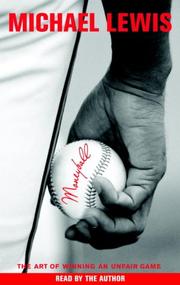
How the Oakland A's won on a small payroll by buying players the market undervalued.
“Moneyball by Michael Lewis was a great example of how a baseball team could be successfully constructed using principles that were very similar to those used by value investors.” — Bill Nygren
Source: Bill Nygren Market Commentary | 1Q14
Recommended by: Bill Nygren, Jim Collins, Joel Greenblatt and 5 others
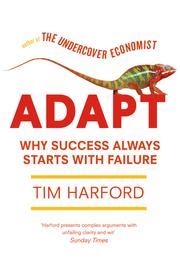
Complex problems yield to trial and error, not expert plans, and how to run it.
“There is a book I recently ran into by Tim Hartford called Adapt. That’s another kind of fun read; I thought that was pretty good.” — Mohnish Pabrai
Source: Pabrai Investment Funds Annual Meeting Transcript 2011, page 48
Recommended by: Mohnish Pabrai, Patrick O'Shaughnessy
Where it sits in the reference 4
Topics 3
As an Amazon Associate I earn from qualifying purchases.