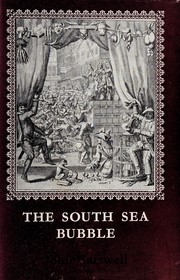
The South Sea Bubble
How the South Sea Company's scheme worked, inflated and collapsed.
The standard account of 1720.
Summary
John Carswell wrote the standard modern history of the South Sea Bubble of 1720, using parliamentary records, company documents and correspondence.
The scheme's mechanics are the substance. The South Sea Company was created in 1711 to take over a portion of the British government's unfunded debt in exchange for annual interest and a monopoly on trade with Spanish America, which never produced meaningful commerce. In 1720 the company proposed to take over the great majority of the remaining national debt: holders of government annuities would exchange them for company shares at a conversion rate determined by the share price, so that the higher the share price, the fewer shares the company needed to issue and the more remained available for it to sell. This gave the directors a direct interest in driving the price up, and Carswell documents how they did it, including lending money to buyers of the stock and distributing shares to politicians on terms that guaranteed profit.
The collapse, the parliamentary inquiry, the confiscation of directors' estates and the political consequences including Robert Walpole's rise are covered in detail. Carswell also covers the parallel Mississippi scheme in France and the relationship between them. The book is scholarly and its explanation of the conversion mechanism is the clearest available; most popular accounts of the bubble do not explain why the share price mattered to the company's own economics.
Key takeaways 7
- The conversion terms meant that a higher share price let the company retire the same debt with fewer shares, which gave directors a direct interest in inflating it.
- The company's Spanish American trading monopoly, which was its nominal business, never produced meaningful commerce.
- Directors lent money to buyers of the company's own stock, which manufactured demand with the company's own resources.
- Shares were distributed to politicians on terms that guaranteed profit, which purchased the legislation the scheme required.
- The scheme was a debt conversion whose entire economics depended on the market price of the converting security.
- Parliament confiscated the directors' estates afterward, which is a resolution mechanism no subsequent bubble has produced.
- Carswell's explanation of the conversion mechanism is clearer than the popular accounts, which usually omit why the share price mattered to the company.
Who should read it
Investors and financial historians who want the mechanism of the first great speculative collapse rather than the anecdotes about it.
Similar books 6
Chosen by shared topics, the entries that hold them, and the people who recommended both.
John Law, the Mississippi bubble and the birth of paper money in France.

The Dutch tulip episode of 1636 and 1637 from archives, and how its legend arose.
John Law as a monetary theorist, beyond the Mississippi Company and its collapse.
The South Sea Bubble re-examined from investors' side: were they rational?
Recommended by: Patrick O'Shaughnessy
The 1929 Wall Street crash: the greed and folly behind America's greatest collapse.
“The Lessons of 1929 The best investing book I’ve read in years, one that pulled me along from chapter to chapter, is 1929: Inside the Greatest Crash in Wall Street History – and How It Shattered a Nation, by Andrew Ross Sorkin.” — Howard Marks
Source: What’s Going on in Private Credit?
Recommended by: Bill Gates, Howard Marks
Interest rates from Babylonian lending through Rome and Europe to modern bonds.
“Courtesy of Homer and Sylla’s A History of Interest Rates, I’ve plotted the market price of the 5% prestiti in the 14th and 15th centuries: Even taking these stumbles into account, investors in medieval and Renaissance Europe earned healthy returns on their capital.” — William J. Bernstein
Source: Efficient Frontier, issue 901 (2001)
Recommended by: Mohnish Pabrai, William J. Bernstein