Updates

  1. Person pages list letters, writing, profiles and links as sortable tables with filters, and show each person's companies as links; Fund letters show each letter's description in its own column.
  2. Experts show a checked job title and a short description of each person; 30 more people have photographs.
  3. Every company, fund, university and publication the experts work for has a page listing the people there.
  4. Fund letters show each letter's thesis and filter by it; 225 person pages list the essays, columns and newsletter issues the person wrote.
  5. Person pages list every essay and newsletter issue a person wrote, and their own books as a table in List view.
  6. Recommends shows the five largest kinds of book and the rest under More; browse pictures load sooner.
  7. Podcasts and talks link the original episode, filter by Audio and video or Press, and list each publisher once.
  8. Pages are wider, Recommends has List and Grid, and a filter clicked again turns off.
  9. Book cards sit in a ruled grid with Open Library and Goodreads links and each book's one-line note.
  10. Funds is now Investors; each investor's styles are buttons that filter the table.
  11. Podcasts and talks on a person's page filter by year and publisher and show as a list or a grid of pictures.
  12. Quotes show only people's own words: 472 summaries written by list sites are gone.
  13. Country pages open from Browse again, and every link on the shelf lands on a page.
  14. Subject and person pages show their sections as tabs, and each book appears once on a person's page.
  15. Book cards show the quote, who said it and the source; grids show five cards to a row.
  16. On a phone, a menu holds the sections, search, Updates, Feedback and dark mode.
  17. Feedback takes a screenshot of the page with no browser prompt, opens a screenshot full size when you click it, and clears itself once sent.
  18. Book cards are centred, search names the topic each book sits in, and any text cut short shows whole on hover.
  19. Search groups its results by kind: people, companies, geographies, subjects, topics, books, funds, fund letters and papers.
  20. The Books table lists who recommended each book by name, and the browser tab names the section you are in.
  21. Feedback can take a screenshot of the page, or one you paste or choose, and opens in the corner beside Updates.
  22. Each rail button reopens its section where you left it, and Browse, Table and People show on every book and subject page.
  23. Filters grey out choices that hold nothing instead of hiding them, and Books › People filters by authors or recommenders.
  24. Feedback takes a subject line and up to three screenshots.
  25. Biographies are grouped by the person they are about: 41 new pages, from Abraham Lincoln to Lee Kuan Yew.
  26. Sport splits into 23 sports, and Religion into one topic per faith.
  27. Book lists show as cards: the cover, one recommendation quote and every recommender by name.
  28. Seventeen subjects that had two or three pages under different names now have one page each.
  29. Every page lists its Experts as authors and recommenders, with a link to them on the Experts tab.
  30. Economics, Financial history, Financial panics and Accounting are subjects of their own, with one page per financial crisis.
  31. Book, person and subject pages open inside the app, so the tabs stay in view.
  32. 996 more book covers, and photographs or logos for 227 more people and companies.
  33. Books › Browse shows every subject as cards, and the rail holds Fund letters, Papers, Experts, Books and Funds.
  34. Every topic over 150 books splits into narrower topics, each with a page of its own.

Send feedback

What is it?
Screenshots, up to 3 (optional)
or paste one with Ctrl+V

We use your email only to reply to you.

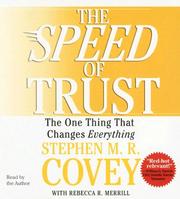
The Speed of Trust

The Speed of Trust

Stephen Covey
2006
T2 384 pages · about 6h 24m to read Open Librarygoodreads

Summary

Stephen M R Covey, the son of the author of The Seven Habits of Highly Effective People, argues that trust is an economic variable with measurable effects on cost and speed. His central formula is that low trust raises transaction costs and slows decisions, which he calls a tax, while high trust does the reverse, which he calls a dividend.

The framework has four parts he calls the cores of credibility. Integrity means acting consistently with stated values. Intent means having motives others can accept. Capabilities means having the skills the situation requires. Results means a track record of delivery. He argues that integrity and intent govern character while capabilities and results govern competence, and that trust requires all four, because a well-intentioned incompetent and a capable liar both fail to earn it.

He then sets out thirteen behaviours that build trust, including talking straight, demonstrating respect, creating transparency, righting wrongs, showing loyalty to the absent, delivering results, confronting reality, clarifying expectations, practising accountability, listening first, keeping commitments and extending trust to others. He organises the analysis into five expanding contexts he calls waves, running from self-trust to relationship, organisational, market and societal trust.

The economic claim is asserted with illustrative figures rather than demonstrated. Covey cites studies on trust and firm performance selectively, and the causal direction is not established: successful firms may generate trust as much as trust generates success. The framework's practical value is as a diagnostic vocabulary for teams, and the behaviour list is genuinely usable. The book is repetitive and heavily branded.

Key takeaways 7

  1. Low trust functions as a tax on every transaction by adding verification cost and slowing decisions.
  2. Trust requires both character and competence, so good intentions without delivery do not produce it.
  3. Integrity means consistency between stated values and behaviour, which is observable and can be audited.
  4. Extending trust to others is itself a behaviour that generates trust, and withholding it guarantees the low-trust outcome.
  5. Speaking about absent colleagues as you would in their presence is the single most diagnostic trust behaviour.
  6. Clarifying expectations in advance prevents most of the failures that get attributed to bad faith.
  7. Restoring trust after a breach requires acknowledging the specific harm rather than apologising in general terms.

Who should read it

Leaders who need a shared vocabulary and a behaviour checklist for diagnosing trust problems inside a team, treating the economic claims as framing rather than evidence.

About Stephen Covey

American leadership author and educator who founded the Covey Leadership Center, later merged into FranklinCovey.

The 7 Habits of Highly Effective People organises personal effectiveness around principles rather than techniques, and its working parts - the circle of influence, the urgency-importance quadrants, begin with the end in mind, think win-win - entered standard managerial vocabulary. Principle-Centered Leadership applies the same framework at organisational scale.

Covey Leadership Center

Who recommended it 1

John Maedareported

Similar books 6

Chosen by shared topics, the entries that hold them, and the people who recommended both.

Stephen Covey · 1989

Applies the Seven Habits to organisations: lead by fixed principles, not by values.

Recommended by: Mohnish Pabrai

Frank Slootman · 2021

How leaders drive hypergrowth by raising standards, focus and urgency.

William J. O'Neil · 2003

Compiled from Investor's Business Daily profiles.
Fred Kofman · 2002

Seven qualities, such as unconditional responsibility, of people who make firms work.

Recommended by: Reid Hoffman, Sheryl Sandberg

Where it sits in the reference 3

Journalists
Business themes
Business themes

Topics

LeadershipBusiness and Management