Updates

  1. Person pages list letters, writing, profiles and links as sortable tables with filters, and show each person's companies as links; Fund letters show each letter's description in its own column.
  2. Experts show a checked job title and a short description of each person; 30 more people have photographs.
  3. Every company, fund, university and publication the experts work for has a page listing the people there.
  4. Fund letters show each letter's thesis and filter by it; 225 person pages list the essays, columns and newsletter issues the person wrote.
  5. Person pages list every essay and newsletter issue a person wrote, and their own books as a table in List view.
  6. Recommends shows the five largest kinds of book and the rest under More; browse pictures load sooner.
  7. Podcasts and talks link the original episode, filter by Audio and video or Press, and list each publisher once.
  8. Pages are wider, Recommends has List and Grid, and a filter clicked again turns off.
  9. Book cards sit in a ruled grid with Open Library and Goodreads links and each book's one-line note.
  10. Funds is now Investors; each investor's styles are buttons that filter the table.
  11. Podcasts and talks on a person's page filter by year and publisher and show as a list or a grid of pictures.
  12. Quotes show only people's own words: 472 summaries written by list sites are gone.
  13. Country pages open from Browse again, and every link on the shelf lands on a page.
  14. Subject and person pages show their sections as tabs, and each book appears once on a person's page.
  15. Book cards show the quote, who said it and the source; grids show five cards to a row.
  16. On a phone, a menu holds the sections, search, Updates, Feedback and dark mode.
  17. Feedback takes a screenshot of the page with no browser prompt, opens a screenshot full size when you click it, and clears itself once sent.
  18. Book cards are centred, search names the topic each book sits in, and any text cut short shows whole on hover.
  19. Search groups its results by kind: people, companies, geographies, subjects, topics, books, funds, fund letters and papers.
  20. The Books table lists who recommended each book by name, and the browser tab names the section you are in.
  21. Feedback can take a screenshot of the page, or one you paste or choose, and opens in the corner beside Updates.
  22. Each rail button reopens its section where you left it, and Browse, Table and People show on every book and subject page.
  23. Filters grey out choices that hold nothing instead of hiding them, and Books › People filters by authors or recommenders.
  24. Feedback takes a subject line and up to three screenshots.
  25. Biographies are grouped by the person they are about: 41 new pages, from Abraham Lincoln to Lee Kuan Yew.
  26. Sport splits into 23 sports, and Religion into one topic per faith.
  27. Book lists show as cards: the cover, one recommendation quote and every recommender by name.
  28. Seventeen subjects that had two or three pages under different names now have one page each.
  29. Every page lists its Experts as authors and recommenders, with a link to them on the Experts tab.
  30. Economics, Financial history, Financial panics and Accounting are subjects of their own, with one page per financial crisis.
  31. Book, person and subject pages open inside the app, so the tabs stay in view.
  32. 996 more book covers, and photographs or logos for 227 more people and companies.
  33. Books › Browse shows every subject as cards, and the rail holds Fund letters, Papers, Experts, Books and Funds.
  34. Every topic over 150 books splits into narrower topics, each with a page of its own.

Send feedback

What is it?
Screenshots, up to 3 (optional)
or paste one with Ctrl+V

We use your email only to reply to you.

Principle Centered Leadership

Principle Centered Leadership

Stephen Covey
1989
T2 334 pages · about 5h 34m to read Open Librarygoodreads

Summary

Covey extends the framework from The Seven Habits of Highly Effective People to organisations, arguing that effectiveness at every level rests on alignment with principles he treats as objective and external rather than as values a person or company chooses.

His structure covers four levels, each with a governing principle. Personal effectiveness rests on trustworthiness, meaning character combined with competence. Interpersonal effectiveness rests on trust, which he argues cannot be created directly but follows from trustworthiness demonstrated over time. Managerial effectiveness rests on empowerment, which he defines specifically as agreements in which the desired result, the guidelines, the available resources, the accountability and the consequences are all stated in advance, so that supervision becomes unnecessary. And organisational effectiveness rests on alignment, meaning that structure, systems, compensation and reporting all reinforce the same principles rather than contradicting them.

His practical argument about organisations is that stated values fail when the systems contradict them, and that the systems always win. A company that says it values teamwork while compensating individual performance has decided against teamwork whatever it says.

Covey's claim that the principles are objective and external is asserted rather than argued, and the framework is unfalsifiable in the way most leadership frameworks are. There is no empirical basis. The material on stewardship agreements and on systems contradicting stated values is the most usable and does not depend on the philosophical claim.

Key takeaways 7

  1. Trust cannot be created directly and follows from trustworthiness, which is character combined with competence demonstrated over time.
  2. Empowerment means an agreement stating the desired result, guidelines, resources, accountability and consequences in advance, which makes supervision unnecessary.
  3. Stated organisational values fail when the compensation and reporting systems contradict them, and the systems always determine behaviour.
  4. A company that says it values teamwork while compensating individual performance has decided against teamwork regardless of what it states.
  5. Alignment means structure, systems, compensation and reporting all reinforce the same principles, and misalignment anywhere undermines everything.
  6. Effectiveness at the organisational level cannot be achieved without effectiveness at the personal and interpersonal levels beneath it.
  7. Problems attributed to people are usually problems with the systems those people operate within.

Who should read it

Executives interested in aligning organisational systems with stated values and in structuring delegation agreements.

About Stephen Covey

American leadership author and educator who founded the Covey Leadership Center, later merged into FranklinCovey.

The 7 Habits of Highly Effective People organises personal effectiveness around principles rather than techniques, and its working parts - the circle of influence, the urgency-importance quadrants, begin with the end in mind, think win-win - entered standard managerial vocabulary. Principle-Centered Leadership applies the same framework at organisational scale.

Covey Leadership Center

Who recommended it 1 · 1 direct

Similar books 6

Chosen by shared topics, the entries that hold them, and the people who recommended both.
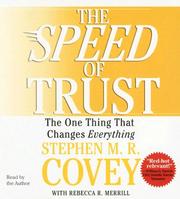
Stephen Covey · 2006

Trust as an economic variable: low trust adds cost and slows everything.

Recommended by: John Maeda

Fred Kofman · 2018

Leadership treated as the creation of meaning inside organisations

Recommended by: Reid Hoffman

Keshavan Nair · 1994

Gandhi's principles restated as a leadership standard for executives

Recommended by: Mohnish Pabrai

Where it sits in the reference 3

Journalists
Business themes
Business themes

Topics

LeadershipPhilosophyPhilosophy of science and mind