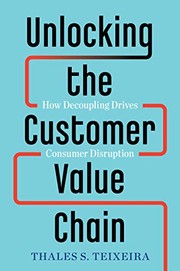
Unlocking the Customer Value Chain
Disruptors win by breaking one link in the customer's chain of activities.
Decoupling: how entrants steal the profitable step in a customer's chain.
Summary
Thales Teixeira, formerly of Harvard Business School, argues that most successful digital disruption does not come from superior technology but from breaking a link in the sequence of activities a customer performs. His term for this is decoupling.
His framework describes the customer value chain as the steps a consumer takes: evaluating options, choosing, purchasing, consuming, and disposing. Incumbent businesses bundle these steps and monetise some while providing others as a cost of doing business. A decoupler takes one step and does it better, leaving the incumbent with the steps that cost money and none of the ones that make it. Showrooming is the clearest case: a customer evaluates a television in a physical store and buys it online, which separates the evaluation the retailer pays for from the purchase it earns from.
Teixeira classifies decoupling into value-creating, value-capturing and value-eroding types, and works through cases including Amazon against Best Buy, Netflix against cable bundles, Birchbox against cosmetics counters, and mobile services against banks. His prescriptions for incumbents are to identify which link is vulnerable, to rebalance what is charged for against what is given away, and either to rebundle by making the separated steps interdependent again or to acquire the decoupler. The framework is genuinely useful for analysing where a business is exposed. The cases are selected on outcomes and the classification requires judgement that is easier applied retrospectively.
Key takeaways 7
- Most successful digital disruption breaks a link in the customer's sequence of activities rather than introducing superior technology.
- Incumbents bundle customer activities and monetise some while supplying others as a cost, which is what makes them vulnerable.
- A decoupler takes the profitable step and leaves the incumbent with the costly ones, which is why revenue falls faster than volume.
- Showrooming separates the evaluation a retailer pays for from the purchase it earns from, and is the clearest illustration.
- Incumbents should identify which link is vulnerable and rebalance what they charge for against what they supply free.
- Rebundling means making separated steps interdependent again so that taking one requires taking the others.
- The cases are selected on outcomes and the classification is easier to apply retrospectively than in prospect.
Who should read it
Operators in incumbent businesses assessing where they are exposed to digital entrants, and founders looking for which link to break.
Similar books 6
Chosen by shared topics, the entries that hold them, and the people who recommended both.

Without shelf limits, sales of many niche products add up to rival the hits.
“also Chris Anderson, The Long Tail: Why the Future of Business Is Selling Less of More (New York: Hyperion, 2006), 121” — Michael Mauboussin
Source: Was Harry Potter Inevitable? Cumulative Advantage, Counterfactuals, and the Halo Effect, page 10
Recommended by: Jim Collins, Michael Mauboussin, Ev Williams and 2 others
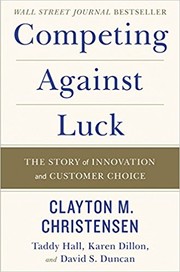
Customers hire products to do a job; innovate by finding the job, not the buyer type.
“Clayton M. Christensen, Taddy Hall, Karen Dillon, and David S. Duncan, Competing Against Luck: The Story of Innovation and Customer Choice (New York: HarperBusiness, 2016)” — Michael Mauboussin
Source: Measuring the Moat: Assessing the Magnitude and Sustainability of Value Creation, page 64
Recommended by: Michael Mauboussin
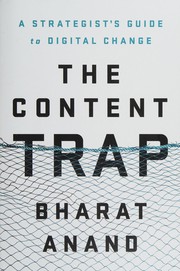
Media firms fail by fixating on content when value lies in the connections around it.
Why social tools should be the backbone of a business model, not just its media.
Recommended by: Kathryn Minshew
Forecasts of how information technology and biotechnology will change business.
Recommended by: Mohnish Pabrai
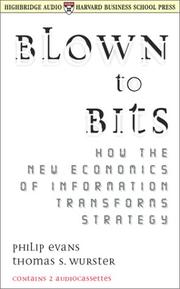
How the new economics of information ends the trade-off between richness and reach.
“Evans, Philip, and Thomas S. Wurster, Blown to Bits: How the New Economics of Information Transforms Strategy (Boston: Harvard Business School Press, 1999)” — Michael Mauboussin
Source: Measuring the Moat: Assessing the Magnitude and Sustainability of Value Creation, page 48
Recommended by: Michael Mauboussin, Mohnish Pabrai