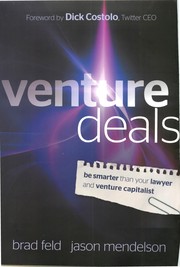
Venture Deals
Multiple editions since 2011; grew out of the 2005 term sheet series
Summary
Feld and Mendelson, who founded Foundry Group, explain venture financing mechanics term by term, aimed at founders negotiating their first rounds. It is the standard reference on the subject.
The book divides terms into economics and control, which is the organising insight. Economic terms include price and the pre-money and post-money distinction, the option pool and how its placement affects the effective valuation, liquidation preferences including participation and multiples, pay-to-play provisions, vesting including acceleration on change of control, and anti-dilution provisions with the arithmetic for weighted average and full ratchet. Control terms include board composition, protective provisions and what each veto covers, drag-along rights, and conversion rights.
They also cover the structure of venture funds and how fund economics shape investor behaviour, the mechanics of raising including how to approach investors and what a term sheet negotiation actually involves, letters of intent for acquisitions, and the negotiation dynamics including the argument that founders should focus on price and control and concede almost everything else. Each term is explained with the investor's rationale, the founder's exposure and the authors' view of what is standard and what is aggressive.
The book has been revised across multiple editions to track changing practice, and terms have shifted since any given edition. It is specific to United States venture practice and does not transfer to other jurisdictions without adjustment. It is written by investors, so the assessment of what is reasonable reflects that position. It remains the most complete term-by-term explanation available to founders.
Key takeaways 8
- Term sheets divide into economic terms and control terms, and founders consistently overweight the first while the second determines outcomes.
- The option pool is usually created before the investment, which dilutes existing shareholders and reduces the effective pre-money valuation.
- Liquidation preference determines who receives what at every exit value except the largest, and participation changes the founder outcome substantially.
- Anti-dilution provisions govern what happens in a down round, and full ratchet transfers far more from founders than weighted average.
- Protective provisions give investors vetoes over specific actions independent of their ownership percentage or board seats.
- Board composition determines most decisions the company will face before an exit, which makes it more consequential than ownership share.
- Fund economics including the ten-year life and the carry structure explain investor behaviour that otherwise appears arbitrary to founders.
- Founders should concentrate negotiation on price and control and concede most other terms, since attention spent elsewhere costs leverage.
Who should read it
Founders negotiating venture rounds who need a term-by-term reference, written by investors and specific to United States practice.
About Brad Feld
Co-founder of Foundry Group and Techstars; earlier co-founder of Intensity Ventures and Mobius Venture Capital
Venture Deals is the standard practitioner reference on term sheets and Startup Communities named a field; both long outlived the blog posts they grew from.
Foundry Group, Techstars, Intensity Ventures, Mobius Venture Capital
Who recommended it 7 · 1 direct
Similar books 6
Chosen by shared topics, the entries that hold them, and the people who recommended both.

How venture capital works, from fund economics to term sheets, for founders.
Recommended by: Benedict Evans, Eric Schmidt, Gaby Goldberg and 2 others
Why startups should build something new and own a small market before growing.
Recommended by: Balaji S. Srinivasan, Eric Weinstein and 36 others
Georges Doriot, who showed that investing in small, risky firms could pay.
Recommended by: Patrick Collison
Venture capital from Arthur Rock to SoftBank, and why a few big bets pay for all.
Recommended by: Andrew Wilkinson, Anthony Pompliano and 4 others
Where it sits in the reference 4
Topics