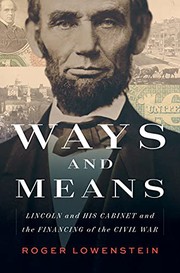
Ways and Means: Lincoln and His Cabinet and the Financing of the Civil War
How Lincoln's Union financed the Civil War and transformed the American state.
Summary
Roger Lowenstein examines how the Union financed the Civil War and argues that the financial measures adopted transformed the American state more permanently than the military outcome did.
The measures were extraordinary for a government that had previously done almost nothing. Salmon Chase, the Treasury Secretary, issued greenbacks, paper money not convertible into specie, which was the first national currency; Congress imposed the first federal income tax; the National Banking Acts created a system of federally chartered banks required to hold government bonds against their note issue, which created a market for the debt and a uniform currency simultaneously; and Jay Cooke sold bonds directly to hundreds of thousands of ordinary citizens through a distribution network he built, which was the first mass retail securities distribution.
Lowenstein sets these against Confederate finance, which failed comprehensively: the South could not tax effectively, could not borrow abroad after the cotton embargo failed, and financed itself almost entirely by printing, producing hyperinflation. He also covers the parallel legislation that reshaped the country, including the Homestead Act, the Pacific Railway Act and the land grant colleges, all passed by a Congress from which the Southern members had withdrawn. His argument is that the war created a national economy and a national state, and that the financial machinery was the instrument. The book is narrative history and well told.
Key takeaways 7
- The Union financed the war through greenbacks, the first federal income tax, a national banking system and mass retail bond sales.
- Greenbacks were the first national paper currency and were issued as legal tender without specie convertibility.
- The National Banking Acts required federally chartered banks to hold government bonds, which created demand for the debt and a uniform currency at once.
- Jay Cooke sold bonds directly to hundreds of thousands of citizens, which was the first mass retail securities distribution.
- Confederate finance failed because the South could not tax, could not borrow abroad, and financed itself by printing.
- A Congress without Southern members passed the homestead, railway and land grant legislation that reshaped the country alongside the war finance.
- Lowenstein argues the financial machinery created a national state and a national economy more durably than the military outcome did.
Who should read it
Investors and readers of financial history who want the origin of American national currency, income taxation and mass securities distribution.
About Roger Lowenstein
Financial journalist and author; Wall Street Journal reporter for over a decade
Buffett: The Making of an American Capitalist and When Genius Failed are the standard reference accounts of Buffett's rise and of the LTCM collapse.
Similar books 6
Chosen by shared topics, the entries that hold them, and the people who recommended both.
How the Federal Reserve was argued into existence, from the 1907 panic to 1913.
Recommended by: Seth Klarman
Interest rates from Babylonian lending through Rome and Europe to modern bonds.
“Courtesy of Homer and Sylla’s A History of Interest Rates, I’ve plotted the market price of the 5% prestiti in the 14th and 15th centuries: Even taking these stumbles into account, investors in medieval and Renaissance Europe earned healthy returns on their capital.” — William J. Bernstein
Source: Efficient Frontier, issue 901 (2001)
Recommended by: Mohnish Pabrai, William J. Bernstein
How the gold standard spread the Depression, and why leaving it early meant recovery.
“Eichengreen, Barry. Golden Fetters: The Gold Standard and the Great Depression, 1919–1939. New York: Oxford University Press, 1996” — Ray Dalio
Source: The Changing World Order — citations and bibliography, page 29
Recommended by: Ray Dalio

Monthly data tested against explanations of Germany's 1919 to 1923 inflation.

Why bankers kept lending to Philip II of Spain despite four payment suspensions.
“Drelichman, Mauricio and Hans-Joachim Voth. Lending to the Borrower from Hell: Debt, Taxes, and Default in the Age of Philip II. Princeton: Princeton University Press, 2014” — Ray Dalio
Source: The Changing World Order — citations and bibliography, page 44
Recommended by: Ray Dalio
How American lending standards loosen in long cycles as the memory of losses fades.
“And right next to him I’d put Peter Bernstein (Against the Gods, The Power of Gold) and James Grant (Money of the Mind), both enormously gifted writers and friends of mine.” — John C. Bogle
Source: The Joy of Writing — Books, Ideas, Advocacy, and Idealism, page 3
Recommended by: John C. Bogle, Mohnish Pabrai, Seth Klarman and 1 other