Updates

  1. Person pages list letters, writing, profiles and links as sortable tables with filters, and show each person's companies as links; Fund letters show each letter's description in its own column.
  2. Experts show a checked job title and a short description of each person; 30 more people have photographs.
  3. Every company, fund, university and publication the experts work for has a page listing the people there.
  4. Fund letters show each letter's thesis and filter by it; 225 person pages list the essays, columns and newsletter issues the person wrote.
  5. Person pages list every essay and newsletter issue a person wrote, and their own books as a table in List view.
  6. Recommends shows the five largest kinds of book and the rest under More; browse pictures load sooner.
  7. Podcasts and talks link the original episode, filter by Audio and video or Press, and list each publisher once.
  8. Pages are wider, Recommends has List and Grid, and a filter clicked again turns off.
  9. Book cards sit in a ruled grid with Open Library and Goodreads links and each book's one-line note.
  10. Funds is now Investors; each investor's styles are buttons that filter the table.
  11. Podcasts and talks on a person's page filter by year and publisher and show as a list or a grid of pictures.
  12. Quotes show only people's own words: 472 summaries written by list sites are gone.
  13. Country pages open from Browse again, and every link on the shelf lands on a page.
  14. Subject and person pages show their sections as tabs, and each book appears once on a person's page.
  15. Book cards show the quote, who said it and the source; grids show five cards to a row.
  16. On a phone, a menu holds the sections, search, Updates, Feedback and dark mode.
  17. Feedback takes a screenshot of the page with no browser prompt, opens a screenshot full size when you click it, and clears itself once sent.
  18. Book cards are centred, search names the topic each book sits in, and any text cut short shows whole on hover.
  19. Search groups its results by kind: people, companies, geographies, subjects, topics, books, funds, fund letters and papers.
  20. The Books table lists who recommended each book by name, and the browser tab names the section you are in.
  21. Feedback can take a screenshot of the page, or one you paste or choose, and opens in the corner beside Updates.
  22. Each rail button reopens its section where you left it, and Browse, Table and People show on every book and subject page.
  23. Filters grey out choices that hold nothing instead of hiding them, and Books › People filters by authors or recommenders.
  24. Feedback takes a subject line and up to three screenshots.
  25. Biographies are grouped by the person they are about: 41 new pages, from Abraham Lincoln to Lee Kuan Yew.
  26. Sport splits into 23 sports, and Religion into one topic per faith.
  27. Book lists show as cards: the cover, one recommendation quote and every recommender by name.
  28. Seventeen subjects that had two or three pages under different names now have one page each.
  29. Every page lists its Experts as authors and recommenders, with a link to them on the Experts tab.
  30. Economics, Financial history, Financial panics and Accounting are subjects of their own, with one page per financial crisis.
  31. Book, person and subject pages open inside the app, so the tabs stay in view.
  32. 996 more book covers, and photographs or logos for 227 more people and companies.
  33. Books › Browse shows every subject as cards, and the rail holds Fund letters, Papers, Experts, Books and Funds.
  34. Every topic over 150 books splits into narrower topics, each with a page of its own.

Send feedback

What is it?
Screenshots, up to 3 (optional)
or paste one with Ctrl+V

We use your email only to reply to you.

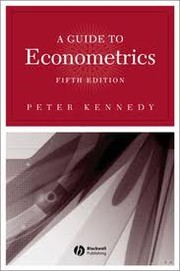
A Guide to Econometrics

A Guide to Econometrics

Peter Kennedy
1998
T4 623 pages · about 10h 23m to read Open Librarygoodreads

The plain-language companion to econometric method and its pitfalls

Summary

Kennedy wrote this as a companion to standard econometrics textbooks rather than a replacement. It explains what each technique is for, what assumptions it requires, what goes wrong when they fail, and how practitioners actually handle the failures, all in words rather than in proofs, with the technical material confined to separate sections.

The coverage is standard: ordinary least squares and its assumptions, violations including heteroskedasticity, autocorrelation, multicollinearity and measurement error, endogeneity and instrumental variables, simultaneous equations, limited dependent variable models, time series including unit roots and cointegration, panel data, Bayesian methods and forecasting. What distinguishes it is the treatment of practice: Kennedy is candid about specification search, about the difference between what textbooks prescribe and what published papers actually do, and about the temptation to keep running regressions until one produces the expected result. His chapter on the ten commandments of applied econometrics, which includes using common sense and economic theory, avoiding type three error by asking the right question, inspecting the data, and being willing to report negative results, is widely assigned.

For investors and analysts the value is in learning to read empirical work critically: knowing what an instrumental variable must satisfy, why a high R-squared means little, and what a specification test does and does not establish. The 1998 edition predates the modern causal inference literature, including difference-in-differences developments, regression discontinuity and the machine learning methods now common. Later editions cover some of this. The intuitive explanation of the core techniques has not been superseded.

Key takeaways 7

  1. Econometric technique is chosen to handle a specific violation of the standard assumptions, so knowing which assumption fails determines which method applies.
  2. Multicollinearity is a data problem rather than a modelling error, and the available responses all involve accepting less information rather than fixing anything.
  3. An instrumental variable must both correlate with the endogenous regressor and be excluded from the outcome equation, and the second condition cannot be tested.
  4. A high R-squared carries almost no information about whether a model is correctly specified or useful.
  5. Published empirical work rarely reports the specification search that produced it, which means reported significance levels overstate the evidence.
  6. Asking the wrong question with correct technique is the most common and least detected error in applied work.
  7. Economic theory and inspection of the data should discipline model specification, since statistical criteria alone will select a model that fits noise.

Who should read it

Analysts and investors who need to read and evaluate empirical research critically without working through the underlying proofs.

Who recommended it 1

Similar books 6

Chosen by shared topics, the entries that hold them, and the people who recommended both.
Joshua D. Angrist, Jorn-Steffen Pischke · 2009

A practical guide to causal inference: regression, instruments, differences.
Athanasios Papoulis, S. Unnikrishna Pillai · 1965

The graduate engineering text on probability and stochastic processes.

Recommended by: Nassim Nicholas Taleb
David A. Freedman · 2009

Freedman on regression's assumptions and the causal claims it cannot support

Recommended by: Nassim Nicholas Taleb
Judea Pearl · 2000

A mathematical theory of causation for statistics, AI, economics and science.
Darrell Huff · 1954

How biased samples, chosen averages and cut-off chart axes make numbers mislead.

Where it sits in the reference 3

Investment styles
Mental models
Economics

Topics

Mathematics and StatisticsEconomicsStatistics, probability and data