Updates

  1. Person pages list letters, writing, profiles and links as sortable tables with filters, and show each person's companies as links; Fund letters show each letter's description in its own column.
  2. Experts show a checked job title and a short description of each person; 30 more people have photographs.
  3. Every company, fund, university and publication the experts work for has a page listing the people there.
  4. Fund letters show each letter's thesis and filter by it; 225 person pages list the essays, columns and newsletter issues the person wrote.
  5. Person pages list every essay and newsletter issue a person wrote, and their own books as a table in List view.
  6. Recommends shows the five largest kinds of book and the rest under More; browse pictures load sooner.
  7. Podcasts and talks link the original episode, filter by Audio and video or Press, and list each publisher once.
  8. Pages are wider, Recommends has List and Grid, and a filter clicked again turns off.
  9. Book cards sit in a ruled grid with Open Library and Goodreads links and each book's one-line note.
  10. Funds is now Investors; each investor's styles are buttons that filter the table.
  11. Podcasts and talks on a person's page filter by year and publisher and show as a list or a grid of pictures.
  12. Quotes show only people's own words: 472 summaries written by list sites are gone.
  13. Country pages open from Browse again, and every link on the shelf lands on a page.
  14. Subject and person pages show their sections as tabs, and each book appears once on a person's page.
  15. Book cards show the quote, who said it and the source; grids show five cards to a row.
  16. On a phone, a menu holds the sections, search, Updates, Feedback and dark mode.
  17. Feedback takes a screenshot of the page with no browser prompt, opens a screenshot full size when you click it, and clears itself once sent.
  18. Book cards are centred, search names the topic each book sits in, and any text cut short shows whole on hover.
  19. Search groups its results by kind: people, companies, geographies, subjects, topics, books, funds, fund letters and papers.
  20. The Books table lists who recommended each book by name, and the browser tab names the section you are in.
  21. Feedback can take a screenshot of the page, or one you paste or choose, and opens in the corner beside Updates.
  22. Each rail button reopens its section where you left it, and Browse, Table and People show on every book and subject page.
  23. Filters grey out choices that hold nothing instead of hiding them, and Books › People filters by authors or recommenders.
  24. Feedback takes a subject line and up to three screenshots.
  25. Biographies are grouped by the person they are about: 41 new pages, from Abraham Lincoln to Lee Kuan Yew.
  26. Sport splits into 23 sports, and Religion into one topic per faith.
  27. Book lists show as cards: the cover, one recommendation quote and every recommender by name.
  28. Seventeen subjects that had two or three pages under different names now have one page each.
  29. Every page lists its Experts as authors and recommenders, with a link to them on the Experts tab.
  30. Economics, Financial history, Financial panics and Accounting are subjects of their own, with one page per financial crisis.
  31. Book, person and subject pages open inside the app, so the tabs stay in view.
  32. 996 more book covers, and photographs or logos for 227 more people and companies.
  33. Books › Browse shows every subject as cards, and the rail holds Fund letters, Papers, Experts, Books and Funds.
  34. Every topic over 150 books splits into narrower topics, each with a page of its own.

Send feedback

What is it?
Screenshots, up to 3 (optional)
or paste one with Ctrl+V

We use your email only to reply to you.

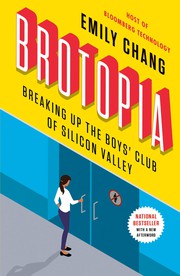
Brotopia

Brotopia

Emily Chang
2018
T3 318 pages · about 5h 18m to read Open Librarygoodreads

Reporting on the culture that produced Uber's 2017 crisis.

Summary

Chang, a Bloomberg journalist, documents the exclusion of women from Silicon Valley and argues that the industry's gender composition was produced by specific decisions rather than by a pipeline shortage. Her historical section is the most useful: women made up over a third of computing graduates in the 1980s and the share fell afterwards, and Chang traces the decline to the marketing of personal computers to boys, to admissions criteria that favoured applicants with prior programming experience, and to the adoption in the 1960s of personality profiles that selected for people who disliked working with others.

The reporting covers venture capital funding disparities, the mechanics of how deals reach investors through personal networks, harassment cases including those at Binary Capital and Uber, the effect of non-disparagement agreements in preventing disclosure, and the culture of specific companies. The chapter on parties, which drew the most attention, describes events attended by investors and founders and argues that they function as professional environments in which women participate on different terms.

Chang also covers the mechanics of exclusion that do not involve misconduct, including referral-based hiring, the compounding effect of small differences in early opportunities, and the way that pattern matching on prior successful founders reproduces the existing composition.

The book is journalism and its evidence is interviews plus available statistics. Some subjects disputed her accounts, particularly regarding the parties chapter. It concentrates on a specific slice of the industry and generalises from it. The historical material on how the field changed composition, and the analysis of network-based deal flow, are the parts with the most analytical value.

Key takeaways 8

  1. Women made up over a third of computing graduates in the mid-1980s, and the decline afterwards was produced by specific decisions rather than by any change in interest.
  2. Personality profiles adopted in the 1960s selected programmers who disliked working with people, which shaped who entered the field for decades.
  3. Marketing personal computers to boys in the 1980s created the prior-experience gap that university admissions then treated as aptitude.
  4. Venture funding reaches founders through personal networks, so the composition of those networks determines who receives capital regardless of any explicit bias.
  5. Pattern matching against previously successful founders reproduces the existing demographic composition automatically.
  6. Non-disparagement and settlement agreements prevented disclosure of misconduct for years and allowed the same individuals to continue operating.
  7. Social events attended by investors and founders function as professional environments in which participation terms differ by gender.
  8. Referral-based hiring compounds early differences in opportunity, which produces large divergences from small initial gaps.

Who should read it

Investors and founders examining how their own networks and hiring practices reproduce composition, and readers wanting the documented history of the field's change.

Who recommended it 6

Aaron Leviereported
Aileen Leereported
Bill Gurleyreported
Steph Smithreported

Similar books 6

Chosen by shared topics, the entries that hold them, and the people who recommended both.

Susan Fowler · 2020

Insider memoir by the engineer whose blog post triggered the reckoning.

Sarah Kessler · 2018

The gig-work model Uber's unit economics depend on.

Alex Rosenblat · 2018

Field research on algorithmic management of drivers.

Alexandrea J. Ravenelle · 2019

Sociology of platform work across Uber and peers.

Where it sits in the reference 1

Companies

Topics

Technology and ComputingSociology and CultureRace, gender and identityTech company stories