Updates

  1. Person pages list letters, writing, profiles and links as sortable tables with filters, and show each person's companies as links; Fund letters show each letter's description in its own column.
  2. Experts show a checked job title and a short description of each person; 30 more people have photographs.
  3. Every company, fund, university and publication the experts work for has a page listing the people there.
  4. Fund letters show each letter's thesis and filter by it; 225 person pages list the essays, columns and newsletter issues the person wrote.
  5. Person pages list every essay and newsletter issue a person wrote, and their own books as a table in List view.
  6. Recommends shows the five largest kinds of book and the rest under More; browse pictures load sooner.
  7. Podcasts and talks link the original episode, filter by Audio and video or Press, and list each publisher once.
  8. Pages are wider, Recommends has List and Grid, and a filter clicked again turns off.
  9. Book cards sit in a ruled grid with Open Library and Goodreads links and each book's one-line note.
  10. Funds is now Investors; each investor's styles are buttons that filter the table.
  11. Podcasts and talks on a person's page filter by year and publisher and show as a list or a grid of pictures.
  12. Quotes show only people's own words: 472 summaries written by list sites are gone.
  13. Country pages open from Browse again, and every link on the shelf lands on a page.
  14. Subject and person pages show their sections as tabs, and each book appears once on a person's page.
  15. Book cards show the quote, who said it and the source; grids show five cards to a row.
  16. On a phone, a menu holds the sections, search, Updates, Feedback and dark mode.
  17. Feedback takes a screenshot of the page with no browser prompt, opens a screenshot full size when you click it, and clears itself once sent.
  18. Book cards are centred, search names the topic each book sits in, and any text cut short shows whole on hover.
  19. Search groups its results by kind: people, companies, geographies, subjects, topics, books, funds, fund letters and papers.
  20. The Books table lists who recommended each book by name, and the browser tab names the section you are in.
  21. Feedback can take a screenshot of the page, or one you paste or choose, and opens in the corner beside Updates.
  22. Each rail button reopens its section where you left it, and Browse, Table and People show on every book and subject page.
  23. Filters grey out choices that hold nothing instead of hiding them, and Books › People filters by authors or recommenders.
  24. Feedback takes a subject line and up to three screenshots.
  25. Biographies are grouped by the person they are about: 41 new pages, from Abraham Lincoln to Lee Kuan Yew.
  26. Sport splits into 23 sports, and Religion into one topic per faith.
  27. Book lists show as cards: the cover, one recommendation quote and every recommender by name.
  28. Seventeen subjects that had two or three pages under different names now have one page each.
  29. Every page lists its Experts as authors and recommenders, with a link to them on the Experts tab.
  30. Economics, Financial history, Financial panics and Accounting are subjects of their own, with one page per financial crisis.
  31. Book, person and subject pages open inside the app, so the tabs stay in view.
  32. 996 more book covers, and photographs or logos for 227 more people and companies.
  33. Books › Browse shows every subject as cards, and the rail holds Fund letters, Papers, Experts, Books and Funds.
  34. Every topic over 150 books splits into narrower topics, each with a page of its own.

Send feedback

What is it?
Screenshots, up to 3 (optional)
or paste one with Ctrl+V

We use your email only to reply to you.

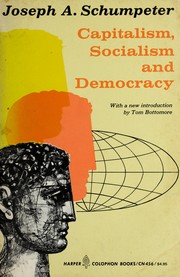
Capitalism, Socialism and Democracy

Capitalism, Socialism and Democracy

Joseph A. Schumpeter
1942
T1 no Open Library recordgoodreads

Summary

Schumpeter published this in 1942 and it contains three largely separate arguments, held together by his method of taking opponents' positions seriously.

The economic argument is the most cited. Schumpeter holds that capitalism's essential feature is not price competition within a static structure but the process by which new products, methods, markets and organisational forms destroy existing ones. He calls this creative destruction and argues it is the fact about capitalism that everything else must accommodate. From this he draws conclusions that contradicted the economics of his time: temporary monopoly profits are the reward that induces innovation and are therefore functional rather than harmful; large firms with research capacity are the primary engines of innovation rather than small competitive ones; and static efficiency comparisons between market structures miss what actually matters.

The prediction is the most striking part. Schumpeter argued that capitalism would not fail economically but would be destroyed by its own success. Growth would create a large educated class with no property stake and a professional interest in criticism. The routinisation of innovation inside corporate research departments would eliminate the entrepreneurial function and with it the social basis for the bourgeoisie. The rationalising habit of mind capitalism produces would erode the traditional loyalties that sustain any social order including its own. Capitalism would therefore evolve into socialism through the decay of its own supporting institutions.

The democracy section rejects the classical theory that democracy expresses a popular will, arguing that no coherent popular will exists and that democracy should be defined procedurally as competition among elites for the people's vote. This became the dominant definition in political science.

The prediction of socialism has not occurred, though the mechanisms he identified, particularly the intellectual class and the bureaucratisation of innovation, are still argued about. The book's prose is dense and the three arguments are unequal in quality.

Key takeaways 7

  1. Capitalism's essential process is the destruction of existing products, methods and firms by new ones, not price competition within a fixed structure.
  2. Temporary monopoly profit is the reward that induces innovation, so it is functional rather than a deadweight loss.
  3. Large firms with research capacity are the primary engines of innovation rather than small competitive firms.
  4. Static comparisons of market structures miss the dynamic process that actually determines living standards.
  5. Capitalism will be destroyed by its own success rather than by economic failure, through the erosion of its supporting institutions.
  6. Growth creates a large educated class with a professional interest in criticising the system that produced it.
  7. Democracy is best defined procedurally as competition among elites for votes, because no coherent popular will exists to be expressed.

Who should read it

Founders, investors and anyone thinking about competition and innovation who wants the original statement of creative destruction and its uncomfortable implications.

Similar books 6

Chosen by shared topics, the entries that hold them, and the people who recommended both.

Adam Smith · 2015

Books One to Three: division of labour, money, prices, wages, profit and capital.

Recommended by: Mohnish Pabrai

Adam Smith · 2015

Books Four and Five: the case against mercantilism, and the role of the state.

Recommended by: Mohnish Pabrai

Karl Marx · 1867

Recommended by: Elon Musk

Ludwig von Mises · 1949

Recommended by: Charles Koch

David Ricardo · 1817

Rent, wages, profit and comparative advantage, reasoned from first assumptions.

Where it sits in the reference 2

Mental models
Economics

Topics

EconomicsPolitics and GovernmentPhilosophyMoral and political philosophyPolitical philosophy and ideology