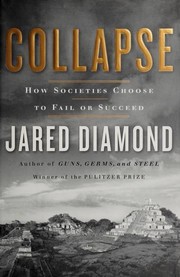
Collapse
Why past societies from Easter Island to the Maya collapsed, and what that teaches.
Summary
Diamond defines collapse as a drastic fall in a society's population or political, economic and social complexity over a wide area for a long time, and compares past and present societies to find what causes it. He names five factors: environmental damage, climate change, hostile neighbours, the loss of trading partners and the society's response to the other four. He argues that the root problem in most cases is a population too large for what its land can support.
Part One describes present-day Montana. Part Two covers the Greenland Norse, Easter Island, Pitcairn Island, the Anasazi and the Maya, against three successes: Tikopia, the New Guinea highlands and forest management in Tokugawa Japan. Part Three covers Rwanda, Haiti against the Dominican Republic, China and Australia. Part Four turns to business, globalisation and the Dutch polder model. Diamond observes that steep decline can begin a decade or two after a society reaches its peak, and names two choices that separate survivors: long-term planning and a willingness to rethink core values. He ends with cautious optimism.
Key takeaways 4
- Collapse comes from five factors: environmental damage, climate change, hostile neighbours, lost trade partners and the society's response.
- A society's decline can begin only a decade or two after its peak in population and wealth.
- Trouble grows when the short-term interests of elites conflict with the long-term interests of the society.
- Societies that survived planned for the long term and were willing to revise their core values.
Who should read it
Readers who want a comparative history of why societies fail or endure, with lessons for business and policy today.
Who recommended it 4 · 4 direct
Similar books 6
Chosen by shared topics, the entries that hold them, and the people who recommended both.
Population and consumption face physical limits that economics ignores.
“In Living Within Limits, Hardin focuses on the neglected problem of overpopulation, making a forceful case for dramatically changing the way we live in and manage our world. Our world itself, he writes, is in the dilemma of the lifeboat: it can only hold a certain number of people before it sinks-not everyone can be saved.” — Shane Parrish
Source: What Books Would You Recommend Someone Read to Improve their General Knowledge of the World?
Recommended by: Charlie Munger, Mohnish Pabrai and 1 other
A computer model of world growth that overshoots its limits and then declines.
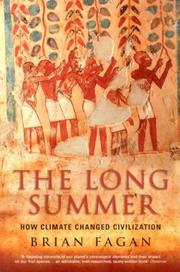
How climate change since the last ice age shaped human civilization.
Recommended by: Stewart Brand
The Fort McMurray wildfire and the changing relationship between fire and people.
Recommended by: Andrew Wilkinson
History told through energy, from muscle and fire to coal, oil and electricity.
Recommended by: Balaji S. Srinivasan, Bill Gates and 1 other
Evidence that violence of nearly every kind has declined over history, and why.
“I think the one that has had the biggest impact on me and the one that I've given the most number of people has been [The Better Angels of Our Nature].” — Eric Schmidt
Source: The Tim Ferriss Show Transcripts: Eric Schmidt (#367)
Recommended by: Bill Gates, Eric Schmidt, Mohnish Pabrai and 7 others