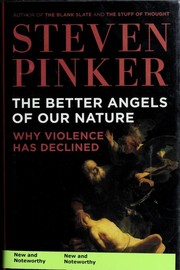
The Better Angels of Our Nature
Evidence that violence of nearly every kind has declined over history, and why.
Long-run violence data against the narrative of a worsening world
Summary
Pinker argues that violence of nearly every kind has declined over historical time, and assembles quantitative evidence across homicide rates, war deaths, genocide, torture, capital punishment, slavery, domestic violence and treatment of children and animals. The book runs about eight hundred pages and the statistical apparatus is extensive.
He identifies six trends: the pacification process as states replaced hunter-gatherer societies, the civilising process where European homicide rates fell by a factor of thirty from the medieval period, the humanitarian revolution of the Enlightenment which ended judicial torture and slavery in Europe, the long peace since 1945 among major powers, the new peace since 1989, and the rights revolutions extending protection to minorities, women, children and animals.
His explanations combine five inner demons that produce violence with four better angels that restrain it, and five historical forces: the state's monopoly on violence, commerce which makes others more valuable alive, feminisation, cosmopolitanism through literacy and mobility, and what he calls the escalator of reason.
The criticisms are substantial and technical. Taleb argues that war deaths follow a fat-tailed distribution in which the observed decline since 1945 carries little statistical information about the future risk. Historians dispute the prehistoric violence estimates and the reliability of comparing rates across radically different data regimes. Others argue that measuring per capita rates understates absolute suffering and ignores structural violence. Pinker's causal story attributing the decline to Enlightenment reason is the weakest part, since correlation with the proposed causes is asserted rather than demonstrated. The data compilation is the contribution.
Key takeaways 8
- Rates of violent death have declined across multiple independent measures over centuries, including homicide, war, genocide and judicial punishment.
- European homicide rates fell roughly thirtyfold from the medieval period to the twentieth century, which Pinker attributes to state monopolisation of force and to commercial interdependence.
- State formation reduced violent death rates substantially compared to stateless societies, despite the state's own capacity for organised killing.
- Commerce reduces violence because trading partners are worth more alive than dead, which changes the calculation independently of any moral change.
- The absence of war between major powers since 1945 is historically unprecedented in duration.
- Expanding circles of moral concern, driven by literacy and by exposure to other perspectives, extended protection to groups previously excluded.
- Perceptions of rising violence come from improved reporting and from availability effects rather than from the underlying rates.
- Taleb and others argue that war deaths follow a fat-tailed distribution, so the recent decline provides weak evidence about future risk.
Who should read it
Readers who want the assembled quantitative case for declining violence, best read alongside the statistical objections to inferring anything about the future from it.
Who recommended it 10 · 5 direct
“I think the one that has had the biggest impact on me and the one that I've given the most number of people has been [The Better Angels of Our Nature].”
Similar books 6
Chosen by shared topics, the entries that hold them, and the people who recommended both.

Recurring patterns drawn from world history: biology, morals, religion, economics.
“…books I've recommended, highlighted to death, or forced on friends.” — Andrew Wilkinson
Source: Andrew Wilkinson's Bookshelf, neverenough.com
Recommended by: Andrew Wilkinson, Balaji S. Srinivasan and 14 others
How fast, automatic thought and slow, deliberate thought shape judgment and error.
“…books I've recommended, highlighted to death, or forced on friends.” — Andrew Wilkinson
Source: Andrew Wilkinson's Bookshelf, neverenough.com
Recommended by: Andrew Wilkinson, Charles de Vaulx and 36 others

A military historian's reflections on what history teaches and why we ignore it.
Recommended by: Morgan Housel, Nat Eliason, Shane Parrish

Principles of observation, inference and avoiding error, from the Holmes stories.
Recommended by: Mohnish Pabrai, Patrick O'Shaughnessy and 1 other
Why people misjudge advantage, and how underdogs win.
“…books I've recommended, highlighted to death, or forced on friends.” — Andrew Wilkinson
Source: Andrew Wilkinson's Bookshelf, neverenough.com
Recommended by: Andrew Wilkinson, John C. Bogle and 2 others
A 20-year test of 28,000 expert forecasts: foxes with many models beat hedgehogs.
“All pundits and commentators should publish their prediction track records, yet don't. What to pay attention to and what to ignore.” — Marc Andreessen
Source: @pmarca, 'Thread: Books I've recently read and recommend'
Recommended by: Marc Andreessen, Michael Mauboussin and 2 others
Where it sits in the reference 1
Topics 4
As an Amazon Associate I earn from qualifying purchases.