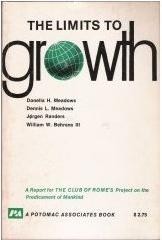
The Limits to Growth
A computer model of world growth that overshoots its limits and then declines.
Summary
Donella Meadows, Dennis Meadows, Jorgen Randers and William Behrens built a computer model called World3 at MIT and published its results for the Club of Rome in 1972. The book sold millions of copies and provoked a debate that has continued for fifty years.
The model links five variables: population, food production, industrialisation, pollution and consumption of non-renewable resources. Its structure incorporates exponential growth in several of these, physical limits on others, and delays in the feedback between them. The central finding is that under most parameter sets the system overshoots its limits and then declines, and that the delays are what produce the overshoot: by the time the constraint becomes visible, the momentum in the system carries it past the sustainable level. The authors ran scenarios including higher resource availability, better pollution control and improved agricultural yields, and found that these postponed rather than prevented the overshoot unless growth itself was addressed.
The book was widely misrepresented as predicting specific resource exhaustion by specific dates, which it did not do; it presented scenarios rather than forecasts. Economists including Julian Simon attacked the treatment of prices, substitution and technological response, which the model handles crudely, and the failure of resource prices to rise as predicted was treated as a refutation. Later comparisons of the standard run against actual data, including work by Graham Turner, found closer correspondence than the book's critics acknowledge. The methodological point about delay and overshoot in systems with exponential growth is the durable contribution.
Key takeaways 7
- Systems combining exponential growth with physical limits and delayed feedback overshoot their sustainable level before the constraint becomes visible.
- Delay in the feedback between consumption and its consequences is what produces overshoot rather than smooth adjustment.
- Increasing resource availability or improving pollution control postpones overshoot rather than preventing it, because growth continues.
- The authors presented scenarios rather than forecasts, and the book was widely misrepresented as predicting dated resource exhaustion.
- Economists attacked the model's crude treatment of prices, substitution and technological response, which is its genuine weakness.
- Later comparisons of the standard run against actual data found closer correspondence than the book's critics acknowledge.
- Addressing growth itself rather than its individual consequences is the only intervention the model finds effective.
Who should read it
Investors and analysts who want the original systems argument about growth and limits rather than the caricature of it in the subsequent debate.
Similar books 6
Chosen by shared topics, the entries that hold them, and the people who recommended both.
An introduction to systems: stocks, flows, feedback loops and where to intervene.
Recommended by: Patrick O'Shaughnessy, Daniel Burka and 3 others
Why past societies from Easter Island to the Maya collapsed, and what that teaches.
Recommended by: Bill Gates, Jim Collins, Mohnish Pabrai and 1 other
Population and consumption face physical limits that economics ignores.
“In Living Within Limits, Hardin focuses on the neglected problem of overpopulation, making a forceful case for dramatically changing the way we live in and manage our world. Our world itself, he writes, is in the dilemma of the lifeboat: it can only hold a certain number of people before it sinks-not everyone can be saved.” — Shane Parrish
Source: What Books Would You Recommend Someone Read to Improve their General Knowledge of the World?
Recommended by: Charlie Munger, Mohnish Pabrai and 1 other
How weather data and computer models built our knowledge of global climate change.
Recommended by: Patrick Collison
An assessment of the proposals for averting climate change, and the energy options.
Recommended by: Mohnish Pabrai

How to build a good future for humanity and the Earth in the Anthropocene.
Recommended by: Richard Branson