
Updates

  1. Person pages list letters, writing, profiles and links as sortable tables with filters, and show each person's companies as links; Fund letters show each letter's description in its own column.
  2. Experts show a checked job title and a short description of each person; 30 more people have photographs.
  3. Every company, fund, university and publication the experts work for has a page listing the people there.
  4. Fund letters show each letter's thesis and filter by it; 225 person pages list the essays, columns and newsletter issues the person wrote.
  5. Person pages list every essay and newsletter issue a person wrote, and their own books as a table in List view.
  6. Recommends shows the five largest kinds of book and the rest under More; browse pictures load sooner.
  7. Podcasts and talks link the original episode, filter by Audio and video or Press, and list each publisher once.
  8. Pages are wider, Recommends has List and Grid, and a filter clicked again turns off.
  9. Book cards sit in a ruled grid with Open Library and Goodreads links and each book's one-line note.
  10. Funds is now Investors; each investor's styles are buttons that filter the table.
  11. Podcasts and talks on a person's page filter by year and publisher and show as a list or a grid of pictures.
  12. Quotes show only people's own words: 472 summaries written by list sites are gone.
  13. Country pages open from Browse again, and every link on the shelf lands on a page.
  14. Subject and person pages show their sections as tabs, and each book appears once on a person's page.
  15. Book cards show the quote, who said it and the source; grids show five cards to a row.
  16. On a phone, a menu holds the sections, search, Updates, Feedback and dark mode.
  17. Feedback takes a screenshot of the page with no browser prompt, opens a screenshot full size when you click it, and clears itself once sent.
  18. Book cards are centred, search names the topic each book sits in, and any text cut short shows whole on hover.
  19. Search groups its results by kind: people, companies, geographies, subjects, topics, books, funds, fund letters and papers.
  20. The Books table lists who recommended each book by name, and the browser tab names the section you are in.
  21. Feedback can take a screenshot of the page, or one you paste or choose, and opens in the corner beside Updates.
  22. Each rail button reopens its section where you left it, and Browse, Table and People show on every book and subject page.
  23. Filters grey out choices that hold nothing instead of hiding them, and Books › People filters by authors or recommenders.
  24. Feedback takes a subject line and up to three screenshots.
  25. Biographies are grouped by the person they are about: 41 new pages, from Abraham Lincoln to Lee Kuan Yew.
  26. Sport splits into 23 sports, and Religion into one topic per faith.
  27. Book lists show as cards: the cover, one recommendation quote and every recommender by name.
  28. Seventeen subjects that had two or three pages under different names now have one page each.
  29. Every page lists its Experts as authors and recommenders, with a link to them on the Experts tab.
  30. Economics, Financial history, Financial panics and Accounting are subjects of their own, with one page per financial crisis.
  31. Book, person and subject pages open inside the app, so the tabs stay in view.
  32. 996 more book covers, and photographs or logos for 227 more people and companies.
  33. Books › Browse shows every subject as cards, and the rail holds Fund letters, Papers, Experts, Books and Funds.
  34. Every topic over 150 books splits into narrower topics, each with a page of its own.

Send feedback

What is it?
Screenshots, up to 3 (optional)
or paste one with Ctrl+V

We use your email only to reply to you.

From Plan to Market

From Plan to Market

Adam Fforde, Stefan de Vylder
1996
T2 358 pages · about 5h 58m to read Open Librarygoodreads

The canonical doi moi study; reform as bottom-up fence-breaking, not decree.

Summary

Fforde and de Vylder wrote this analysis of Vietnam's transition from central planning to a market economy, based on long field research in the country.

Their central argument distinguishes Vietnam's path from the transitions in Eastern Europe. Vietnam's reform was not designed and imposed from above. Instead, as the planned system failed to supply what enterprises and households needed through the late 1970s and early 1980s, participants at every level began transacting outside the plan: state enterprises sold output on the side to obtain inputs the plan did not deliver, cooperatives contracted land to households, and local authorities permitted arrangements the centre had not authorised. The authors call this fence-breaking. The reforms formalised in 1986 and after largely ratified practices that had already spread rather than introducing new ones.

The analytical implication is that market institutions emerged from the failure of the plan through decentralised adaptation, and that the formal policy changes followed rather than led. This explains why Vietnam avoided the output collapse that accompanied Eastern European transitions: the market activity was already operating when the plan was abandoned, so there was no institutional vacuum.

They also cover the agricultural decollectivisation that produced a rapid supply response and turned Vietnam from a rice importer into a major exporter, the currency and price reforms that ended high inflation, the treatment of state enterprises which were reformed rather than privatised, and the political arrangement under which economic liberalisation proceeded without political liberalisation.

The book is academic and from 1996, so it covers the early transition rather than the subsequent industrialisation and export growth. Its argument about bottom-up institutional emergence remains the standard account of the Vietnamese case.

Key takeaways 7

  1. Vietnam's transition was driven by participants transacting outside the plan before any policy change authorised it.
  2. Formal reforms from 1986 largely ratified practices that had already spread rather than introducing new arrangements.
  3. Market activity was already operating when the plan was abandoned, which is why Vietnam avoided an institutional vacuum.
  4. Vietnam did not experience the output collapse that accompanied Eastern European transitions.
  5. Agricultural decollectivisation produced a rapid supply response that turned a rice importer into a major exporter.
  6. State enterprises were reformed rather than privatised, which avoided the ownership transfer problems seen elsewhere.
  7. Economic liberalisation proceeded without political liberalisation, which distinguishes the case from the European transitions.

Who should read it

Analysts of economic transition and of institutional change who want the case where reform emerged from below rather than being imposed from above.

Similar books 6

Chosen by shared topics, the entries that hold them, and the people who recommended both.

David W. P. Elliott · 2012

How Vietnam's Communist Party talked itself into opening the economy and joining WTO.

Ivan T. Berend · 1996

Economic history that explains the industrial base the Czechs privatised.

Marcin Piatkowski · 2018

How Poland achieved Europe's fastest sustained growth after 1989.
Tadeusz Kowalik · 2011

The critique of the transition's distributional cost.

Ivan T. Berend · 2009

Covers EU accession as the main driver of Romanian institutional change.
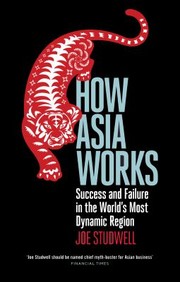
Joe Studwell · 2013

Why some Asian nations grew rich: land reform, export-led industry, directed credit.

“it's a good read for anyone who wants to understand what actually determines whether a developing economy will succeed.” — Bill Gates

Source: Gates Notes review of How Asia Works

Recommended by: Bill Gates, Mohnish Pabrai, Patrick Collison

Where it sits in the reference 2

Geographies
Economics

Topics

EconomicsPolitics and GovernmentGeneral HistoryAsia, Africa, Latin America and the Middle EastAsia and the Pacific