Updates

  1. Person pages list letters, writing, profiles and links as sortable tables with filters, and show each person's companies as links; Fund letters show each letter's description in its own column.
  2. Experts show a checked job title and a short description of each person; 30 more people have photographs.
  3. Every company, fund, university and publication the experts work for has a page listing the people there.
  4. Fund letters show each letter's thesis and filter by it; 225 person pages list the essays, columns and newsletter issues the person wrote.
  5. Person pages list every essay and newsletter issue a person wrote, and their own books as a table in List view.
  6. Recommends shows the five largest kinds of book and the rest under More; browse pictures load sooner.
  7. Podcasts and talks link the original episode, filter by Audio and video or Press, and list each publisher once.
  8. Pages are wider, Recommends has List and Grid, and a filter clicked again turns off.
  9. Book cards sit in a ruled grid with Open Library and Goodreads links and each book's one-line note.
  10. Funds is now Investors; each investor's styles are buttons that filter the table.
  11. Podcasts and talks on a person's page filter by year and publisher and show as a list or a grid of pictures.
  12. Quotes show only people's own words: 472 summaries written by list sites are gone.
  13. Country pages open from Browse again, and every link on the shelf lands on a page.
  14. Subject and person pages show their sections as tabs, and each book appears once on a person's page.
  15. Book cards show the quote, who said it and the source; grids show five cards to a row.
  16. On a phone, a menu holds the sections, search, Updates, Feedback and dark mode.
  17. Feedback takes a screenshot of the page with no browser prompt, opens a screenshot full size when you click it, and clears itself once sent.
  18. Book cards are centred, search names the topic each book sits in, and any text cut short shows whole on hover.
  19. Search groups its results by kind: people, companies, geographies, subjects, topics, books, funds, fund letters and papers.
  20. The Books table lists who recommended each book by name, and the browser tab names the section you are in.
  21. Feedback can take a screenshot of the page, or one you paste or choose, and opens in the corner beside Updates.
  22. Each rail button reopens its section where you left it, and Browse, Table and People show on every book and subject page.
  23. Filters grey out choices that hold nothing instead of hiding them, and Books › People filters by authors or recommenders.
  24. Feedback takes a subject line and up to three screenshots.
  25. Biographies are grouped by the person they are about: 41 new pages, from Abraham Lincoln to Lee Kuan Yew.
  26. Sport splits into 23 sports, and Religion into one topic per faith.
  27. Book lists show as cards: the cover, one recommendation quote and every recommender by name.
  28. Seventeen subjects that had two or three pages under different names now have one page each.
  29. Every page lists its Experts as authors and recommenders, with a link to them on the Experts tab.
  30. Economics, Financial history, Financial panics and Accounting are subjects of their own, with one page per financial crisis.
  31. Book, person and subject pages open inside the app, so the tabs stay in view.
  32. 996 more book covers, and photographs or logos for 227 more people and companies.
  33. Books › Browse shows every subject as cards, and the rail holds Fund letters, Papers, Experts, Books and Funds.
  34. Every topic over 150 books splits into narrower topics, each with a page of its own.

Send feedback

What is it?
Screenshots, up to 3 (optional)
or paste one with Ctrl+V

We use your email only to reply to you.

From Schweizerische Kreditanstalt to Credit

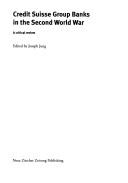
From Schweizerische Kreditanstalt to Credit Suisse Group: The History of a Bank

Joseph Jung
2000
T4 447 pages · about 7h 27m to read Open Librarygoodreads

Authorised 150-year corporate history

Summary

The reference has not verified this book in detail; the summary states only what the title, author and subject establish.

Jung, who served as Credit Suisse's institutional historian, wrote this commissioned history of the bank from its 1856 founding to the late twentieth century. The reference has not verified the book's detailed contents.

The institution's history covers a long period. Schweizerische Kreditanstalt was founded in 1856 by Alfred Escher, a Zurich politician and businessman, primarily to finance railway construction in Switzerland, which required capital that existing Swiss institutions could not supply. The bank was therefore created as an instrument of national infrastructure development, on the model of the French Credit Mobilier, and it financed the railways, the Gotthard tunnel and subsequent industrial development.

The subsequent history includes the bank's development into a universal bank, its role in Swiss industrial finance, its position through both world wars and the questions that arise about Swiss banking in that period, the postwar growth of Swiss banking on the basis of secrecy and stability, the acquisition of First Boston which gave the group an international investment banking business, the merger with Winterthur insurance, and the group's development into one of the two large Swiss banking groups.

Commissioned institutional histories written by an in-house historian have archival access that outsiders lack and an evident interest in the subject, and both affect how they should be read.

The bank's subsequent collapse and forced acquisition by UBS in 2023 is entirely outside this volume. Readers wanting that should consult recent accounts. This is a history of the institution's first century and a half, ending before the events that ended it.

Key takeaways 7

  1. The bank was founded in 1856 primarily to finance Swiss railway construction, which existing institutions could not fund.
  2. It was created on the model of the French Credit Mobilier as an instrument of national infrastructure development.
  3. Financing the Gotthard tunnel and subsequent industrial development established its position in Swiss industrial finance.
  4. Postwar Swiss banking growth rested on secrecy and political stability rather than on any operational advantage.
  5. Acquiring First Boston gave the group an international investment banking business with a different culture and risk profile.
  6. A history written by an institution's own historian has archival access and an evident interest, and both shape it.
  7. The bank's 2023 collapse and forced acquisition by UBS is entirely outside this volume.

Who should read it

Readers researching the institutional history of Credit Suisse before its collapse, using recent accounts for what ended it.

Similar books 6

Chosen by shared topics, the entries that hold them, and the people who recommended both.

Bryan Burrough, John Helyar · 1989

The 1988 bidding war for RJR Nabisco, the largest leveraged buyout to that date.

Connie Bruck · 1994

Steve Ross's path from funeral homes and parking lots to the Time Warner merger.

William D. Cohan · 2011

Goldman Sachs from Marcus Goldman to the 2008 crisis, from internal documents.

Recommended by: Mohnish Pabrai
Ron Chernow · 1990

The Morgan banks from 1830s London to J.P. Morgan and Morgan Stanley in the 1980s.

Recommended by: Mohnish Pabrai, Paul Graham

Where it sits in the reference 2

Companies
Financial history

Topics

Company HistoriesFinancial History