Updates

  1. Person pages list letters, writing, profiles and links as sortable tables with filters, and show each person's companies as links; Fund letters show each letter's description in its own column.
  2. Experts show a checked job title and a short description of each person; 30 more people have photographs.
  3. Every company, fund, university and publication the experts work for has a page listing the people there.
  4. Fund letters show each letter's thesis and filter by it; 225 person pages list the essays, columns and newsletter issues the person wrote.
  5. Person pages list every essay and newsletter issue a person wrote, and their own books as a table in List view.
  6. Recommends shows the five largest kinds of book and the rest under More; browse pictures load sooner.
  7. Podcasts and talks link the original episode, filter by Audio and video or Press, and list each publisher once.
  8. Pages are wider, Recommends has List and Grid, and a filter clicked again turns off.
  9. Book cards sit in a ruled grid with Open Library and Goodreads links and each book's one-line note.
  10. Funds is now Investors; each investor's styles are buttons that filter the table.
  11. Podcasts and talks on a person's page filter by year and publisher and show as a list or a grid of pictures.
  12. Quotes show only people's own words: 472 summaries written by list sites are gone.
  13. Country pages open from Browse again, and every link on the shelf lands on a page.
  14. Subject and person pages show their sections as tabs, and each book appears once on a person's page.
  15. Book cards show the quote, who said it and the source; grids show five cards to a row.
  16. On a phone, a menu holds the sections, search, Updates, Feedback and dark mode.
  17. Feedback takes a screenshot of the page with no browser prompt, opens a screenshot full size when you click it, and clears itself once sent.
  18. Book cards are centred, search names the topic each book sits in, and any text cut short shows whole on hover.
  19. Search groups its results by kind: people, companies, geographies, subjects, topics, books, funds, fund letters and papers.
  20. The Books table lists who recommended each book by name, and the browser tab names the section you are in.
  21. Feedback can take a screenshot of the page, or one you paste or choose, and opens in the corner beside Updates.
  22. Each rail button reopens its section where you left it, and Browse, Table and People show on every book and subject page.
  23. Filters grey out choices that hold nothing instead of hiding them, and Books › People filters by authors or recommenders.
  24. Feedback takes a subject line and up to three screenshots.
  25. Biographies are grouped by the person they are about: 41 new pages, from Abraham Lincoln to Lee Kuan Yew.
  26. Sport splits into 23 sports, and Religion into one topic per faith.
  27. Book lists show as cards: the cover, one recommendation quote and every recommender by name.
  28. Seventeen subjects that had two or three pages under different names now have one page each.
  29. Every page lists its Experts as authors and recommenders, with a link to them on the Experts tab.
  30. Economics, Financial history, Financial panics and Accounting are subjects of their own, with one page per financial crisis.
  31. Book, person and subject pages open inside the app, so the tabs stay in view.
  32. 996 more book covers, and photographs or logos for 227 more people and companies.
  33. Books › Browse shows every subject as cards, and the rail holds Fund letters, Papers, Experts, Books and Funds.
  34. Every topic over 150 books splits into narrower topics, each with a page of its own.

Send feedback

What is it?
Screenshots, up to 3 (optional)
or paste one with Ctrl+V

We use your email only to reply to you.

Globalization: n. the irrational fear that s

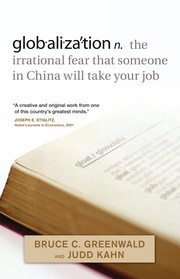
Globalization: n. the irrational fear that someone in China will take your job

Bruce Greenwald, Judd Kahn
2008
T3 256 pages · about 4h 16m to read Open Librarygoodreads

Summary

Greenwald and Kahn argue that globalisation is far less economically significant than both its advocates and its opponents claim, and that the important economic transformation of the period is the shift from manufacturing to services, which is inherently local.

Their evidence is the composition of advanced economies. Services account for the large majority of output and employment, most services must be produced where they are consumed, and international trade is concentrated in goods, which are a shrinking share of the economy. They document that trade as a share of GDP, correctly measured against the tradeable portion of the economy, has grown far less than headline figures suggest, and that most economic activity in developed countries is untouched by international competition.

They then apply Greenwald's competitive strategy framework, arguing that competitive advantage is almost always local, deriving from customer captivity, local economies of scale relative to a defined market, and regulatory position, and that global scale is rarely a source of advantage because the fixed costs it spreads are usually small relative to the coordination costs it adds. From this they argue that most global expansion strategies destroy value and that firms should dominate defined local markets instead.

The strategic argument is the stronger half and is consistent with Greenwald's other work. The macroeconomic argument understates the labour market effects of import competition, which subsequent research on the China shock documented as larger and more geographically concentrated than the book allows. The 2008 publication also predates the services trade growth of the following decade.

Key takeaways 7

  1. Services account for most output and employment in advanced economies and must largely be produced where they are consumed, which limits globalisation's reach.
  2. Trade measured against the tradeable portion of the economy has grown far less than headline trade-to-GDP figures suggest.
  3. Competitive advantage is almost always local, deriving from customer captivity and economies of scale relative to a defined market rather than from global size.
  4. Global scale rarely creates advantage because the fixed costs it spreads are small relative to the coordination costs it adds.
  5. Most international expansion by firms destroys value, because the firm enters markets where local competitors hold the advantages it holds at home.
  6. Dominating a defined local market produces higher returns than participating in a global one, since local dominance is defensible and global participation is not.
  7. The significant economic transformation of the period is the shift from manufacturing to services, not the increase in trade.

Who should read it

Operators and investors assessing international expansion strategies who want the case that competitive advantage is local.

About Bruce Greenwald

Robert Heilbrunn Professor Emeritus of Finance and Asset Management, Columbia Business School; former director of the Heilbrunn Center for Graham and Dodd Investing

Value Investing: From Graham to Buffett and Beyond is the canonical modern restatement of the Columbia value framework, and Competition Demystified is its standard companion on barriers to entry.

Columbia Business School, Heilbrunn Center for Graham and Dodd Investing

Similar books 6

Chosen by shared topics, the entries that hold them, and the people who recommended both.
Bruce Greenwald, Judd Kahn · 2005

Barriers to entry as the only durable source of a toll.

Recommended by: Mohnish Pabrai, Li Lu
Bruce Greenwald, Jonathan A. Knee, Ava Seave · 2009

Why most media companies destroy shareholder value: few have barriers to entry.

Recommended by: Keith Rabois
Adam M. Brandenburger, Barry J. Nalebuff · 1996

Game theory applied to business, which is cooperative and competitive at once.

Recommended by: Mohnish Pabrai
David A. Lax, James K. Sebenius · 2006

The deal is shaped before the table: set up the parties, interests and options first.
Hamilton Helmer · 2016

Seven sources of lasting advantage, each a benefit plus a barrier to rivals.

Where it sits in the reference 5

Academics
Academics
Business themes
Business themes
Economics

Topics

EconomicsBusiness and Management