Updates

  1. Person pages list letters, writing, profiles and links as sortable tables with filters, and show each person's companies as links; Fund letters show each letter's description in its own column.
  2. Experts show a checked job title and a short description of each person; 30 more people have photographs.
  3. Every company, fund, university and publication the experts work for has a page listing the people there.
  4. Fund letters show each letter's thesis and filter by it; 225 person pages list the essays, columns and newsletter issues the person wrote.
  5. Person pages list every essay and newsletter issue a person wrote, and their own books as a table in List view.
  6. Recommends shows the five largest kinds of book and the rest under More; browse pictures load sooner.
  7. Podcasts and talks link the original episode, filter by Audio and video or Press, and list each publisher once.
  8. Pages are wider, Recommends has List and Grid, and a filter clicked again turns off.
  9. Book cards sit in a ruled grid with Open Library and Goodreads links and each book's one-line note.
  10. Funds is now Investors; each investor's styles are buttons that filter the table.
  11. Podcasts and talks on a person's page filter by year and publisher and show as a list or a grid of pictures.
  12. Quotes show only people's own words: 472 summaries written by list sites are gone.
  13. Country pages open from Browse again, and every link on the shelf lands on a page.
  14. Subject and person pages show their sections as tabs, and each book appears once on a person's page.
  15. Book cards show the quote, who said it and the source; grids show five cards to a row.
  16. On a phone, a menu holds the sections, search, Updates, Feedback and dark mode.
  17. Feedback takes a screenshot of the page with no browser prompt, opens a screenshot full size when you click it, and clears itself once sent.
  18. Book cards are centred, search names the topic each book sits in, and any text cut short shows whole on hover.
  19. Search groups its results by kind: people, companies, geographies, subjects, topics, books, funds, fund letters and papers.
  20. The Books table lists who recommended each book by name, and the browser tab names the section you are in.
  21. Feedback can take a screenshot of the page, or one you paste or choose, and opens in the corner beside Updates.
  22. Each rail button reopens its section where you left it, and Browse, Table and People show on every book and subject page.
  23. Filters grey out choices that hold nothing instead of hiding them, and Books › People filters by authors or recommenders.
  24. Feedback takes a subject line and up to three screenshots.
  25. Biographies are grouped by the person they are about: 41 new pages, from Abraham Lincoln to Lee Kuan Yew.
  26. Sport splits into 23 sports, and Religion into one topic per faith.
  27. Book lists show as cards: the cover, one recommendation quote and every recommender by name.
  28. Seventeen subjects that had two or three pages under different names now have one page each.
  29. Every page lists its Experts as authors and recommenders, with a link to them on the Experts tab.
  30. Economics, Financial history, Financial panics and Accounting are subjects of their own, with one page per financial crisis.
  31. Book, person and subject pages open inside the app, so the tabs stay in view.
  32. 996 more book covers, and photographs or logos for 227 more people and companies.
  33. Books › Browse shows every subject as cards, and the rail holds Fund letters, Papers, Experts, Books and Funds.
  34. Every topic over 150 books splits into narrower topics, each with a page of its own.

Send feedback

What is it?
Screenshots, up to 3 (optional)
or paste one with Ctrl+V

We use your email only to reply to you.

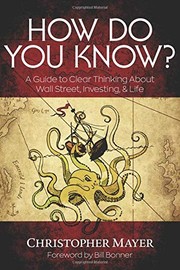
How Do You Know?

How Do You Know?

Christopher Mayer
2018
T4 240 pages · about 4h to read Open Librarygoodreads

Subtitled A Guide to Clear Thinking About Wall Street, Investing, and Life.

Summary

Christopher Mayer applies Alfred Korzybski's general semantics to investment analysis. Korzybski's claim, set out in Science and Sanity in 1933, is that human beings confuse their verbal abstractions with the things those abstractions describe, and that most reasoning errors follow from that confusion. Mayer works through the specific forms this takes in markets: treating a company's name as if it denoted a fixed object, treating an accounting figure as if it were the underlying economic fact, and treating labels such as growth stock or value stock as if they carried information about the security.

The practical apparatus comes from Korzybski and from Wendell Johnson. Mayer recommends dating statements, so that General Electric in 2001 is treated as a different object from General Electric in 2017. He recommends indexing, so that bank number one is not assumed to behave like bank number two. He recommends etc., an explicit acknowledgement that any description of a company omits most of what is true about it. He supports these with investment examples and with reflections on his own errors.

The book is short and idiosyncratic, and it does not offer a valuation method or a screening approach. Korzybski's system has never been accepted in academic linguistics or psychology, and readers should treat it as a discipline for handling one's own language rather than as a validated theory of cognition. The overlap with more familiar material on base rates and overconfidence is considerable, and Mayer does not always distinguish his contribution from that literature.

Key takeaways 7

  1. An accounting number is an abstraction several layers removed from the economic activity it describes, and analysts routinely forget the distance.
  2. Statements about a company should carry a date, because the company that existed when the thesis was formed no longer exists.
  3. Category labels such as growth and value describe the analyst's classification scheme rather than any property of the business.
  4. Any description of a company is necessarily incomplete, and the appropriate response is to hold conclusions loosely rather than to seek more detail.
  5. Investors mistake the confidence produced by a fluent narrative for evidence about the underlying business.
  6. Words such as bubble, recession and crisis create the impression of a single identifiable event where a range of different phenomena exist.
  7. The most useful question an investor can ask about any claim is how the person making it came to know it.

Who should read it

Investors who already have a valuation process and want a discipline for auditing the language in which they state their own theses.

About Christopher Mayer

Co-founder and portfolio manager, Woodlock House Family Capital 2018-present; previously newsletter writer at Agora Financial

100 Baggers turned Thomas Phelps's buy-and-hold arithmetic into a working screen and has outlived its publication cycle as a reference for long-hold investors.

Woodlock House Family Capital, Agora Financial

Similar books 6

Chosen by shared topics, the entries that hold them, and the people who recommended both.
Daniel C. Dennett · 2013

Thought experiments and other tools a philosopher uses to reason carefully.

John Kay, Mervyn King · 2020

Why economics misapplies probability to problems where the future is unknowable.
Nassim Nicholas Taleb · 2007

Rare, unforeseen, high-impact events drive history, explained only after the fact.

“The message of The Black Swan is how important it is to realize that the things everyone rules out can still come to pass.” — Howard Marks

Source: Oaktree memo 'The Limits to Negativism'

Recommended by: Howard Marks, Marc Andreessen, Nat Eliason and 18 others

Peter Bevelin · 2016

Dialogue form; Munger's inversion habit worked through systematically.

Randomness by Nassim Nicholas Taleb

Recommended by: Nat Eliason

Where it sits in the reference 2

Investors
Investment philosophy

Topics

InvestingDecision MakingPhilosophyPhilosophy of science and mind