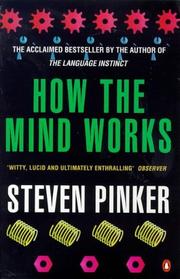
How the Mind Works
The mind's functions and quirks explained by evolution.
Summary
Pinker, a cognitive psychologist, tries to explain the human mind's functions and quirks in evolutionary terms: why memories fade, why people lose their tempers, why people fall in love. He argues for a computational theory of mind combined with a neo-Darwinian, adaptationist view of evolution, which together he sees as the core of evolutionary psychology, and draws heavily on the paradigm set out by John Tooby and Leda Cosmides.
He moves from computation and evolution to how the mind lets people see, think, feel, interact and pursue art, religion and philosophy, covering vision, emotion, feminism and the meaning of life. He criticises difference feminism on the grounds that research shows women and men differ little or not at all in moral reasoning. Published in 1997, the book was a Pulitzer Prize finalist.
Key takeaways 4
- The mind's functions and quirks can be explained as products of evolution.
- Emotions such as anger and love can be explained as adaptations.
- Pinker joins a computational theory of mind to adaptationist evolution as the basis of evolutionary psychology.
- He argues that research finds little difference between men and women in moral reasoning.
Who should read it
Readers who want a broad, readable statement of evolutionary psychology from one of its main advocates.
Who recommended it 4 · 3 direct
“Wilson was great, "How the Mind Works" Steven Pinker. I love "The Operator" about David Geffen and I like reading biology - sorry, biographies.”
“Steven Pinker, How the Mind Works (New York: W.W. Norton & Company, 1997)”
Similar books 6
Chosen by shared topics, the entries that hold them, and the people who recommended both.
A neurologist's case that emotion and feeling are part of reason.
“Antonio R. Damasio, Descartes’ Error: Emotion, Reason and the Human Brain (New York: Avon Books, 1994), 3-10” — Michael Mauboussin
Source: Mine Your Mind: Neuroscience and Investing, page 6
Recommended by: Michael Mauboussin, Mohnish Pabrai
Language as a human instinct, and what science knows of grammar and learning.
“He gave me this book called The Language Instinct, written by Steven Pinker... And Pinker proves his point pretty well.” — Charlie Munger
Source: Poor Charlie's Almanack, Talk Two: A Lesson on Elementary, Worldly Wisdom
Recommended by: Charlie Munger, Michael Mauboussin and 3 others
How consciousness and the senses evolved, and the history of the mind.
Recommended by: Mohnish Pabrai, Nassim Nicholas Taleb
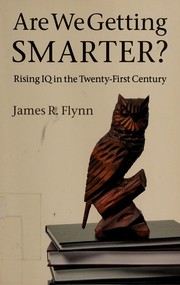
Why IQ scores have risen from one generation to the next, the Flynn effect.
Recommended by: Mohnish Pabrai
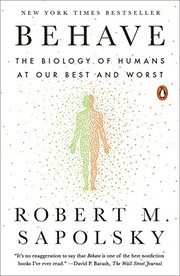
Explains an action by tracing its causes back from neurons to hormones to evolution.
“…books I've recommended, highlighted to death, or forced on friends.” — Andrew Wilkinson
Source: Andrew Wilkinson's Bookshelf, neverenough.com
Recommended by: Andrew Wilkinson, Vinod Khosla, Bill Gates and 5 others
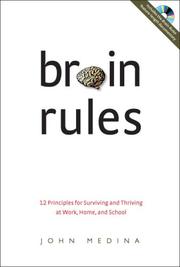
What brain science says about learning, sleep, stress, memory and multitasking.
“New scientific insights into why our brains work this way, and how to use what we now know to learn or work better.” — Derek Sivers
Source: Derek Sivers book notes (primary, rated list) · Rating: 8/10
Recommended by: Derek Sivers, Mohnish Pabrai, Nat Eliason and 2 others
Where it sits in the reference 3
As an Amazon Associate I earn from qualifying purchases.