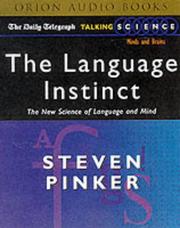
The Language Instinct
Language as a human instinct, and what science knows of grammar and learning.
Language as an evolved instinct; a Munger multidisciplinary reading
Summary
Pinker argues that language is a human instinct, wired into the brain by evolution, rather than a cultural invention. He explains how language works, how children learn it, how it changes, how the brain computes it and how it evolved, using examples drawn from humour and wordplay.
In his preface Pinker says he wants to show the language lover the richness of everyday speech, and to explain to readers of popular science what lies behind reported discoveries and non-discoveries: universal deep structures, grammar genes, signing chimpanzees, talking Neanderthals, feral children, identical twins raised apart, brain imaging and the search for the first language. He also answers questions such as why there are so many languages and why adults find them hard to learn. The book received the William James Book Prize from the American Psychological Association and the Public Interest Award from the Linguistic Society of America; later editions add an update on the science since first publication.
Key takeaways 4
- Language is an instinct that evolution wired into the human brain.
- Children acquire language through this built-in capacity rather than through formal teaching alone.
- Everyday speech follows rules as rich as any of the curiosities of etymology or usage.
- Many popular reports about language, from grammar genes to signing chimpanzees, need careful reading.
Who should read it
Readers who want to understand how the mind produces language, a staple of Charlie Munger's multidisciplinary reading.
Who recommended it 5 · 4 direct
“He gave me this book called The Language Instinct, written by Steven Pinker... And Pinker proves his point pretty well.”
“Steven Pinker, The Language Instinct: How the Mind Creates Language (New York: HarperCollins, 1994), 150- 151”
Similar books 6
Chosen by shared topics, the entries that hold them, and the people who recommended both.
How natural selection, not a designer, produces the complexity of living things.
“Richard Dawkins, The Blind Watchmaker (New York: W.W. Norton & Company, 1986)” — Michael Mauboussin
Source: Thirty Years: Reflections on the Ten Attributes of Great Investors, page 17
Recommended by: Jim Collins, Michael Mauboussin and 4 others
Behavioural genetics on how much of who we are is inherited.
Recommended by: James Cameron, Michael Mauboussin
Species change over time as natural selection favours heritable variations.
“So begins paragraph three of “On the Origin of Species by Means of Natural Selection” by Charles Darwin, the bicentenary of whose birth falls this year.” — Nick Sleep
Source: Nomad Investment Partnership - Letters to Partners, complete collection 2001-2013, page 157
Recommended by: Jim Collins, Mohnish Pabrai, Naval Ravikant and 6 others
Evolutionary psychology explained through Darwin's own life and behaviour.
Recommended by: Mohnish Pabrai, Ryan Holiday, Morgan Housel and 2 others
Sex evolved as a defence against parasites, and that shapes human mating.
“I really highly, highly recommend picking up Genome, The Red Queen, Origins of Virtue, The Rational Optimist, and The Evolution of Everything.” — Naval Ravikant
Source: The Tim Ferriss Show — Naval Ravikant Q&A, full transcript
Recommended by: Mohnish Pabrai, Naval Ravikant, Seth Klarman and 1 other
Twenty-three chapters, one per chromosome, each using a gene to open a subject.
“I highly recommend Genome as well, to figure out the rational basis behind ethics and the origin of virtue.” — Naval Ravikant
Source: Nav.al — 'Matt Ridley: How Innovation Works, Part 2' (Naval's podcast, edited transcript)
Recommended by: Charlie Munger, Mohnish Pabrai and 2 others
Where it sits in the reference 1
Topics 3
As an Amazon Associate I earn from qualifying purchases.