Updates

  1. Person pages list letters, writing, profiles and links as sortable tables with filters, and show each person's companies as links; Fund letters show each letter's description in its own column.
  2. Experts show a checked job title and a short description of each person; 30 more people have photographs.
  3. Every company, fund, university and publication the experts work for has a page listing the people there.
  4. Fund letters show each letter's thesis and filter by it; 225 person pages list the essays, columns and newsletter issues the person wrote.
  5. Person pages list every essay and newsletter issue a person wrote, and their own books as a table in List view.
  6. Recommends shows the five largest kinds of book and the rest under More; browse pictures load sooner.
  7. Podcasts and talks link the original episode, filter by Audio and video or Press, and list each publisher once.
  8. Pages are wider, Recommends has List and Grid, and a filter clicked again turns off.
  9. Book cards sit in a ruled grid with Open Library and Goodreads links and each book's one-line note.
  10. Funds is now Investors; each investor's styles are buttons that filter the table.
  11. Podcasts and talks on a person's page filter by year and publisher and show as a list or a grid of pictures.
  12. Quotes show only people's own words: 472 summaries written by list sites are gone.
  13. Country pages open from Browse again, and every link on the shelf lands on a page.
  14. Subject and person pages show their sections as tabs, and each book appears once on a person's page.
  15. Book cards show the quote, who said it and the source; grids show five cards to a row.
  16. On a phone, a menu holds the sections, search, Updates, Feedback and dark mode.
  17. Feedback takes a screenshot of the page with no browser prompt, opens a screenshot full size when you click it, and clears itself once sent.
  18. Book cards are centred, search names the topic each book sits in, and any text cut short shows whole on hover.
  19. Search groups its results by kind: people, companies, geographies, subjects, topics, books, funds, fund letters and papers.
  20. The Books table lists who recommended each book by name, and the browser tab names the section you are in.
  21. Feedback can take a screenshot of the page, or one you paste or choose, and opens in the corner beside Updates.
  22. Each rail button reopens its section where you left it, and Browse, Table and People show on every book and subject page.
  23. Filters grey out choices that hold nothing instead of hiding them, and Books › People filters by authors or recommenders.
  24. Feedback takes a subject line and up to three screenshots.
  25. Biographies are grouped by the person they are about: 41 new pages, from Abraham Lincoln to Lee Kuan Yew.
  26. Sport splits into 23 sports, and Religion into one topic per faith.
  27. Book lists show as cards: the cover, one recommendation quote and every recommender by name.
  28. Seventeen subjects that had two or three pages under different names now have one page each.
  29. Every page lists its Experts as authors and recommenders, with a link to them on the Experts tab.
  30. Economics, Financial history, Financial panics and Accounting are subjects of their own, with one page per financial crisis.
  31. Book, person and subject pages open inside the app, so the tabs stay in view.
  32. 996 more book covers, and photographs or logos for 227 more people and companies.
  33. Books › Browse shows every subject as cards, and the rail holds Fund letters, Papers, Experts, Books and Funds.
  34. Every topic over 150 books splits into narrower topics, each with a page of its own.

Send feedback

What is it?
Screenshots, up to 3 (optional)
or paste one with Ctrl+V

We use your email only to reply to you.

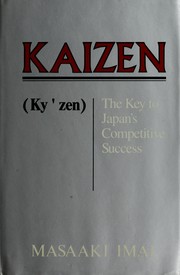
Kaizen

Kaizen

Masaaki Imai
1986
T2 259 pages · about 4h 19m to read Open Librarygoodreads

The book that introduced continuous improvement to Western managers.

Summary

Imai introduced the term kaizen to Western management, presenting it as the organising concept behind Japanese manufacturing performance rather than as one technique among several.

His central distinction is between innovation and kaizen. Innovation means large discontinuous improvement through capital investment or new technology, requires substantial resources, and comes from specialists. Kaizen means small continuous improvement made by everyone in the organisation, requires little investment, and depends on effort and standards rather than on money. Imai argues that Western management is oriented almost entirely toward innovation and treats maintenance and incremental improvement as beneath managerial attention, while Japanese management allocates a defined share of every role to improvement work. The consequence is that Western performance rises in steps and decays between them, while continuous improvement holds the gains and compounds.

The second distinction is between process orientation and result orientation. Imai argues that managing by results alone gives people no information about how to improve and rewards outcomes that may be produced by luck, so measurement systems must include process indicators covering effort, participation and adherence to standard work.

The practical content covers the tools: the plan-do-check-act cycle, quality circles, suggestion systems with high participation rates and small individual suggestions, standardisation as the baseline from which improvement is measured, total quality control, cross-functional management for quality, cost and delivery, and the deployment of policy through the organisation.

The book is dated in presentation and reflects the moment when Japanese manufacturing appeared unbeatable, which produced overclaiming across the whole management literature of the period. It also describes practices as they existed in large Japanese manufacturers with lifetime employment and enterprise unions, and the transferability of suggestion systems and quality circles to firms without those conditions has been mixed. Imai's later Gemba Kaizen is more practical.

Key takeaways 7

  1. Kaizen means small continuous improvement made by everyone, and it is distinct from innovation, which means large discontinuous change made by specialists.
  2. Improvement gains decay unless a standard is set that makes the new method the baseline for the next improvement.
  3. Managing by results alone gives people no information about how to improve, so process measures must be part of the system.
  4. Every role should contain a defined share of improvement work rather than only maintenance of the current method.
  5. Suggestion systems succeed on participation rate and volume of small suggestions rather than on the value of individual ideas.
  6. Cross-functional management for quality, cost and delivery is required because those outcomes are produced across departments rather than within them.
  7. Improvement made by the people doing the work costs almost nothing, which is why it compounds where capital-intensive innovation cannot.

Who should read it

Operators building improvement systems who want the original statement of continuous improvement as a management system rather than a toolkit.

Similar books 6

Chosen by shared topics, the entries that hold them, and the people who recommended both.

Eliyahu M. Goldratt · 1997

A novel applying the theory of constraints to finishing projects on time.
Jeremy Hope, Robin Fraser · 2003

Why the annual budget harms firms, and how some run without one.

Charles H. Fine · 1998

Fast-moving industries reveal supply-chain dynamics slow ones take decades to show.
Jr. George Stalk, Thomas M. Hout · 1990

Recommended by: Tim Cook

Bob Fifer · 1994

Cost discipline handbook widely used by buyout and turnaround operators

Emi Osono, Norihiko Shimizu, Hirotaka Takeuchi · 2008

Argues Toyota runs on deliberate internal contradictions.

Where it sits in the reference 2

Business themes
Business themes

Topics

Business and ManagementProductivity and HabitsTime management and focus