Updates

  1. Person pages list letters, writing, profiles and links as sortable tables with filters, and show each person's companies as links; Fund letters show each letter's description in its own column.
  2. Experts show a checked job title and a short description of each person; 30 more people have photographs.
  3. Every company, fund, university and publication the experts work for has a page listing the people there.
  4. Fund letters show each letter's thesis and filter by it; 225 person pages list the essays, columns and newsletter issues the person wrote.
  5. Person pages list every essay and newsletter issue a person wrote, and their own books as a table in List view.
  6. Recommends shows the five largest kinds of book and the rest under More; browse pictures load sooner.
  7. Podcasts and talks link the original episode, filter by Audio and video or Press, and list each publisher once.
  8. Pages are wider, Recommends has List and Grid, and a filter clicked again turns off.
  9. Book cards sit in a ruled grid with Open Library and Goodreads links and each book's one-line note.
  10. Funds is now Investors; each investor's styles are buttons that filter the table.
  11. Podcasts and talks on a person's page filter by year and publisher and show as a list or a grid of pictures.
  12. Quotes show only people's own words: 472 summaries written by list sites are gone.
  13. Country pages open from Browse again, and every link on the shelf lands on a page.
  14. Subject and person pages show their sections as tabs, and each book appears once on a person's page.
  15. Book cards show the quote, who said it and the source; grids show five cards to a row.
  16. On a phone, a menu holds the sections, search, Updates, Feedback and dark mode.
  17. Feedback takes a screenshot of the page with no browser prompt, opens a screenshot full size when you click it, and clears itself once sent.
  18. Book cards are centred, search names the topic each book sits in, and any text cut short shows whole on hover.
  19. Search groups its results by kind: people, companies, geographies, subjects, topics, books, funds, fund letters and papers.
  20. The Books table lists who recommended each book by name, and the browser tab names the section you are in.
  21. Feedback can take a screenshot of the page, or one you paste or choose, and opens in the corner beside Updates.
  22. Each rail button reopens its section where you left it, and Browse, Table and People show on every book and subject page.
  23. Filters grey out choices that hold nothing instead of hiding them, and Books › People filters by authors or recommenders.
  24. Feedback takes a subject line and up to three screenshots.
  25. Biographies are grouped by the person they are about: 41 new pages, from Abraham Lincoln to Lee Kuan Yew.
  26. Sport splits into 23 sports, and Religion into one topic per faith.
  27. Book lists show as cards: the cover, one recommendation quote and every recommender by name.
  28. Seventeen subjects that had two or three pages under different names now have one page each.
  29. Every page lists its Experts as authors and recommenders, with a link to them on the Experts tab.
  30. Economics, Financial history, Financial panics and Accounting are subjects of their own, with one page per financial crisis.
  31. Book, person and subject pages open inside the app, so the tabs stay in view.
  32. 996 more book covers, and photographs or logos for 227 more people and companies.
  33. Books › Browse shows every subject as cards, and the rail holds Fund letters, Papers, Experts, Books and Funds.
  34. Every topic over 150 books splits into narrower topics, each with a page of its own.

Send feedback

What is it?
Screenshots, up to 3 (optional)
or paste one with Ctrl+V

We use your email only to reply to you.

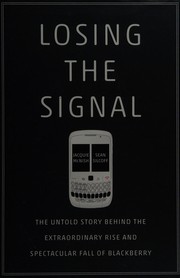
Losing the Signal

Losing the Signal

Jacquie McNish, Sean Silcoff
2015
T2 279 pages · about 4h 39m to read Open Librarygoodreads

BlackBerry's rise and collapse, Canada's largest technology failure.

Summary

McNish and Silcoff, Canadian business journalists, reconstruct Research In Motion from Mike Lazaridis's engineering work through the BlackBerry's dominance and its collapse after the iPhone. They had access to Lazaridis and Jim Balsillie and to many former executives.

The technical origin is the most important part. BlackBerry was built for network efficiency, compressing data so that a message consumed a fraction of the bandwidth of a competing device, because carrier networks in the 1990s could not support anything heavier. That constraint produced the network operations centre architecture, the battery life, and the carrier relationships that made the company. When networks improved, the engineering advantage that defined the product became irrelevant, and the same architecture became a liability that made BlackBerry slow to support a full browser and third-party applications.

The organisational story is the co-chief-executive structure, which worked while the questions were engineering and sales and failed when the company needed a single strategic decision. McNish documents Lazaridis's technical objection to the iPhone, which was correct on its merits about network load and battery, and irrelevant because customers wanted the device anyway. She covers the patent litigation with NTP, the stock option backdating investigation, the Storm's failure and the PlayBook. For founders and investors the case is about a competitive advantage that was defined by a constraint, and about what happens when the constraint disappears. The book ends in 2015 and does not cover the software pivot.

Key takeaways 7

  1. BlackBerry's advantage came from extreme network efficiency, which was decisive while carrier bandwidth was scarce and worthless once it was not.
  2. Lazaridis's technical criticisms of the iPhone were accurate about battery and network load and irrelevant to what customers chose.
  3. The co-chief-executive structure functioned while the company faced separable engineering and commercial problems and failed when a single strategic choice was required.
  4. Carrier relationships that were BlackBerry's distribution advantage became a constraint, because carriers wanted devices that used more data rather than less.
  5. The company's architecture, built around a central network operations centre, could not be adapted quickly to a full browser and an application ecosystem.
  6. BlackBerry's enterprise security position was real but did not protect it, because employees brought consumer devices to work and employers accepted them.
  7. An incumbent defending a technically superior product loses when the basis of customer preference shifts to a dimension the incumbent has optimised away.

Who should read it

Founders and investors studying how a technical advantage tied to a temporary constraint disappears, and how governance structures fail under strategic pressure.

Who recommended it 2 · 2 direct

Similar books 6

Chosen by shared topics, the entries that hold them, and the people who recommended both.
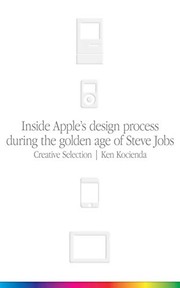
Ken Kocienda · 2018

Insider account by the engineer who built the iPhone keyboard.

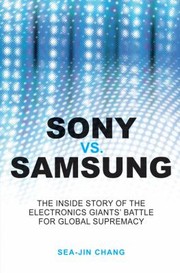
Sea-Jin Chang · 2008

Strategy comparison explaining how Samsung overtook Sony.

Ken Segall · 2012

Simplicity as Apple's operating principle, from the adman who worked with Jobs.

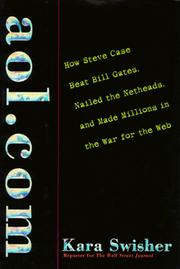
Kara Swisher · 1998

Recommended by: Mohnish Pabrai

Peter C. Newman · 1985

The first volume of a history of the Hudson's Bay Company.

Jenny Chan, Mark Selden, Pun Ngai · 2020

Foxconn from the inside; the labour cost of the contract model.

Where it sits in the reference 2

Geographies
Industries

Topics

Company HistoriesTechnology and ComputingTech company stories