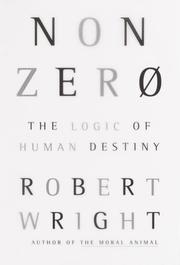
Nonzero
History as a growing web of non-zero-sum games, in which both sides can gain.
History read as an expanding series of non-zero-sum games
Summary
Wright argues that history has a direction, driven by the increasing scope and complexity of non-zero-sum interactions, meaning situations where the parties can both gain. His claim is that both biological evolution and cultural evolution produce increasing complexity because organisms and societies that find ways to cooperate outcompete those that do not.
The historical section traces the expansion of non-zero-sum relationships from hunter-gatherer bands through agriculture, chiefdoms, states, empires and eventually global economic integration. He argues that technology, particularly information and transport technology, expands the range over which cooperation is possible, and that societies which adopt technologies enabling wider cooperation displace those that do not. The biological section makes the parallel argument for evolution, covering the transitions from replicating molecules to cells, from cells to multicellular organisms, and from organisms to social groups, each of which involved previously independent units becoming interdependent.
His argument about the direction of history is explicitly against Stephen Jay Gould's position that evolution has no direction, and Wright addresses this directly. The final section speculates about global governance and about whether the expansion of non-zero-sum relationships implies a purpose, which is where he loses most readers who accepted the earlier argument.
The thesis is difficult to falsify, since almost any development can be described as an expansion of non-zero-sum relations after the fact. Wright underweights the zero-sum conflicts and the destroyed societies that his direction requires. The framework for thinking about when cooperation is available is useful independent of the directional claim.
Key takeaways 8
- History has a direction driven by the increasing scope and complexity of situations where parties can both gain.
- Societies that find ways to cooperate across wider ranges outcompete those that do not, which produces the direction without anyone intending it.
- Technology, particularly in information and transport, expands the range over which cooperation is possible and therefore drives the expansion.
- Biological evolution shows the same pattern, with previously independent units repeatedly becoming interdependent at higher levels of organisation.
- Non-zero-sum relationships require mechanisms for detecting and punishing defection, which is why trust infrastructure develops alongside trade.
- Increasing interdependence makes conflict more costly for both parties, which changes the calculation independently of any moral development.
- The thesis can describe almost any development as an expansion of non-zero-sum relations after the fact, which makes it hard to falsify.
- Wright underweights the zero-sum conflicts and the destroyed societies that the directional claim requires him to account for.
Who should read it
Readers interested in a framework for when cooperation becomes available and profitable, treating the directional claim as a hypothesis.
Who recommended it 4 · 2 direct
“His book Nonzero is among my five favorite books of all time. So, that book came out recently, and I gave that to my closest friend and my family.”
Similar books 6
Chosen by shared topics, the entries that hold them, and the people who recommended both.
Von Neumann, game theory and the prisoner's dilemma in nuclear strategy.
“For international relations, see William Poundstone, Prisoner’s Dilemma (New York: Doubleday, 1992)” — Michael Mauboussin
Source: The Colonel Blotto Game: Transitivity and How to Win When You’re an Underdog, page 8
Recommended by: Michael Mauboussin
Game theory without maths, with new examples: commitment, signals, bargaining.
“for business, see Avinash K. Dixit and Barry J. Nalebuff, The Art of Strategy (New York: W.W. Norton & Company, 2008)” — Michael Mauboussin
Source: The Colonel Blotto Game: Transitivity and How to Win When You’re an Underdog, page 8
Recommended by: Michael Mauboussin
Computer tournaments of the prisoner's dilemma show why tit-for-tat wins.
“That clever but unsatisfying explanation eventually led me to the book and article that I'm recommending this year - The Evolution of Cooperation by Robert Axelrod, and a related journal article1 (jointly, "EoC").” — Mark Leonard
Source: Constellation Software Inc. 2014 President's Letter, page 5
Recommended by: Mark Leonard, Michael Mauboussin and 2 others
Game theory without maths: look forward, reason back, and make threats credible.
“Avinash K. Dixit and Barry J. Nalebuff, Thinking Strategically (New York: W. W. Norton & Co., 1991)” — Michael Mauboussin
Source: Measuring the Moat: Assessing the Magnitude and Sustainability of Value Creation, page 47
Recommended by: Michael Mauboussin
A history of Western philosophy from the Greeks to the Renaissance.
Recommended by: Mohnish Pabrai, Nassim Nicholas Taleb
Why states rise and fall, explained through asabiyyah, the cohesion of a group.
Recommended by: Mohnish Pabrai, Mark Zuckerberg