Updates

  1. Person pages list letters, writing, profiles and links as sortable tables with filters, and show each person's companies as links; Fund letters show each letter's description in its own column.
  2. Experts show a checked job title and a short description of each person; 30 more people have photographs.
  3. Every company, fund, university and publication the experts work for has a page listing the people there.
  4. Fund letters show each letter's thesis and filter by it; 225 person pages list the essays, columns and newsletter issues the person wrote.
  5. Person pages list every essay and newsletter issue a person wrote, and their own books as a table in List view.
  6. Recommends shows the five largest kinds of book and the rest under More; browse pictures load sooner.
  7. Podcasts and talks link the original episode, filter by Audio and video or Press, and list each publisher once.
  8. Pages are wider, Recommends has List and Grid, and a filter clicked again turns off.
  9. Book cards sit in a ruled grid with Open Library and Goodreads links and each book's one-line note.
  10. Funds is now Investors; each investor's styles are buttons that filter the table.
  11. Podcasts and talks on a person's page filter by year and publisher and show as a list or a grid of pictures.
  12. Quotes show only people's own words: 472 summaries written by list sites are gone.
  13. Country pages open from Browse again, and every link on the shelf lands on a page.
  14. Subject and person pages show their sections as tabs, and each book appears once on a person's page.
  15. Book cards show the quote, who said it and the source; grids show five cards to a row.
  16. On a phone, a menu holds the sections, search, Updates, Feedback and dark mode.
  17. Feedback takes a screenshot of the page with no browser prompt, opens a screenshot full size when you click it, and clears itself once sent.
  18. Book cards are centred, search names the topic each book sits in, and any text cut short shows whole on hover.
  19. Search groups its results by kind: people, companies, geographies, subjects, topics, books, funds, fund letters and papers.
  20. The Books table lists who recommended each book by name, and the browser tab names the section you are in.
  21. Feedback can take a screenshot of the page, or one you paste or choose, and opens in the corner beside Updates.
  22. Each rail button reopens its section where you left it, and Browse, Table and People show on every book and subject page.
  23. Filters grey out choices that hold nothing instead of hiding them, and Books › People filters by authors or recommenders.
  24. Feedback takes a subject line and up to three screenshots.
  25. Biographies are grouped by the person they are about: 41 new pages, from Abraham Lincoln to Lee Kuan Yew.
  26. Sport splits into 23 sports, and Religion into one topic per faith.
  27. Book lists show as cards: the cover, one recommendation quote and every recommender by name.
  28. Seventeen subjects that had two or three pages under different names now have one page each.
  29. Every page lists its Experts as authors and recommenders, with a link to them on the Experts tab.
  30. Economics, Financial history, Financial panics and Accounting are subjects of their own, with one page per financial crisis.
  31. Book, person and subject pages open inside the app, so the tabs stay in view.
  32. 996 more book covers, and photographs or logos for 227 more people and companies.
  33. Books › Browse shows every subject as cards, and the rail holds Fund letters, Papers, Experts, Books and Funds.
  34. Every topic over 150 books splits into narrower topics, each with a page of its own.

Send feedback

What is it?
Screenshots, up to 3 (optional)
or paste one with Ctrl+V

We use your email only to reply to you.

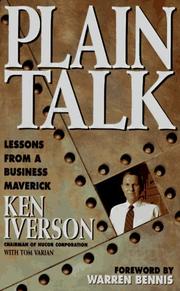
Plain Talk: Lessons from a Business Maverick

Plain Talk: Lessons from a Business Maverick

Ken Iverson
1997
T3 202 pages · about 3h 22m to read Open Librarygoodreads

Nucor's chief executive on flat structure, incentive pay and minimills

Summary

Iverson ran Nucor from 1965 to 1998 and built it from a near-bankrupt conglomerate into one of the largest American steel producers, using electric arc minimills that produced steel from scrap while the integrated producers used blast furnaces and iron ore.

The management structure is the substance and it is extreme. Nucor had four management layers between the chief executive and the front line, against a dozen or more at competitors. The head office employed around two dozen people for a company of seven thousand. There were no company cars, no executive dining rooms, no reserved parking, no corporate jet and no assigned offices for executives. Everyone flew economy including Iverson. Every employee received the same insurance and the same holiday arrangements.

The compensation system paid production workers a low base wage plus a bonus based on the output of their shift group, calculated weekly and paid weekly, which produced total earnings well above industry averages in good periods and substantially below in bad ones. Managers and executives had a larger proportion of their pay at risk than production workers did, and in downturns executive pay fell by a larger percentage than anyone else's.

His stated position is that layers of management exist to control people who are assumed to be untrustworthy, and that removing the assumption removes the need for the layers. The book is short and Iverson's own account. Nucor operated in a commodity business where output was measurable, which is what made the bonus system possible. The compensation structure and the layer reduction are the transferable elements.

Key takeaways 8

  1. Nucor operated with four management layers between the chief executive and the front line, against a dozen or more at competitors.
  2. The head office employed around two dozen people for a company of seven thousand, which forced decisions to be made in the operations.
  3. Production workers received a low base wage plus a weekly bonus based on their shift group's output, calculated and paid weekly.
  4. Executive pay had a larger proportion at risk than production workers' pay, and fell by a larger percentage in downturns.
  5. Eliminating executive privileges including cars, dining rooms, reserved parking and assigned offices removed the visible distinction between levels.
  6. Management layers exist to control people assumed to be untrustworthy, and removing the assumption removes the need for the layers.
  7. Adopting a new production technology, in this case the electric arc minimill, allowed a small company to displace far larger integrated producers.
  8. The bonus system depended on output being measurable at the group level, which is what made the approach possible in this specific business.

Who should read it

Executives interested in radical layer reduction and in output-based compensation, from a company that ran both for three decades.

Who recommended it 1 · 1 direct

“Another great builder of our time was Kenneth Iverson. In just a few decades, Iverson transformed a small, nearly bankrupt company into the largest and most profitable steel company in the U.S…”

Similar books 6

Chosen by shared topics, the entries that hold them, and the people who recommended both.

Jack Stack, Bo Burlingham · 2002

Building an ownership culture in which employees think and act like owners.

Bryce G. Hoffman · 2012

The 2006-2010 turnaround told with close management access.

Recommended by: Mohnish Pabrai

Where it sits in the reference 6

Companies
Business themes
Industries
Business themes
Business themes
Business themes

Topics

Business and ManagementLeadership